THE HOUSE ALWAYS WINS

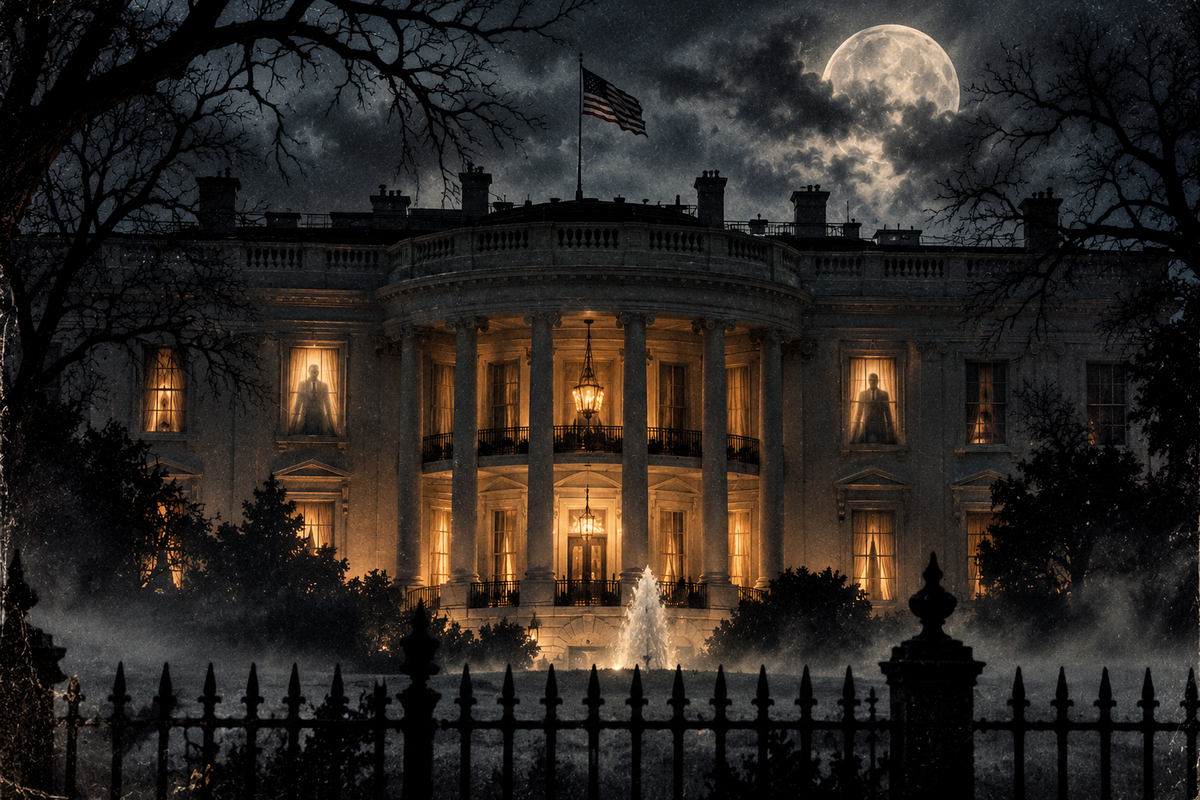
Something Wicked This Way Comes
Pragmatic Issues | Wednesday, 28 October 2026
There is an old saying about haunted houses.
The dead are rarely the problem.
It’s the living who refuse to leave.
Welcome to Washington, D.C., where the corridors are crowded with political ghosts, the closets are overflowing with skeletons, and the current occupants appear to have mistaken the Constitution for an inconvenient piece of antique furniture.
Halloween is approaching.
The pumpkins are carved. The cobwebs are hanging. The neighbourhood children are preparing to terrorise unsuspecting homeowners in exchange for miniature chocolate bars.
Meanwhile, inside the White House, the adults have apparently decided to demonstrate that reality can be considerably more frightening than fiction.
And considerably less entertaining.
So, dear reader, come inside.
Mind the loose floorboards.
Ignore the screaming.
And whatever you do, do not ask who’s buried in the basement.
The management gets terribly defensive about that.
THE MAN BEHIND THE CURTAIN
Our first stop is the grand ballroom, where President Donald Trump is preparing for another election.
Not his own, mind you.
The congressional midterms.
An election that will determine whether Republicans retain control of Congress or find themselves sharing the building with considerably less accommodating houseguests.
Naturally, the president has been asked whether he will respect the results.
His answer?
'I will if they’re honest elections.'
How reassuring.
Apparently, American democracy now comes with terms and conditions.
And wouldn’t you know it, the person questioning whether those conditions will be satisfied is the same fellow whose party stands to lose.
Convenient little arrangement, isn’t it?
This is hardly unfamiliar territory.
Trump has spent years questioning electoral legitimacy, particularly when the outcome threatens his political ambitions.
Now, with voters already casting ballots, his administration is pursuing legal challenges involving state election procedures.
In Washington state, the Department of Justice has threatened legal action over approximately 400 people it alleges are improperly registered.
State election officials have challenged aspects of those allegations, including the use of outdated information.
And there lies the problem.
Investigating genuine election irregularities is entirely appropriate.
But casting suspicion on an election before the votes have even been counted is something else altogether.
It’s rather like inviting everyone to dinner, announcing that somebody is going to poison the soup, and then appointing yourself the only person qualified to determine whether the meal is safe.
One wonders whether the president has considered simply accepting the possibility that voters might disagree with him.
A radical concept, admittedly.
But democracy has always contained that rather irritating feature.
The public gets a say.
Even when the president doesn’t particularly care for what they’re saying.
THE GENTLEMAN WHO RETURNED FROM POLITICAL RETIREMENT
Something rather unexpected has happened inside our haunted mansion.
A gentleman has arrived.
No screaming.
No dramatic threats.
No declarations that the entire building will collapse unless everyone agrees with him.
Just a familiar face, a measured voice and some rather uncomfortable questions.
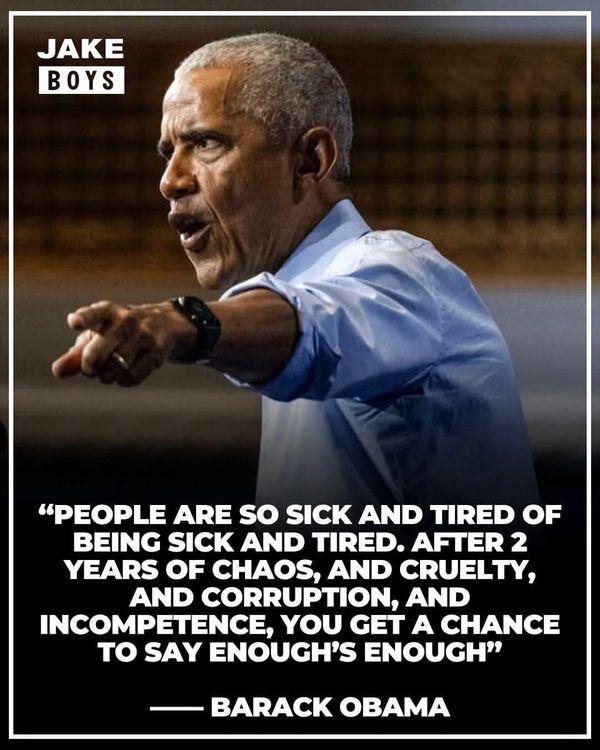
Barack Obama has returned to the political stage.
And judging by his recent criticism of Donald Trump, the former president has apparently decided that politeness should no longer be mistaken for silence.
Speaking in Cleveland on October 24, Obama delivered a particularly pointed assessment of his successor.
'The current president chose to make a series of bad decisions.'
And then he went further.
'These are not serious people.'
Now, Obama is hardly a stranger to political confrontation.
He spent eight years in the White House, endured relentless personal attacks and watched his successor spend years promoting falsehoods about his birthplace.
Through much of it, Obama maintained the sort of composure that must have required an extraordinary amount of self-restraint.
Personally, I suspect I would have needed considerably more than a cup of tea.
But what makes his latest criticism interesting isn’t simply that he’s challenging Trump.
It’s what he’s challenging.
His judgement.
His priorities.
His decisions.
And whether those decisions demonstrate the seriousness required of someone entrusted with extraordinary presidential authority.
That is a considerably more consequential criticism than calling someone an unpleasant dinner guest.
Because the presidency isn’t a reality television programme.
Although, admittedly, someone appears to have forgotten to inform the current occupant.
Obama also found time to address Trump’s enthusiastic approach to White House renovations.
'He seems very focused on home renovations. He should be on HGTV.'
And then came a particularly delicious observation.
'He’s got the White House looking like Saddam Hussein opened a Cheesecake Factory.'
Well.
That certainly wasn’t on my political bingo card.
And coming from Obama, whose public appearances have generally favoured measured criticism over theatrical insults, it was rather magnificent and personally, I rather loved that line.
But beneath the humour was a serious accusation.
That the president appears more concerned with spectacle than substance.
More interested in the appearance of power than the responsibilities accompanying it.
And that distinction matters.
A president can be loud, confident, charismatic or thoroughly unpleasant.
None of those characteristics automatically establishes whether he possesses the judgement necessary to govern.
The presidency requires restraint.
An understanding of consequences.
A willingness to consider uncomfortable information.
And occasionally, the humility to recognise that being the loudest person in the room doesn’t necessarily make you the smartest.
Trump has built much of his political identity around projecting strength.
He threatens.
He boasts.
He demands.
And when challenged, he frequently responds as though disagreement itself constitutes a personal betrayal.
But there is a fundamental difference between projecting strength and exercising power responsibly.
A man can pound his fist upon the table until the dishes rattle.
That doesn’t mean he knows how to prepare the dinner.
Obama’s criticism of Trump’s handling of Iran was particularly pointed.
He described the conflict as unnecessary and challenged the administration’s claims of success.
He also defended the nuclear agreement negotiated during his presidency, arguing that diplomacy had achieved meaningful restrictions on Iran’s nuclear programme without requiring military intervention.
That agreement was not without critics or limitations. But it did impose substantial restrictions and international monitoring requirements before Trump withdrew the United States in 2018.
And now, with renewed military strikes reportedly under consideration, Obama’s concerns about presidential judgement deserve attention.
Because wars aren’t won through campaign slogans.
International crises aren’t resolved by insulting everyone who disagrees with you.
And presidential authority is not a substitute for wisdom.
Obama also reminded voters that the midterms offer an opportunity to constrain presidential power.
He described the election as a 'circuit breaker in the system.'
An interesting choice of words.
Because when the wiring inside a house becomes dangerously overloaded, a circuit breaker exists to prevent the entire building from catching fire.
Perhaps Washington could use an electrician.
Preferably one who understands that covering everything in gold doesn’t repair faulty wiring.
What I find most compelling about Obama’s intervention is that he isn’t simply asking Americans to dislike Trump.
He’s asking them to consider the consequences of his decisions.
And those questions should transcend political affiliation.
Every president deserves scrutiny.
Every administration should be accountable.
And loyalty to a political leader should never outweigh loyalty to the country.
After all, the last thing anyone wants is to discover that the person responsible for keeping the monsters outside has been inviting them in for dinner.
And handing them the keys.
THE SKELETONS HAVE STARTED TALKING
Now, if you’ll follow me down this corridor, we’ll arrive at a room that has remained locked for quite some time.
The Epstein room.
Yes, that Epstein.
The name that refuses to disappear, regardless of how desperately some of Washington’s most powerful residents might wish it would.
This week, Democrats on the House Judiciary Committee released a report examining Donald Trump’s connections to Jeffrey Epstein.
The report describes accounts involving 11 women, including five who accuse Trump of rape or sexual assault in Epstein’s company or presence.
Some allegations have been publicly discussed before, the report brings together accounts and additional material.
These are allegations, not criminal convictions, and the White House has denied them.
But the seriousness of the claims demands something considerably more substantial than political name-calling.
An independent examination of the evidence would be a reasonable place to begin.
Instead, Americans find themselves watching another familiar production.
Accusations.
Denials.
Counteraccusations.
And an increasingly exhausted public attempting to determine which documents have been released, which remain concealed and whether anyone in authority is genuinely interested in finding the truth.
The Democrats allege that the Justice Department has withheld important evidence and obstructed scrutiny.
Those accusations also require investigation rather than automatic acceptance.
Because this is precisely where political loyalty becomes dangerous.
Sexual assault allegations should never be treated as entertainment, campaign ammunition or inconvenient background noise.
The women making these accusations deserve to have their accounts examined fairly and seriously.
And the accused has been convicted of a like crime before.
This type of criminal accusation should not depend upon which party controls the White House in order to be heard, properly investigated and those who are guilty brought to trial.
Yet here we are.
A country where some of the loudest voices demanding scrutiny of Epstein’s associates seem considerably less enthusiastic when the questions turn towards their preferred political figures.
Funny how quickly the appetite for transparency can disappear when the dinner guest is someone you voted for.
Perhaps the most disturbing question isn’t whether Washington has skeletons in its closets.
Of course it does.
The question is whether anyone still possesses the courage to open the doors.
And whether the public will insist upon it.
THE WAR ROOM: PLEASE IGNORE THE SMOKE
Now we come to the room that concerns me most.
It’s located at the back of the house.
No windows.
Heavy doors.
A peculiar smell of burning.
And a sign reading:
NOTHING TO WORRY ABOUT.
Naturally, this is where the military planning takes place.
For months, Trump has presented his confrontation with Iran as evidence of American strength.
He has repeatedly boasted about the damage inflicted upon Iran’s military capabilities and economic position.
Yet Iran has not surrendered.
And despite the president’s confident declarations, the conflict remains unresolved.
Now comes the particularly unsettling part.
According to recent reporting, American and Israeli officials have developed plans for possible renewed military strikes against Iran.
Not necessarily tomorrow.
Not necessarily next week.
But potentially after the November 3 midterm elections.
The White House has explicitly ruled out renewed American attacks before the election.
Meanwhile, Israeli sources have described preparations for possible military action afterwards.
And when Trump was asked on October 28 whether additional strikes might follow the election, his response was:
“Anything’s possible.”
Well, isn’t that comforting?
Americans are preparing to vote on the direction of their government, and the president is entertaining the possibility of another major military offensive immediately afterwards.
What a delightful little surprise to leave beneath the Christmas tree.
Except this isn’t a holiday gift.
It’s war.
Real war.
With real consequences for American service members, Iranian civilians, regional stability and the global economy.
And wars have an unfortunate tendency to ignore the schedules of the politicians who start them.
The administration may believe another military campaign could force Iran into concessions.
Perhaps that is the calculation or rather yet another miscalculation.
And, what happens if Iran refuses?
What happens if retaliation spreads across the region?
What happens to oil prices, shipping routes and the American economy?
And what happens when a supposedly short military operation develops the thoroughly inconvenient habit of becoming a long one?
We have service members according recent headlines who became suicidal due to the conditions abroad and lack of food, care, packages from families that we the United States put them into and caused.
History is littered with governments that promised quick victories.
Some of those promises are still buried beneath the rubble.
What troubles me most is the timing.
The White House has publicly ruled out renewed attacks before the election, whilst leaving open the possibility of military action afterwards.
That doesn’t establish an electoral conspiracy.
Nor does military planning mean that another attack is inevitable.
It does, however, raise a perfectly legitimate question.
If a major military escalation is being contemplated, shouldn’t Americans understand the potential consequences before they vote?
The president is fond of presenting himself as the only person capable of solving problems that other leaders supposedly cannot.
Yet genuine leadership requires more than threats, military hardware and a carefully rehearsed declaration of victory.
It requires knowing when not to pull the trigger.
Because once the missiles are launched, the consequences cannot be recalled simply because the president decides the audience has stopped applauding.
And if the administration is preparing another dramatic performance in the Middle East, Americans deserve to know whether they’re about to become unwilling investors in another extraordinarily expensive production.
Tickets are apparently mandatory.
Refunds are unavailable.
And the exits?
Well, those appear to be locked.
THE HALL OF MIRRORS
Every respectable haunted mansion has one.
A room filled with mirrors.
Some make you look taller.
Others make you look thinner.
A few distort your reflection so dramatically that you scarcely recognise yourself.
Welcome to modern American political communication.
Where an accusation becomes a conviction if it’s directed at an opponent.
Where an investigation becomes persecution if it involves an ally.
Where economic difficulties are inherited from the previous administration, but economic successes are personally delivered by the current one.
And where the definition of election integrity appears increasingly dependent upon which party wins.
Trump has made political exaggeration something of an art form.
But the issue isn’t simply that politicians lie.
They’ve been doing that since somebody first discovered that promising free bread was an excellent way to attract a crowd.
The issue is what happens when dishonesty becomes so routine that it no longer shocks anyone.
A false claim is repeated.
Then repeated again.
Then defended.
Eventually, millions of people begin discussing it as though it were an established fact.
And somewhere along the way, the original evidence becomes less important than the number of people willing to believe the story.
It’s a remarkably effective trick.
One that doesn’t require supernatural powers.
Just repetition, an accommodating audience and enough political allies willing to insist that the emperor’s magnificent new wardrobe is the finest they’ve ever seen.
Never mind that the emperor is standing naked in the middle of Pennsylvania Avenue.
Apparently, questioning his attire makes you an enemy of the state.
But here’s the part that genuinely disturbs me.
We’ve become so accustomed to political deception that we’re beginning to treat honesty as a personality trait rather than a basic requirement of public office.
We celebrate politicians for acknowledging obvious facts.
We applaud officials for admitting mistakes.
We act positively astonished when someone answers a question without first consulting a collection of talking points.
What a peculiar standard we’ve established.
Imagine hiring a contractor to renovate your house.
He lies about the price.
He changes the completion date.
He insists the roof is finished whilst rain pours into your bedroom.
Then he announces that anyone questioning his workmanship is participating in a politically motivated witch hunt.
Would you hire him again?
Of course not.
You’d demand your money back and probably call an attorney.
Yet somehow, when the building being renovated is the United States government, millions of Americans are willing to overlook considerably worse workmanship.
Perhaps the mirrors aren’t the problem.
Perhaps we’ve simply forgotten what an honest reflection looks like.
THE CLOCK STRIKES NOVEMBER
And now, dear reader, we’ve reached the final room.
It’s remarkably quiet.
There’s an enormous clock on the wall.
Its hands are approaching November 3.
Outside, Americans are voting.
Inside, Washington’s political residents are watching the clock with varying degrees of enthusiasm.
Some are preparing victory speeches.
Others are preparing excuses.
A few appear to be preparing both.
And somewhere behind those heavy doors, decisions are being contemplated that could have consequences far beyond the election itself.
The possibility of renewed war with Iran.
Unresolved allegations involving powerful men.
An administration questioning the legitimacy of an election before its conclusion.
And a political culture increasingly comfortable asking citizens to choose loyalty over evidence.
None of these developments exists in isolation.
Together, they reveal something troubling about the relationship between power and accountability.
Power doesn’t necessarily corrupt everyone who possesses it.
But it does provide extraordinary opportunities for people who would prefer not to be questioned.
And the longer those questions go unanswered, the easier it becomes for political leaders to mistake public office for personal ownership.
The White House is not a private residence in the ordinary sense.
It belongs to the American people.
Congress belongs to the American people.
The institutions of government exist to serve the American people.
Not a president.
Not a political party.
Not the wealthy donors financing another election cycle.
And certainly not whichever collection of political personalities happens to occupy the building this Halloween.
There is a reason the most effective horror stories rarely reveal the monster immediately.
The audience hears footsteps.
A door closes.
Something moves in the darkness.
The characters assure one another that everything is perfectly normal.
Until eventually, somebody turns on the light.
And discovers that the monster was never hiding beneath the bed.
It was sitting comfortably at the dinner table.
Smiling.
Making promises.
And asking for another four years.
Halloween ends on Saturday.
The costumes will disappear.
The decorations will come down.
Children will count their sweets, and exhausted parents will begin quietly confiscating the chocolate.
But Washington’s particular brand of horror doesn’t operate according to a holiday calendar.
The election will come.
The election will go.
And the consequences of the decisions made by those in power will remain long after the campaign signs have been removed.
So when the clock strikes midnight next Tuesday, pay attention.
Not merely to who wins.
But to how the losers respond.
To what happens behind the locked doors.
To which investigations continue.
And especially to what happens in the Middle East once the votes have been counted.
Because the most frightening part of a haunted house isn’t discovering that something terrible happened there.
It’s discovering that something terrible may be about to happen again.
And this time, the entire country is inside.
Welcome to Washington.
Please enjoy your stay.
Management assumes no responsibility for what happens after the election.
— Pragmatic Issues