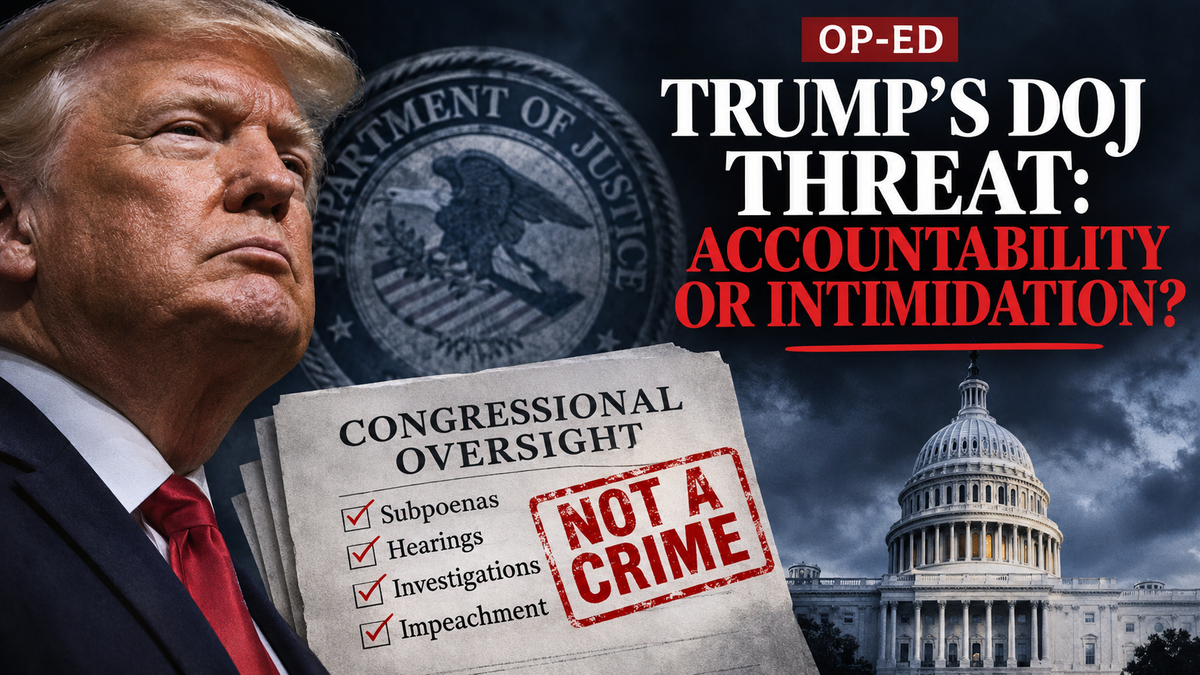
TRUMP’S DOJ THREAT: ACCOUNTABILITY OR INTIMIDATION?

An American president is threatening imprisonment for political opponents who intend to exercise constitutional oversight. The country deserves to understand exactly what that means.
November 8, 2026 | Opinion
Four days after Americans voted to change the balance of power in Washington, President Donald Trump responded with a threat that should concern every American, regardless of political affiliation.
He publicly directed the Department of Justice to investigate Democrats for what he characterised as criminal threats against administration officials and Republican donors.
He called their conduct extortion.
And then he went further.
“The imprisonment should be against these EXTORTIONISTS,” Trump declared on Truth Social.
Read those words again.
The president of the United States is calling for the imprisonment of political opponents as they prepare to assume control of Congress and investigate his administration.
This is not merely another heated political disagreement. It raises a fundamental question about the separation of powers and the independence of American law enforcement.
Since when does a president get to decide that congressional oversight is a crime?
CONGRESS DOES NOT NEED THE PRESIDENT’S PERMISSION
The Constitution establishes three branches of government for a reason.
Congress is not an extension of the White House. It does not exist to protect a president from uncomfortable questions, embarrassing disclosures or legitimate investigations.
Congress has the authority to investigate government misconduct, examine federal expenditures, issue lawful subpoenas and pursue impeachment when constitutionally warranted.
Those powers do not disappear because the president dislikes the people exercising them.
Trump has accused Democrats of threatening Republican officials and donors with politically motivated investigations and punishment. If there is credible evidence that an individual has committed extortion or another crime, that evidence should be examined under the law.
But announcing plans to investigate possible government misconduct is not, by itself, extortion.
Nor is discussing impeachment inherently criminal. Impeachment is a constitutional process, not an illegal threat simply because the president objects to it.
The distinction is not complicated.
Investigating possible criminal conduct is accountability. Threatening prosecution to discourage lawful investigation raises the prospect of intimidation.
And Americans should be deeply concerned when those two concepts become deliberately blurred.
THE DEPARTMENT OF JUSTICE IS NOT A PRESIDENTIAL WEAPON
The Justice Department has an extraordinary responsibility.
Its prosecutors possess the power to investigate individuals, seek indictments and pursue criminal convictions. Those powers carry consequences that can destroy reputations, livelihoods and personal freedom.
That authority must never become a mechanism for punishing political disagreement.
A president may express concerns about alleged criminal conduct. But criminal investigations should be grounded in evidence and applicable law, not in a president’s anger over an election result or anticipated congressional scrutiny.
On Saturday, Trump publicly ordered the department to examine what he called criminal acts by Democrats, without publicly presenting evidence establishing those crimes.
That distinction matters.
An accusation is not evidence.
A political disagreement is not probable cause.
And a president’s demand for imprisonment is not a judicial finding of guilt.
The American justice system was designed to provide safeguards against precisely that kind of concentration of power.
If the Department of Justice begins treating legitimate oversight activity as grounds for criminal investigation simply because the president demands it, the implications extend far beyond the Democratic Party.
They reach every American who expects the law to operate independently of political allegiance.
ACCOUNTABILITY IS NOT REVENGE — AND IT MUST NEVER BECOME ONE
Earlier this week, I argued that Democrats must not squander their electoral victory pursuing political revenge.
I stand by that position.
Americans did not vote to replace one form of political retaliation with another. They voted for representation, accountability and a government capable of addressing the problems affecting their lives.
Democrats should not enter January with predetermined verdicts, politically motivated prosecutions or investigations designed solely to humiliate their opponents.
They should follow evidence.
They should examine government conduct.
They should identify where laws may have been violated and pursue appropriate remedies.
And they should be prepared to close investigations when the evidence does not support allegations of wrongdoing.
But there is another side to that principle.
Refusing to pursue revenge does not mean surrendering the constitutional obligation to investigate misconduct.
Democrats should not be intimidated into silence simply because the president threatens to turn federal law enforcement against them.
The standard must remain the same for everyone.
Republican. Democrat. Independent.
No official should be prosecuted for political affiliation.
And no official should escape legitimate scrutiny because of political affiliation.
That is what equal justice under law is supposed to mean.
THE PRESIDENT MUST ANSWER TO THE CONSTITUTION, TOO
Trump’s public statements come at a particularly consequential moment.
Democrats are preparing to take control of both chambers of Congress in January. Their incoming majorities have promised investigations into administration policies, spending and potential misconduct.
Trump has every right to dispute accusations, challenge subpoenas through lawful procedures and defend his administration’s record.
He does not have the authority to declare lawmakers criminals merely for exercising legitimate constitutional responsibilities.
The president’s words carry institutional weight.
When he calls for imprisonment, federal officials hear him. Political allies hear him. Potential witnesses hear him. And members of Congress hear him.
That is why presidential threats cannot be dismissed as ordinary political rhetoric without examining their potential consequences.
A threat need not result in a conviction to create concern about intimidation.
The possibility that federal investigative powers could be used against political opponents may itself discourage people from speaking, cooperating with investigators or performing their public duties.
Whether that occurs here remains to be seen.
But the president’s statements warrant scrutiny now, not only after potential damage has occurred.
THIS IS BIGGER THAN DONALD TRUMP
Americans should consider a simple question.
Would they accept a Democratic president publicly directing the Justice Department to investigate Republican lawmakers for announcing plans to scrutinize a Democratic administration?
Would they accept that president calling for those Republicans to be imprisoned before any criminal conduct had been established?
If the answer changes depending on which party occupies the White House, then the principle being defended is not equal justice.
It is political power.
The Constitution does not grant different protections to different political parties.
It does not permit a president to suspend congressional oversight because an election produced an unfavorable outcome.
And it does not make loyalty to the president a substitute for obedience to the law.
These protections matter most when political tensions are high, when investigations are uncomfortable and when those holding power would prefer not to answer questions.
AMERICA NEEDS GOVERNING, NOT THREATS
Americans are confronting serious challenges.
Families are struggling with affordability. The country faces difficult questions about the Iran war. Ukraine continues to fight for its survival. International relationships require attention and repair.
Those problems will not disappear because Washington becomes consumed by another confrontation between the White House and Congress.
Democrats have a responsibility to govern responsibly while conducting legitimate oversight.
Republicans have a responsibility to defend constitutional institutions even when doing so creates political discomfort.
And the president has a responsibility to respect the limits of his office.
None of those responsibilities depends on whether the people involved like one another.
The country cannot function if every investigation becomes an accusation of persecution and every demand for accountability is answered with a threat of criminal prosecution.
That is not sustainable constitutional government.
It is a recipe for institutional conflict in which ordinary Americans bear the consequences.
THE LINE MUST BE CLEAR
Donald Trump has the right to defend himself and his administration.
Democrats have the right—and the responsibility—to conduct lawful congressional oversight.
The Justice Department has the responsibility to investigate actual violations of federal law.
And the American people have the right to expect those institutions to operate within their constitutional boundaries.
There should be no confusion about where those boundaries lie.
No president should be permitted to use the threat of criminal investigation as a substitute for answering legitimate questions.
No political party should use oversight as a disguise for revenge.
And no elected official should be placed above the law or beneath its protection because of political affiliation.
The central question is no longer simply whether Democrats will hold the Trump administration accountable. It is whether that accountability can proceed without the president attempting to turn the machinery of federal law enforcement against those conducting it.
The answer will reveal something important about the strength of America’s constitutional institutions.
Congressional oversight is not a crime.
Political opposition is not a crime.
And the Department of Justice must never become an instrument for deciding which Americans are permitted to question their government.
The Constitution does not belong to the president. It belongs to the American people.