
TWO CLOWNS, ONE PRESS CONFERENCE, AND A NATION GROUNDED

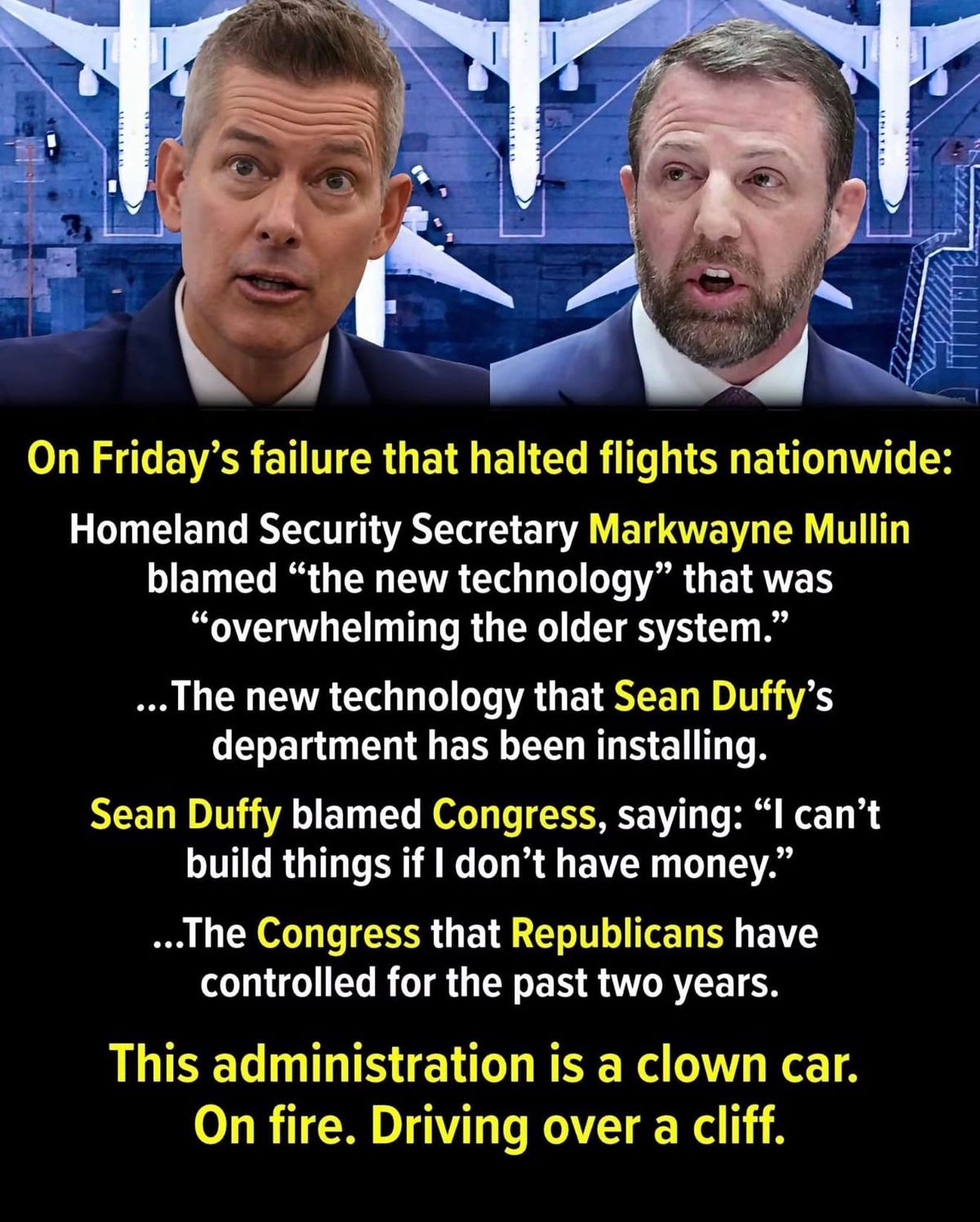
When Washington’s aviation system failed, the administration sent out two officials to explain why nobody was responsible.
By Pragmatic Issues | November 14, 2026
Somewhere in Washington, a clown car is on fire, barreling toward a cliff, and the two men in the front seat are arguing over who was supposed to install the brakes.
One insists the brakes are too old.
The other says Congress didn’t give him enough money to replace them.
Neither appears particularly concerned that the car is approaching the edge.
Ladies and gentlemen, allow me to introduce Transportation Secretary Sean Duffy and Homeland Security Secretary Markwayne Mullin.
Friday the 13th delivered a nationwide aviation shutdown, thousands of disrupted flights, stranded passengers, and a government press conference that could reasonably have been mistaken for an audition for a political comedy.
Except nobody was laughing at the airports.
And the people delivering the explanations were actually in charge.
THE NEW TECHNOLOGY DID IT!
Let’s begin with Markwayne Mullin.
According to Mullin, the problem involved new technology overwhelming an older system.
Well, there’s a revelation.
Apparently, the government has discovered that introducing modern technology into aging infrastructure requires something called planning.
Who knew?
One can almost imagine the conversation.
‘Secretary Mullin, we’ve installed the new equipment.’
‘Excellent! Does it work?’
‘Well, it seems to be overwhelming the old equipment.’
‘Have we tested it?’
‘Define tested.’
And then, somewhere in America, the aviation system collectively decided to take Friday afternoon off.
Now, Mullin’s explanation raises a rather inconvenient question.
If new technology was overwhelming older infrastructure, who authorised its installation without ensuring the existing system could accommodate it?
Technology doesn’t generally install itself.
Equipment doesn’t wander into federal facilities, plug itself into a communications network, and announce that it’s taking over.
People make those decisions.
Engineers evaluate compatibility.
Managers approve implementation.
Leadership is supposed to ensure that testing, safeguards, and contingency plans are in place.
So if Mullin’s explanation accurately describes what happened, he’s not simply identifying a technical problem.
He’s raising questions about the management responsible for implementing the technology.
That would include the administration standing behind him.
Awkward.
CONGRESS ATE MY HOMEWORK
Enter Sean Duffy.
While Mullin was busy explaining that new technology overwhelmed old infrastructure, Duffy offered another familiar Washington explanation.
Congress didn’t provide enough money.
‘I can’t build things if I don’t have money,’ Duffy complained.
Oh, Sean.Wait, he can build ‘stuff’ right?
If only someone had thought to give the federal government a budget.
Or perhaps an entire congressional appropriations process.
Or billions of dollars already designated for aviation modernisation.
Congress approved $12.5 billion toward modernising the air traffic control system last year. Now the administration wants approximately $30 billion more.
And apparently, the problem is that nobody gave Sean enough money to build things.
Let’s be clear: modernising America’s air traffic control system is expensive, necessary, and long overdue.
But there’s something particularly entertaining about a Cabinet secretary standing before the American public, complaining about congressional funding while serving an administration whose own party has controlled Congress.
Perhaps Duffy should send Congress a strongly worded letter.
Or call the Republican leadership.
Or check whether anyone in the building knows who has been approving the federal budget.
The possibilities are endless.
And here’s another thought.
If the administration knew the infrastructure was dangerously outdated, why was technology being introduced that could overwhelm it?
If the system couldn’t handle modernisation safely, why wasn’t that risk addressed before deployment?
If additional funding was essential, what specific work had been delayed?
And what happened to the funding already approved?
Those aren’t partisan questions.
They’re basic management questions.
Questions any competent executive should be prepared to answer.
WAIT. WHICH ONE OF YOU IS DRIVING?
This is where Friday’s press conference becomes particularly extraordinary.
Mullin describes a technology integration problem.
Duffy describes a funding problem.
The public is left wondering whether the government’s aviation infrastructure was too old, the new technology was too demanding, the modernisation was inadequately funded, or some combination of all three.
And the two men responsible for explaining the crisis somehow managed to make the situation sound even more alarming.
Imagine taking your vehicle to a repair shop.
The first mechanic tells you the new engine overwhelmed the old transmission.
The second tells you the garage didn’t have enough money to install the engine correctly.
Then both hand you a bill for another $30 billion.
Would you give them your credit card?
Or would you ask why anyone allowed the vehicle onto the highway in the first place?
There’s an important caveat here. The precise technical cause of Friday’s shutdown still requires investigation, and Duffy has maintained that the newer equipment itself did not fail.
Fair enough.
But that makes a thorough technical explanation even more important.
Because the issue isn’t simply whether an individual component malfunctioned.
It’s whether the entire system was properly designed, tested, integrated, and protected against cascading failures.
And when the government grounds flights nationwide because communications and radar information have become unreliable, Americans have every right to ask who was responsible for preventing that scenario.
THE PRESIDENT HAS LEFT THE CIRCUS
And where was President Donald Trump during all this?
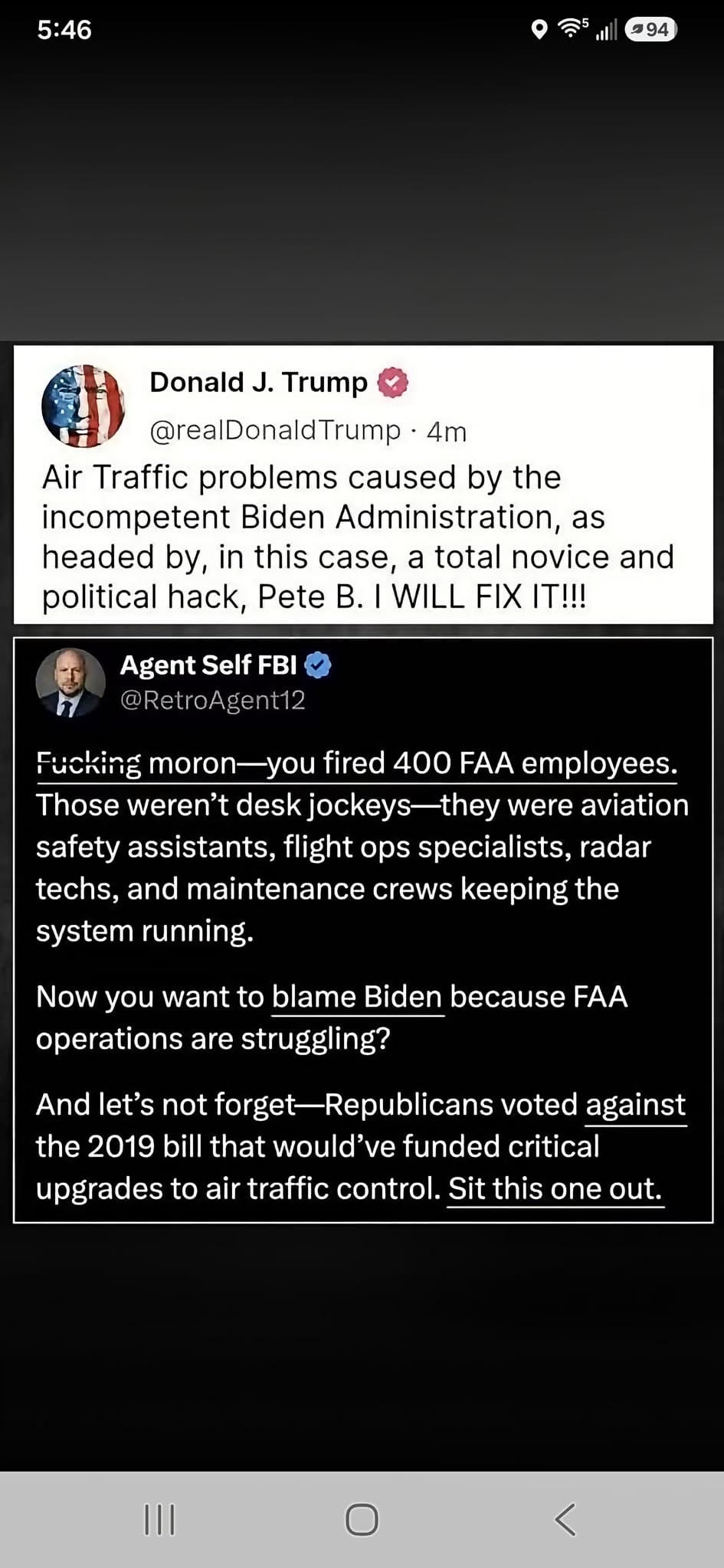
A man who can find time to post political grievances, criticise opponents, and dominate the news cycle apparently had little to say publicly while America’s aviation system was experiencing a nationwide emergency.
Now, presidents don’t need to personally repair telecommunications equipment.
Nobody expects Trump to crawl underneath an FAA console with a flashlight and a screwdriver.
Frankly, I would strongly discourage it.
But public leadership during a national disruption isn’t an unreasonable expectation.
A brief statement acknowledging the emergency, reassuring travellers, and promising a transparent investigation would have been appropriate.
Instead, Americans got Duffy and Mullin.
One pointing at the technology.
The other pointing at Congress.
And the president apparently nowhere near the microphone.
Perhaps the clown car had already left without him.
FRIDAY THE 13TH: THE ROUTERS ARE POSSESSED
Naturally, social media responded exactly as one might expect.
Flying jellyfish.
Alien invasions.
Government bunkers.
Military conspiracies.
And enough ominous background music to produce an entire season of The X-Files.
Personally, I think we’re overlooking the most obvious supernatural explanation.
The routers are haunted.
Somewhere deep inside an FAA communications facility, the ghost of a 1987 computer technician is wandering the corridors, furious that nobody ever replaced his equipment.
Every time someone installs a modern component, he throws another switch.
Every time Washington announces a modernisation initiative, he rattles the cables.
And every time Congress approves another billion dollars, he whispers:
‘Have you tried turning it off and back on again?’
At this point, it might be worth investigating.
Because the alternative explanation or excuse that highly paid government officials failed to anticipate a serious vulnerability in critical national infrastructure is considerably less entertaining.
And considerably more disturbing.
THE PEOPLE WHO ACTUALLY KNOW WHAT THEY’RE DOING
There is one group of people who deserve recognition rather than ridicule.
America’s air traffic controllers, pilots, aviation professionals, and airline personnel.
These are the people who had to manage the consequences of Friday’s failure.
They didn’t get to stand at a podium and blame Congress.
They didn’t get to explain that the technology was old and therefore apparently beyond anyone’s control.
They had to do their jobs.
And they did so under extraordinary pressure.
Air traffic controllers have warned for years about staffing shortages, fatigue, aging infrastructure, and increasingly demanding working conditions.
Their concerns deserve serious attention.
Because the real problem isn’t simply that the federal government possesses outdated technology.
It’s that the professionals responsible for keeping aircraft safely separated are expected to compensate for institutional shortcomings that should have been addressed long ago.
And when something fails, they’re the ones left managing the consequences.
Not the officials pointing fingers at a press conference.
THE CLOWN CAR NEEDS AN AUDIT
Here’s where the jokes end.
Friday’s nationwide ground stop was not merely an inconvenience.
It exposed a serious vulnerability in an essential national transportation system.
The decision to halt departures when critical information became unreliable was appropriate. Protecting passengers must always come first.
But the fact that aviation professionals responded effectively doesn’t absolve federal leadership of responsibility for understanding and correcting the failure.
Congress should demand a comprehensive investigation into the technical cause, the modernisation process, existing safeguards, and whether warnings were ignored.
The administration should explain precisely how previously appropriated funds have been spent and what additional funding would accomplish.
And Duffy and Mullin should be required to reconcile their explanations with the technical findings.
If outdated infrastructure was the problem, identify it.
If integration was the problem, explain how it happened.
If funding was insufficient, document the consequences and the decisions made in response.
And if multiple failures contributed, tell the American people that.
What we don’t need is another performance in which government officials describe an avoidable catastrophe as though it were an unfortunate act of nature.
Aging equipment doesn’t absolve leadership.
Insufficient funding doesn’t absolve management.
And blaming Congress doesn’t erase the executive branch’s responsibility to operate federal agencies competently.
Both political parties have presided over decades of aviation infrastructure challenges, and both deserve scrutiny for their roles.
But Duffy and Mullin are the officials responsible for explaining this administration’s response today.
They don’t get to hide behind yesterday’s mistakes.
AND NOW, BACK TO OUR REGULARLY SCHEDULED DISASTER
America can put spacecraft into orbit, develop extraordinary artificial intelligence systems, and build some of the most sophisticated aircraft ever designed.
Yet on Friday afternoon, the country couldn’t reliably maintain the systems necessary to keep normal commercial departures operating.
And when Americans asked what happened, two Cabinet secretaries appeared to explain that the equipment was old, the new technology was overwhelming it, and Congress needed to provide more money.
It was a remarkable performance.
Not because either man necessarily intended to mislead the public.
But because their explanations illustrated precisely why accountability matters.
Government leadership isn’t simply about identifying problems after they’ve disrupted millions of lives.
It’s about anticipating risks, managing resources, evaluating decisions, and accepting responsibility when things go wrong.
Duffy and Mullin may ultimately be able to demonstrate that their agencies responded appropriately and that the failure resulted from longstanding infrastructure vulnerabilities.
If so, the evidence should establish that.
But until the investigation is complete, Americans shouldn’t be expected to accept a collection of competing explanations and a multibillion-dollar funding request as a satisfactory conclusion.
The clown car is still on fire.
Sean Duffy is shouting that Congress didn’t buy enough gasoline.
Markwayne Mullin is explaining that the new engine overwhelmed the old transmission.
And somewhere in the back seat, the American taxpayer is wondering why nobody checked the vehicle before leaving the garage.
Gentlemen, stop arguing about the engine.
The cliff is right in front of you.
Pragmatic Issues — Independent perspectives. Uncomfortable questions. Accountability without allegiance.