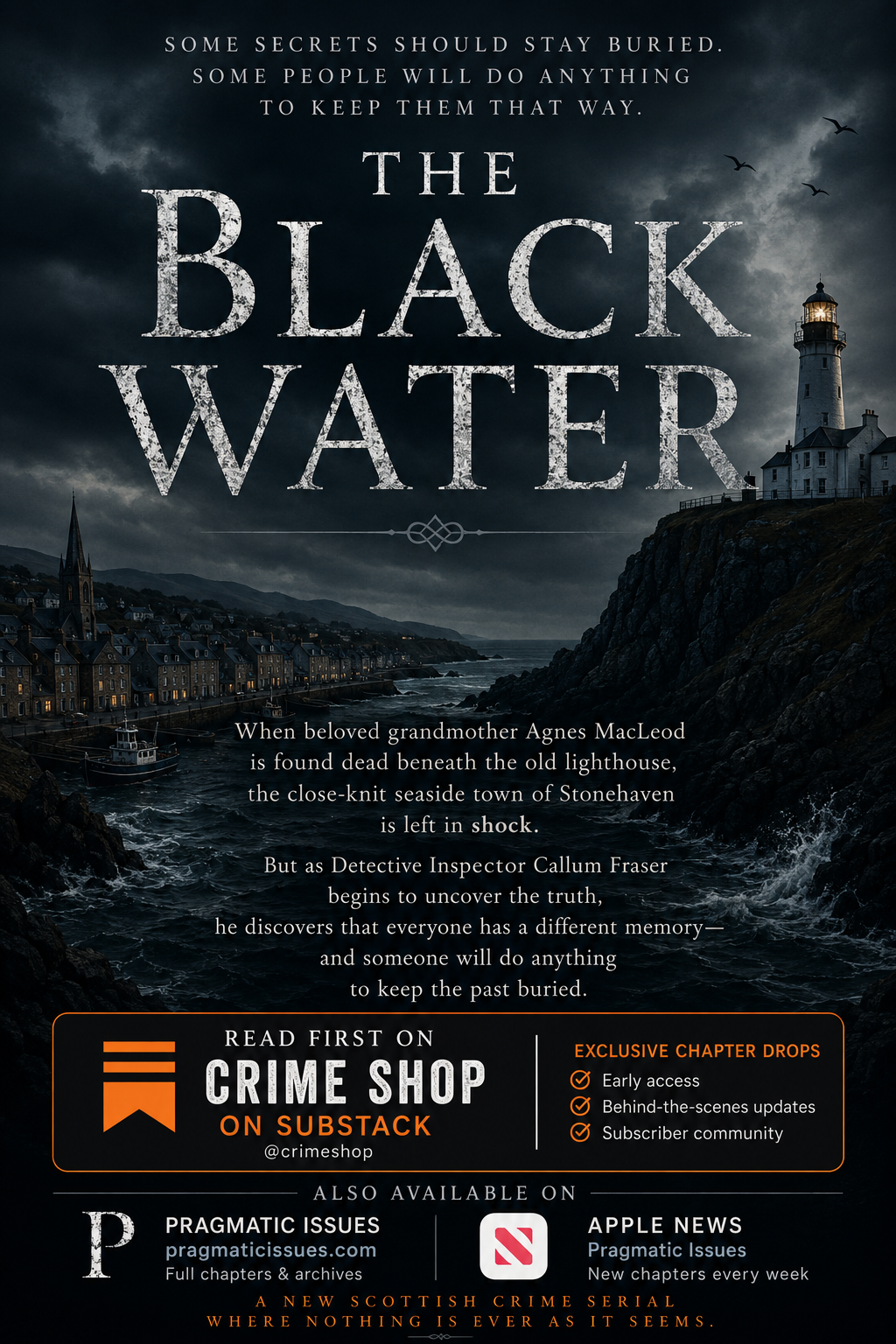
The Black Water

By: Cristal M Clark
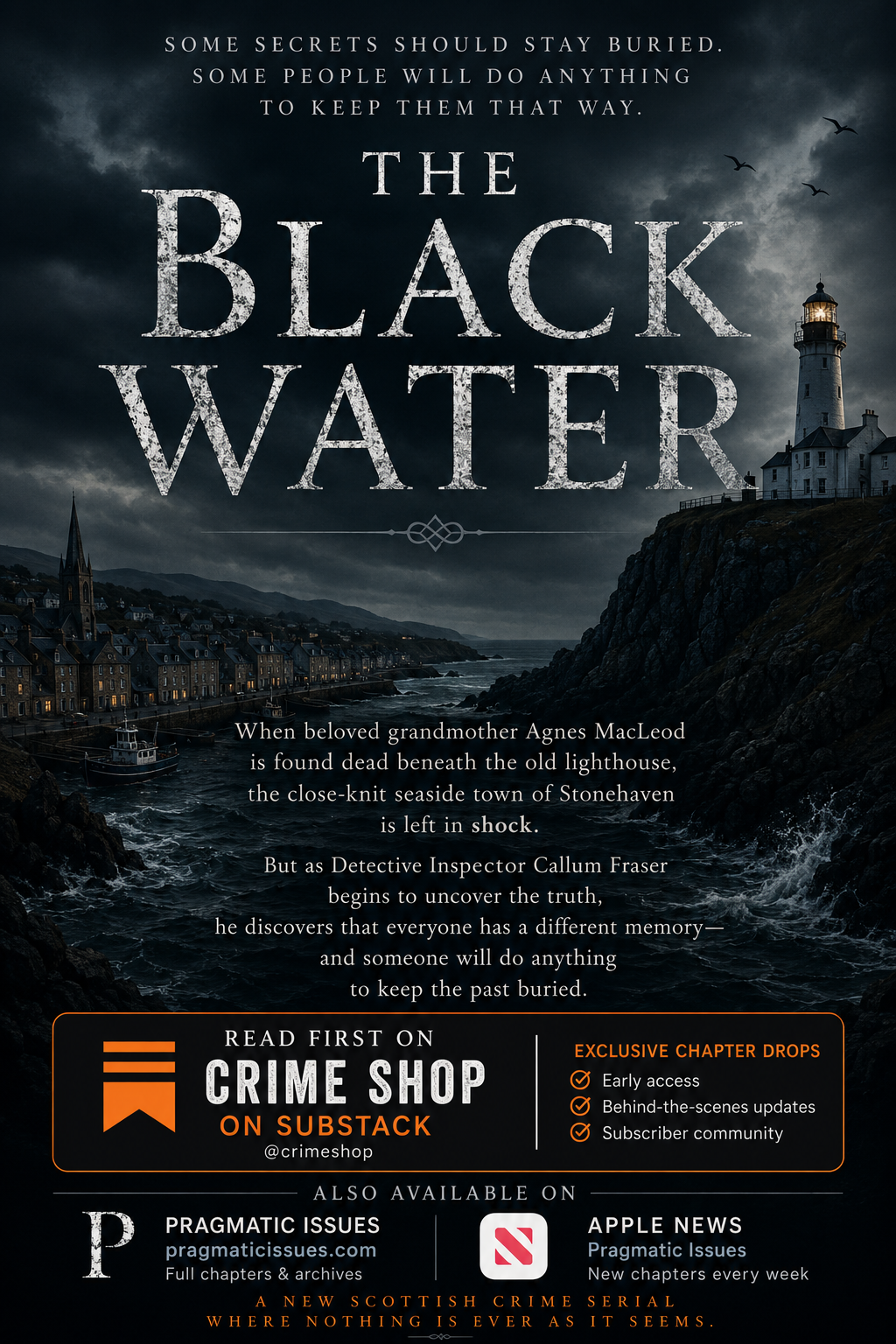
The Black Water
By C.M. Clark
Part One
Chapter One — Beneath the Lighthouse
Rosie MacLeod knew her mother was dead before anyone said her name.
Years later, when people asked how she had known, Rosie would struggle to explain it.
There had been no premonition. No strange dream. No telephone ringing in the middle of the night.
Only a knock at the door.
Three firm knocks at 7:14 on a grey Tuesday morning.
Rosie stood at the kitchen sink with her hands submerged in warm washing-up water and stared through the window above it. Beyond the glass, Stonehaven was waking beneath a colourless sky. Chimney smoke hung low over the slate roofs. Gulls wheeled above the harbour, screaming at one another as though the day had already offended them.
The sea was rough.
It had been rough all night.
Rosie had listened to it from bed, the North Sea throwing itself against the harbour wall again and again.
Then came the knock.
She stopped washing the mug in her hands.
Her daughter Fiona looked up from the kitchen table.
'Are you expecting someone?'
Rosie didn't answer.
Three knocks.
Not the postman.
Not Mrs Murray from next door, who knocked once and then walked in anyway.
Not her mother.
Agnes never knocked.
Rosie slowly pulled her hands from the water.
'Mum?'
Fiona was twenty-nine, but in that moment her voice belonged to the little girl who had once crawled into Rosie's bed during thunderstorms.
Rosie wiped her hands on the tea towel.
'I know.'
'Know what?'
Rosie looked at her.
She couldn't explain it.
'I just know.'
She walked through the narrow hallway.
Through the frosted glass in the front door she could see two shapes.
One tall.
One broad.
Rosie's hand stopped on the latch.
For perhaps two seconds, she simply stood there.
Then she opened the door.
Detective Sergeant Ewan Reid was standing on the step.
Rosie had known Ewan since primary school. Everyone in Stonehaven knew everyone, or at least knew enough about everyone to pretend they did.
Beside him stood a uniformed constable Rosie didn't recognise.
Ewan wasn't wearing his usual expression.
That was when the last tiny piece of hope disappeared.
'Rosie.'
She stared at him.
He removed his hat.
'Can we come inside?'
'It's Mum.'
Ewan hesitated.
Behind Rosie, a chair scraped across the kitchen floor.
'Mum?' Fiona called.
Rosie never took her eyes from Ewan.
'It's Agnes, isn't it?'
'Rosie, perhaps we should—'
'Tell me.'
The constable looked away.
Ewan swallowed.
'A woman was found early this morning.'
Something inside Rosie seemed to collapse.
'Where?'
'We haven't formally—'
'Where?'
Ewan hesitated again.
'Below the old lighthouse.'
Rosie stared at him.
For a moment, grief didn't come.
Confusion did.
'No.'
'Rosie—'
'No.'
She shook her head.
'That's not Mum.'
Fiona appeared behind her.
'Gran?'
Ewan looked past Rosie and his face changed.
Fiona understood immediately.
Her hand went to her mouth.
Rosie shook her head harder.
'No. You've got the wrong person.'
'We still need a formal identification.'
'Then why are you here?'
'There were personal belongings.'
'What belongings?'
'Rosie—'
'What belongings?'
Ewan lowered his voice.
'Her handbag.'
Rosie stopped moving.
Agnes MacLeod had carried the same brown leather handbag for nearly twenty years.
Fiona had bought her a new one for Christmas two years earlier.
Agnes had thanked her, transferred everything into it, carried it to church once, then quietly returned to the old brown one.
'Perfectly good bag,' she'd said.
Rosie's face crumpled.
Fiona reached for her.
'Mum.'
Rosie pushed past Ewan.
'Where are you going?'
She grabbed her coat from the hook.
'I'm going to her.'
'Rosie, you can't.'
'Get out of my way.'
'The area is restricted.'
'That's my mother.'
'I understand.'
'No, you bloody don't.'
Her voice cracked.
'That's my mother.'
Fiona caught her arm.
'Mum, wait.'
Rosie spun around.
'I'm not waiting.'
And she didn't.
By the time Detective Inspector Callum Fraser arrived at the lighthouse, half of Stonehaven already seemed to know.
That was the trouble with small towns.
Information moved faster than police cars.
The old lighthouse stood on the headland north of the harbour, a white tower rising from black rock above the sea. It had been decommissioned decades earlier and now existed mostly as a landmark for tourists, photographers and teenagers looking for somewhere to drink where their parents wouldn't find them.
Callum hated the place.
Not for any sensible reason.
It simply made him uneasy.
Perhaps because it stood too close to the edge.
Perhaps because on certain mornings the fog swallowed everything beneath it, leaving the tower floating alone above the cliffs.
Or perhaps because when Callum had been fourteen, a boy from his school had climbed the railing after drinking half a bottle of whisky and fallen thirty metres onto the rocks.
Callum still remembered the sound of the boy's mother screaming when they brought the body up.
Thirty-two years later, he heard that sound again.
'MUM!'
Callum turned.
A woman was running towards the police barrier.
Rosie MacLeod.
He recognised her immediately.
Most people would have.
Rosie ran the little bakery on Harbour Street. Her mother Agnes had lived three streets away for most of her eighty-two years.
Callum had known Agnes since childhood.
Everyone had.
She had volunteered at the church hall, organised collections for families who'd fallen on hard times and somehow remembered every child's birthday in the neighbourhood.
She had once chased Callum and two friends down an alley with a wooden spoon after catching them stealing apples from her garden.
She had caught him.
The others escaped.
Agnes had given him the apple anyway.
Now she lay beneath a white forensic sheet forty metres away.
'MUM!'
Rosie hit the barrier.
A constable grabbed her.
'Mrs MacLeod—'
'Let me through!'
'You can't go down there.'
'That's my mother!'
People were watching from farther down the road.
Callum saw Fiona running behind her.
'Mum!'
Rosie fought against the constable.
'Let me see her!'
Callum walked quickly towards them.
'Rosie.'
She looked at him.
For a second she seemed not to recognise him.
Then she did.
'Callum.'
He hadn't heard his first name spoken with that much desperation in years.
'Please.'
He stopped in front of her.
'Please let me see her.'
'You can't go down there.'
'I need to know it's her.'
'We will arrange that.'
'Now.'
'Rosie—'
'NOW!'
The scream ripped out of her.
She folded.
Not gracefully.
Not like people did on television.
Her knees simply gave way.
Callum caught one arm while the constable caught the other, but Rosie dragged them both towards the ground.
A sound came from her that Callum would remember long afterwards.
A deep, broken animal sound.
'Mum…'
Fiona dropped beside her.
Rosie clutched her daughter.
'She's down there.'
'I know.'
'She's all alone.'
'I know, Mum.'
'She's cold.'
Fiona began crying.
'Mum, please.'
Rosie rocked back and forth.
'She hates being cold.'
Callum looked away.
He had spent twenty-three years in policing.
He had seen grief arrive in almost every imaginable form.
Silence.
Anger.
Denial.
Occasionally laughter.
People sometimes laughed when told someone they loved was dead. The brain did strange things when reality became unbearable.
But this was different.
This was devastation without restraint.
Whatever else had happened here, Callum thought, Rosie MacLeod had loved her mother.
He crouched beside her.
'Rosie.'
She didn't look at him.
'We're going to take care of Agnes.'
'Don't leave her there.'
'We won't.'
'Promise me.'
'I promise.'
Rosie finally looked at him.
Her face was wet and twisted with grief.
'Find out what happened.'
Callum nodded.
'I will.'
At that moment, he believed he could.
Agnes MacLeod lay among the rocks beneath the eastern side of the headland.
The tide had been coming in when a fisherman named Alec Byrne spotted something pale between the rocks shortly after six.
At first he'd thought it was rubbish.
Then he'd seen the hand.
Callum stood above the body while Dr Moira Bell crouched beside it.
'Fall?' he asked.
Moira didn't answer immediately.
She was examining Agnes's hands.
'Possibly.'
Callum looked up at the cliff.
'That's helpful.'
'You asked before I've examined her.'
'I'm impatient.'
'You've always been impatient.'
They had known one another for fifteen years.
Moira glanced towards him.
'But I wouldn't assume anything yet.'
Callum looked at Agnes.
Her body had landed awkwardly between two rocks.
There was blood.
Not as much as he would have expected.
One shoe was missing.
Her grey coat was buttoned almost to the neck.
Her handbag had been found several metres away.
Callum crouched.
'Anything immediately strange?'
Moira looked at him.
'Apart from an eighty-two-year-old woman apparently falling off a cliff before sunrise?'
'Apart from that.'
Moira gestured towards Agnes's legs.
'Her tights aren't torn.'
Callum frowned.
'Meaning?'
'Look at the terrain.'
Sharp rock.
Heather.
Gorse.
Mud.
'If she walked out here in darkness,' Moira said, 'I'd expect damage.'
Callum looked again.
There was almost none.
'Could've come along the path.'
'Perhaps.'
'Then fallen.'
'Perhaps.'
Callum sighed.
'I hate it when you say perhaps.'
'I hate it when detectives decide what happened before pathology gets involved.'
He stood.
A uniformed constable approached.
'Sir?'
'What?'
'We've got something.'
Callum followed him towards the cliff path.
Another officer was standing beside a patch of wet ground.
'Footprints?'
'Yes, sir.'
Callum crouched.
There were several impressions.
Boots.
Large.
Probably one of the responding officers.
But beside them was something else.
A small shoe print.
Callum looked towards Agnes's body.
'Her missing shoe?'
'Possibly.'
Callum stared at the print.
Then at the path.
Then back towards the lighthouse.
'Where are the others?'
The constable frowned.
'Sir?'
'If that's Agnes's footprint, where are the rest?'
The ground was damp enough to hold impressions.
Yet there was only one.
Callum stood.
'Nobody walks through mud once.'
By afternoon, Stonehaven had turned Agnes MacLeod's death into twenty different stories.
She had jumped.
She had fallen.
She had been robbed.
She had been meeting someone.
She had dementia.
She had been sleepwalking.
Someone had seen a suspicious car.
Someone else had heard shouting.
By four o'clock, social media had managed to add an unidentified man in a black coat who almost certainly did not exist.
Callum ignored all of it.
He sat in Agnes's tiny living room while Rosie stared at a cup of tea she hadn't touched.
Fiona sat beside her.
'When did you last speak to her?' Callum asked.
Rosie wiped her nose.
'Yesterday.'
'What time?'
'About half six.'
'How did she seem?'
'Normal.'
'Upset?'
'No.'
'Worried?'
'No.'
'Did she mention meeting anyone?'
Rosie looked up.
'No.'
'Going anywhere?'
'No.'
'Did your mother walk much?'
Something changed in Rosie's expression.
It was subtle.
Confusion breaking through grief.
'Yes.'
Callum waited.
'But not there.'
'The lighthouse?'
Rosie shook her head.
'Never.'
'Never is a strong word.'
'I mean never.'
Fiona looked at her mother.
Rosie leaned forward.
'She hated that path.'
'Why?'
'The cliff.'
Callum nodded.
'She was afraid of heights?'
'Terrified.'
That interested him.
'Since when?'
'Always.'
Rosie looked towards the window.
'Dad took us up there once when I was little. Mum couldn't even walk near the railing. She stayed by the car.'
Callum wrote something in his notebook.
'People change.'
'Not Mum.'
'Could she have gone to meet someone?'
'At five in the morning?'
'We don't know what time she arrived.'
Rosie stared at him.
Then said something that made Callum stop writing.
'She couldn't have walked there anyway.'
He looked up.
'Why not?'
'Her hip.'
'What about it?'
'She had it replaced last year. She walks fine around town, but hills are difficult.'
Fiona nodded.
'Gran wouldn't even walk up Bervie Braes anymore. I'd drive her.'
Callum pictured the path.
The steep climb.
The uneven ground.
The rocks.
An eighty-two-year-old woman with a replaced hip.
Afraid of heights.
Walking alone before dawn.
Something tightened in his stomach.
'Did she drive?'
'She stopped three years ago.'
'Taxi?'
Rosie shook her head.
'She hated taxis.'
'Bus?'
'Not at that hour.'
Callum closed his notebook.
'Rosie, did your mother know anyone who lived near the lighthouse?'
'No.'
'Anyone she might have visited?'
'No.'
'Anyone who could have driven her?'
Rosie hesitated.
'Half the town.'
That was the problem.
Agnes MacLeod had lived in Stonehaven for eighty-two years.
Half the town probably would have driven her somewhere if she'd asked.
Callum stood.
'I'll need a list of people she spoke with regularly.'
Rosie nodded.
He walked towards the door.
'Callum?'
He turned.
Rosie was standing now.
Her face looked exhausted.
'She didn't go there.'
Callum studied her.
'You're certain.'
'I knew my mother.'
Her voice trembled.
'She did not walk to that lighthouse.'
That evening, Callum returned alone.
The forensic teams had gone.
The lighthouse stood against a bruised purple sky while the North Sea churned below.
He walked the path slowly.
From the road.
Past the gate.
Across the damp ground.
Towards the cliff.
It took him eleven minutes.
He was forty-six and reasonably fit.
Agnes had been eighty-two.
He stopped where her body had been found.
The tide had risen.
Black water surged between the rocks below.
Callum looked back towards the town.
Lights were appearing in windows.
Stonehaven looked peaceful from up here.
Safe.
The sort of place where people believed they knew their neighbours.
The sort of place where everyone remembered Agnes MacLeod differently.
Callum turned towards the lighthouse.
Something white fluttered near the fence.
He walked towards it.
A piece of paper had caught beneath a stone.
Probably rubbish.
He almost ignored it.
Then he saw the handwriting.
Callum pulled on a glove and lifted it carefully.
The paper was old.
Folded several times.
Only four words had been written across it.
YOU SHOULD HAVE FORGOTTEN.
Callum stared at them.
Behind him, the sea struck the cliffs.
He looked towards the place where Agnes MacLeod had died.
Then towards the darkening town below.
Rosie had been right about one thing.
Agnes hadn't simply gone for a walk.
The question was no longer why an old woman had climbed to the lighthouse.
It was who had brought her there.
And what Agnes MacLeod had remembered that someone else desperately wanted buried.
----------------
Chapter Two - The Road to the Lighthouse
By half past nine, everyone in Strathmuir knew Agnes MacLeod was dead.
By ten, they knew where she had been found.
By eleven, they had begun deciding why.
That was the way of small places.
News did not travel in Strathmuir. It seeped.
Through the post office and the harbour office. Across the counter at McBride's. Between fishermen unloading creels beneath screaming gulls. Through kitchens where kettles boiled and curtains shifted as police cars passed.
Agnes MacLeod.
Eighty-two years old.
Found beneath the old lighthouse.
Dead.
The facts were repeated until they became something else entirely.
She had fallen.
She had jumped.
She had been confused.
She had gone walking in the night.
She had been meeting someone.
She had been murdered.
Detective Inspector Callum Fraser had heard most of these theories before he had even finished his second coffee.
He stood beside his car at the edge of the harbour, looking back towards the cliffs.
From here, the lighthouse was barely visible.
A dark finger against a colourless sky.
It had been abandoned for thirty-seven years.
The council had fenced it off twice.
The village had torn the fencing down twice.
Teenagers went there to drink. Tourists occasionally ignored the warning signs and wandered up for photographs. Local children dared one another to touch the rusted door after dark.
But Agnes MacLeod did not go there.
That was what everyone kept telling him.
Not wouldn't.
Not probably didn't.
Didn't.
As though it were a fact as certain as the tide.
Callum climbed into the car.
Constable Eilidh Grant was waiting in the passenger seat with a notebook balanced on one knee.
She was twenty-seven, clever, and still young enough to believe that if you asked a question correctly, people would give you the truth.
Callum had once believed that too.
'Well?' he asked.
Eilidh glanced down.
'Rosie MacLeod confirmed her mother had arthritis in both knees. Worse in the left. Used a walking stick outdoors.'
'We didn't find one.'
'No.'
'House?'
'Locked. Nothing obviously disturbed. Handbag still inside. Purse. Bank cards. Mobile.'
Callum looked at her.
'Mobile?'
'On the kitchen table.'
'When was it last used?'
'Yesterday afternoon. Call to Fiona.'
Fiona Campbell.
The granddaughter.
Twenty-nine. Lived fifteen miles away in Banff and visited Agnes several times a week.
'What time?'
'Four seventeen.'
'And after that?'
'Nothing.'
Callum started the engine.
'Let's see the house.'
Agnes lived in a narrow stone cottage on Shore Street, three doors down from the bakery and directly opposite the sea.
It was the sort of house that looked as though it had grown from the village rather than been built in it.
Whitewashed walls.
Blue door.
Two windows facing the water.
A small brass number nine screwed crookedly beside the frame.
Someone had already left flowers on the doorstep.
Callum stopped when he saw them.
'Christ.'
Eilidh followed his gaze.
There were three bunches.
Agnes had been dead less than six hours.
'Small village,' Eilidh said.
Callum didn't answer.
Rosie had given police permission to enter.
Inside, Agnes MacLeod's life remained stubbornly intact.
Her slippers sat beneath the radiator.
A cardigan hung over the back of an armchair.
A half-finished crossword lay beside a pair of spectacles.
On the kitchen counter sat a loaf of bread wrapped in paper and a small dish containing three tomatoes.
There was washing in the machine.
Callum opened it.
Wet.
Not damp.
Wet.
'She started this yesterday.'
Eilidh appeared behind him.
'Probably.'
Callum closed the machine.
People planning to disappear did not generally leave washing halfway through.
Then again, people rarely planned their deaths with the consideration detectives would prefer.
He moved through the kitchen slowly.
Nothing overturned.
Nothing broken.
No blood.
No obvious sign that anyone had searched the place.
He stopped beside the back door.
Two pairs of shoes sat neatly on a rubber mat.
Brown slippers.
Black walking shoes.
Beside them was an empty space.
Callum crouched.
'What did she have on when she was found?'
'Black ankle boots.'
He looked at Eilidh.
'Arthritis in both knees.'
'Yes.'
'Walking stick?'
'Still missing.'
Callum straightened.
The boots bothered him.
Not because an elderly woman couldn't wear boots.
Because the path to the lighthouse was miserable even for someone half Agnes's age.
Steep in places.
Loose rock.
Mud after rain.
And it had rained for most of yesterday.
He walked to the front room.
Photographs covered the mantelpiece.
Agnes younger, laughing beside a man Callum assumed had been her husband.
Rosie as a child.
Rosie getting married.
Fiona in school uniform.
Fiona graduating.
Three generations of women arranged across fifty years.
There was another photograph at the end.
Black and white.
Much older.
Perhaps the 1950s.
A group of villagers standing outside the harbour office.
Callum counted fourteen people.
Someone had drawn a small blue circle around the face of a young man in the back row.
He leaned closer.
'Eilidh.'
She came in.
'Know who that is?'
'No.'
Callum lifted the photograph.
On the back, written in faded ink, were seven words.
Summer 1958. Before the black water came.
He read it twice.
'What does that mean?' Eilidh asked.
'No idea.'
He returned the photograph to the mantelpiece.
For now, it was merely an old photograph and an odd sentence.
Every family possessed things that made perfect sense to the dead and none at all to anyone left behind.
He continued upstairs.
Agnes's bedroom was immaculate.
Bed made.
Curtains open.
A bottle of hand cream beside the lamp.
Her wardrobe contained the modest accumulation of eighty-two years lived without much interest in fashion.
Callum checked the pockets of the coats.
Nothing.
Then Eilidh called from the hallway.
'Sir?'
There was something in her voice.
He stepped out.
She was standing beside a narrow table beneath the stairs.
On it sat an old landline telephone.
'What?'
'Rosie said her mother hardly used this anymore.'
Callum waited.
Eilidh held up the handset.
'It's off the hook.'
He stared at it.
'Could've knocked it.'
'Maybe.'
'Anything else?'
Eilidh pointed.
The telephone cord had been pulled tight.
Not unplugged.
Stretched.
As though someone had walked away while holding the receiver.
Callum took it from her.
A faint tone buzzed through the earpiece.
He replaced it.
'When did Rosie last come here?'
'Yesterday morning.'
'Was it like that?'
'She doesn't know.'
Callum looked towards the kitchen.
Something had begun to change.
Not dramatically.
There was no cinematic revelation. No bloodstained weapon hidden beneath a floorboard.
Just small things.
Wet washing.
A missing walking stick.
Boots on an eighty-two-year-old woman who supposedly climbed a treacherous cliff path.
A telephone left dangling.
Tiny inconsistencies.
Callum had spent twenty-six years learning that murder often announced itself quietly.
The post-mortem would not happen until the following morning.
Until then, Callum wanted the route.
He wanted to know how Agnes MacLeod had reached the lighthouse.
They began at her front door.
Shore Street ran north before splitting beside the old kirk.
Left led towards the main road.
Right climbed gradually towards the cliffs.
Agnes would have needed to walk almost a mile.
Callum timed it.
Nine minutes to the kirk for him.
For Agnes?
Twenty.
Maybe more.
Then the pavement ended.
The road narrowed.
The incline sharpened.
Eilidh was breathing harder by the time they reached the gate leading onto the coastal path.
Beyond it, the ground deteriorated quickly.
Mud.
Stone.
Heather.
The sea crashing below.
Callum stopped.
'Nae.'
Eilidh looked at him.
'Nae what?'
'She didn't walk this.'
'We don't know that.'
He pointed towards the slope ahead.
'Eighty-two. Arthritis. Walking stick. After heavy rain?'
Eilidh studied the path.
'Maybe someone drove her.'
That was possible.
There was an access road on the opposite side of the hill, built decades ago for lighthouse maintenance.
Locked now.
At least officially.
They continued.
The lighthouse appeared gradually through the mist.
First the top.
Then the tower.
Then the ruined keeper's cottage beside it.
Crime-scene officers were still working below the cliff.
Callum avoided looking towards the place where Agnes's body had been found.
Instead, he studied the ground.
'Where were her footprints?'
Eilidh stopped.
'What?'
'The path.'
She looked behind them.
Rain had softened the earth.
Their own footprints were obvious.
So were those of the officers who had come before them.
Callum turned towards the lighthouse.
'Scene team mapped everything before anyone walked through?'
'Yes.'
'And?'
'I'll check.'
She pulled out her phone.
Callum already knew.
He walked towards the rusted fence surrounding the lighthouse grounds.
Someone had cut through the chain years ago.
The gap was large enough for a person to squeeze through.
He imagined Agnes doing it.
Eighty-two years old.
Bad knees.
In the dark.
No.
Eilidh lowered the phone.
Her expression had changed.
'What?'
'They found footprints from the search team. Two sets belonging to the teenagers who were here last night. A few older impressions they can't identify.'
'And Agnes?'
'Nothing they can confidently attribute to her.'
Callum looked back along the path.
'Boot prints near the body?'
'Yes.'
'Her boots?'
'They're checking.'
The wind rose suddenly.
It came off the North Sea with enough force to make Eilidh turn her face away.
Callum stared at the lighthouse.
For the first time that morning, he stopped thinking about how Agnes MacLeod had died.
He began thinking about how she had arrived.
Rosie MacLeod was waiting when they returned to Shore Street.
She sat at her mother's kitchen table with both hands wrapped around a mug she wasn't drinking from.
Fiona stood by the window.
Neither woman looked as they had at the cliff.
Shock had settled differently upon them.
Rosie seemed smaller.
Fiona seemed angry.
Callum recognised both reactions.
He sat opposite Rosie.
'I need to ask you something.'
She nodded.
'Your mother ever go to the lighthouse?'
Rosie looked up.
'No.'
'Ever?'
'No.'
'Not recently. Years ago?'
Something moved across Rosie's face.
So quickly Callum almost missed it.
'No.'
Fiona turned from the window.
'Gran hated that place.'
Rosie looked at her.
It was a sharp look.
A warning, perhaps.
Callum caught it.
'Why?'
Fiona hesitated.
'I don't know.'
'You just said she hated it.'
'She did.'
'Why?'
Fiona looked at her mother.
Rosie set down the mug.
'My father died at sea.'
Callum waited.
'Near the lighthouse?'
'No. Miles north.'
'Then why would that make Agnes hate the lighthouse?'
Rosie's eyes met his.
For the first time since he had seen her screaming beneath the cliff, Callum saw something in them other than grief.
Fear.
'She just did.'
He let the silence sit.
People hated silence.
Eventually, they filled it.
Rosie didn't.
Interesting.
'Your mother's walking stick is missing.'
Rosie frowned.
'What?'
'We didn't find it.'
'She never went anywhere without it.'
'Was she capable of walking to the lighthouse?'
Rosie gave a short, disbelieving laugh.
'My mother struggled getting to the bakery.'
'Could she have climbed the coastal path?'
'No.'
'Could she have climbed through the fence?'
'No.'
'Could she have climbed the lighthouse stairs?'
Rosie's face went pale.
'I don't understand.'
'Neither do I.'
Fiona stepped forward.
'You think someone took her there.'
Callum didn't answer.
Because he wasn't ready to say it.
Not yet.
Instead, he asked Rosie when she had last seen her mother alive.
'Yesterday morning.'
'What time?'
'About eleven.'
'How was she?'
'Fine.'
'Worried?'
'No.'
'Upset?'
'No.'
'Expecting anyone?'
'No.'
'Did she mention the lighthouse?'
Rosie stared at him.
'No.'
'Did she mention 1958?'
The room changed.
It was almost imperceptible.
But Callum felt it.
Rosie's fingers tightened around the mug.
Fiona looked at her mother.
Callum continued.
'We found a photograph.'
Rosie said nothing.
'Fourteen people outside the harbour office. Someone circled. On the back, your mother wrote something about the black water.'
Fiona frowned.
'The what?'
Rosie stood abruptly.
'I'd like you to leave.'
'Mrs MacLeod—'
'My mother is dead.'
'I know.'
'You don't know anything, you are waisting time talking to me.'
Her voice cracked.
For a moment, the grief returned so completely that Callum almost regretted asking.
Almost.
Rosie pressed a hand to her mouth.
Then she whispered something.
Callum didn't hear.
'What was that?'
She lowered her hand.
'I said leave the past alone.'
Callum studied her.
'What past?'
Rosie looked towards the window.
Out beyond the glass, the North Sea had darkened beneath the approaching weather.
'The kind that doesn't stay buried once you start digging.'
That evening, Callum returned to the lighthouse alone.
He told himself it was because he wanted to see the path at roughly the hour Agnes might have travelled it.
That was partly true.
The mist had thickened.
The village below had become a collection of yellow lights suspended in grey.
He walked slowly.
Looking.
Thinking.
There had been no handbag.
No mobile.
No walking stick.
Nothing to suggest Agnes had planned to go anywhere.
And if she had walked here, she had done so without leaving a trail anyone could confidently identify.
He reached the fence.
Beyond it, the lighthouse rose into darkness.
Callum switched on his torch.
The beam swept across weeds.
Broken stone.
The keeper's cottage.
Then something reflected.
Small.
Metallic.
Near the base of the lighthouse.
He walked towards it.
The object lay half-buried in mud beneath a clump of grass.
Callum crouched.
A ferrule.
The small metal cap fitted to the bottom of a walking stick.
He did not touch it.
He stared.
Then lifted his phone and called Eilidh.
'I need scene officers back up here.'
A pause.
'What did you find?'
Callum looked towards the cliff.
'Part of Agnes's stick.'
He moved the torch slightly.
There was something else in the mud.
A mark.
A long narrow groove dragged through the earth.
Then another.
Parallel.
Callum stood.
The marks continued towards the lighthouse.
Not footprints.
Drag marks.
His stomach tightened.
He followed them with the torch until they disappeared across harder ground.
The wind pushed through the broken windows of the keeper's cottage.
A low whistle rose from somewhere inside.
Callum turned.
For a moment, he had the peculiar sensation that someone was standing behind one of the windows.
Watching him.
There was no one there.
Only darkness.
He looked back at the ferrule.
Agnes MacLeod had not walked to the lighthouse.
Someone had brought her here.
And judging by the marks in the mud, for at least part of the journey—
she had not been walking at all.
Chapter Three - The Last Walk
The village awoke beneath a blanket of low cloud.
Mist rolled in from the North Sea, swallowing the harbour until only the tops of the fishing boats remained visible. The abandoned lighthouse stood high above it all, little more than a dark silhouette against the morning sky.
By breakfast, no one was speaking about the weather.
Everyone was speaking about Agnes MacLeod.
The bakery opened late.
The butcher served customers in near silence.
Outside the village shop, neighbours clustered together, their conversations stopping the moment Detective Inspector Callum Fraser walked past.
He wasn’t surprised.
Small villages didn’t simply lose one of their own.
They carried the loss together.
Rosie MacLeod answered the door before Callum had a chance to knock twice.
She looked exhausted.
Her eyes were swollen from crying, but the wild panic he’d witnessed yesterday had settled into something quieter.
Something heavier.
‘Inspector.’
‘Mrs MacLeod.’
She stepped aside.
‘Please… come in.’
The cottage felt exactly as it had the day before.
Agnes’s knitting still rested beside her favourite chair.
An unfinished crossword lay open on the coffee table.
Reading glasses perched neatly on top of it.
The kettle sat cold on the stove.
It felt less like a home and more like time had simply… stopped.
Rosie noticed Callum looking around.
‘I still haven’t moved anything.’
‘I wouldn’t expect you to.’
She gave a faint nod before leading him into the kitchen.
Once they were seated, Callum closed his notebook.
‘I want to thank you for agreeing to speak with me again.’
Rosie managed a tired smile.
‘I don’t know that I’ll be much more help today.’
‘Actually,’ he said gently, ‘you may be.’
She looked at him curiously.
‘Yesterday you were in shock. Anyone would have been. The first conversation after something like that is rarely the clearest one.’
He paused.
‘Sometimes people remember small things after they’ve had a little time. Things that didn’t seem important yesterday.’
Rosie folded her hands together.
‘I’ll try.’
‘That’s all I can ask.’
‘Let’s start with yesterday morning.’
Rosie closed her eyes for a moment.
‘Mum was making raspberry jam.’
‘As she often did?’
‘Every summer.’
‘Did anything seem different about her?’
Rosie thought carefully.
‘No…’
She stopped.
‘Actually… maybe.’
Callum didn’t interrupt.
‘She kept looking out the kitchen window.’
‘Watching for someone?’
‘I don’t know.’
‘Did she say anything?’
Rosie frowned.
‘She asked what day it was.’
‘Is that unusual?’
‘Not really.’
‘Anything else?’
Rosie hesitated.
‘She asked if I’d locked the back door the night before.’
‘Did that concern you?’
‘At the time? No.’
‘Now?’
Rosie looked down at the table.
‘Yes.’
‘Did anyone visit the house yesterday morning?’
‘No.’
‘Any telephone calls?’
‘Not while I was there.’
‘Letters? Deliveries?’
‘Nothing.’
Callum made a note.
‘Did your mother leave carrying anything?’
Rosie’s brow furrowed.
‘I… don’t think so.’
‘Her handbag?’
‘It was still hanging beside the front door.’
‘Her walking stick?’
‘Also here.’
Callum looked up.
‘Your mother rarely walked anywhere without it?’
‘Never.’
He wrote another note.
‘What about a coat?’
Rosie blinked.
‘That’s odd…’
‘What is?’
‘Her blue raincoat is gone.’
Callum glanced toward the hallway.
‘May I see?’
Rosie led him to a small wooden coat rack.
Three jackets hung neatly in place.
A gardening coat.
A thick winter coat.
A light cardigan.
An empty hook remained between them.
‘That’s where it always hung,’ Rosie said quietly.
Callum nodded.
‘Did she wear it often?’
‘Whenever she left the house.’
He studied the empty hook for several seconds.
One missing coat.
One handbag left behind.
One walking stick never used.
None of it fit together.
He turned another page in his notebook.
‘Yesterday, you told me your mother would never have gone to the lighthouse.’
Rosie’s expression changed immediately.
She became almost defensive.
‘She wouldn’t.’
‘Can you help me understand why you’re so certain?’
Rosie stared out of the kitchen window toward the sea.
‘When I was little, Mum refused to let me play anywhere near those cliffs.’
‘Did she say why?’
‘She’d only ever say one thing.’
Callum waited.
‘Some places take more than they give.’
The words hung in the room.
‘Did she ever explain what she meant?’
Rosie slowly shook her head.
‘Whenever I asked, she’d change the subject.’
‘Did something happen there?’
‘I don’t know.’
She looked genuinely frustrated.
‘She hated even talking about the lighthouse.’
By midday, Callum had interviewed nearly everyone who had spoken with Agnes during the previous week.
Each conversation painted the same picture.
Kind.
Patient.
Stubborn.
Beloved.
No enemies.
No arguments.
No financial worries.
Nothing that explained why an eighty-two-year-old widow had somehow ended up beneath an abandoned lighthouse she refused to visit.
Then he met Malcolm Kerr.
The old fisherman had known Agnes for more than sixty years.
Unlike the others, he didn’t smile when speaking about her.
He looked troubled.
‘Something was bothering her.’
Callum leaned forward.
‘You’re certain?’
‘Aye.’
‘Why didn’t you mention it yesterday?’
‘I wasn’t sure it mattered.’
‘Everything matters.’
Malcolm nodded slowly.
‘She kept looking over her shoulder.’
‘As though someone was following her?’
‘Aye.’
‘Did she ever tell you why?’
‘No.’
‘Did she say anything unusual?’
The old fisherman rubbed his weathered hands together.
‘She asked me a question.’
‘What was it?’
Malcolm looked down at the floor.
‘Have you ever wished you’d forgotten something?’
Silence filled the room.
‘And what did you say?’
‘I laughed.’
His voice cracked.
‘I thought she was talking nonsense.’
That afternoon, Detective Sergeant Isla Murray spread the crime scene photographs across the incident room table.
Callum studied them carefully.
Then he noticed something.
‘Or rather… the absence of something.’
He pointed to the muddy footpath leading toward the lighthouse.
‘Where are Agnes’s footprints?’
Isla nodded.
‘Exactly.’
He looked again.
The responding officers’ boot prints covered the path.
Forensic markers dotted the ground.
But beneath them…
Nothing.
No small shoe prints.
No walking stick impressions.
No drag marks.
Nothing.
‘She never walked up that hill,’ Callum said quietly.
‘That’s our conclusion as well.’
‘Then someone brought her there.’
‘Perhaps.’
‘Perhaps?’
Isla slid another photograph across the table.
‘If they did… they somehow managed to leave no trace.’
Callum stared at the image.
Impossible.
Wet ground always told a story.
This ground was telling none.
As evening approached, Callum drove back to the abandoned lighthouse alone.
The wind had picked up, carrying the sharp scent of salt and seaweed.
He stood where Agnes’s body had been found.
From there, he looked back toward the village.
The climb alone would have exhausted an elderly woman.
Especially one without her walking stick.
He turned toward the lighthouse.
The rusted door creaked open with a low groan.
Dust coated the floor inside.
Broken machinery sat untouched.
Collapsed timber littered the corners.
Nothing looked disturbed.
Until he reached the spiral staircase.
Halfway up, something caught the beam of his torch.
A tiny piece of blue fabric.
Fresh.
Clean.
Recently torn.
He carefully placed it into an evidence bag.
Then he shone the light higher.
The dust covering the steps had been disturbed.
Not by dozens of visitors.
By one careful set of footprints.
Leading only upward.
None coming back down.
Callum’s eyes slowly followed the staircase into darkness.
Someone had been here recently.
Someone who wanted investigators to believe Agnes MacLeod had come to the lighthouse of her own accord.
But the evidence was beginning to suggest something else entirely.
Someone had brought her there.
And someone had been waiting for the police to discover her.
Far above, beyond the lighthouse windows, a solitary figure stood motionless on the opposite cliff, watching the detective’s torch flicker through the darkness.
By the time Callum reached the top of the stairs…
The watcher had already disappeared.
—————-
Chapter Four - What Agnes Knew
By Thursday morning, someone had left flowers outside Agnes MacLeod’s cottage.
Not one bunch.
Dozens.
They lay against the low stone wall in damp layers, wrapped in supermarket cellophane and brown paper gone translucent with rain. Daffodils. Carnations. Roses already bowing under the weight of the weather. Someone had tucked a handwritten card beneath a jar of heather.
For Agnes, who remembered everybody.
Detective Inspector Callum Fraser stood across the road beneath the awning of the village chemist and read the words twice.
That, he was beginning to think, might have been the problem.
Agnes remembered everybody.
She remembered birthdays and funerals. Who had married whom and who should never have married anyone. Which child belonged to which family even when the family preferred another version. She remembered bankruptcies, affairs, pregnancies, grudges, accidents and things the village had agreed, without ever formally discussing it, to stop mentioning.
For eighty-two years Agnes MacLeod had lived in Blackwater Bay.
For most of those years, Blackwater Bay had been talking to her.
Callum crossed the road.
Constable Ewan Kerr waited by Agnes’s front door, shoulders hunched against the drizzle.
‘SOCO finished twenty minutes ago.’
‘Anything?’
‘Nothing dramatic.’
‘That usually means something irritating.’
Ewan gave a tired smile. ‘No sign of forced entry. Nothing missing that Rosie can identify. Purse is there. Jewellery. Cash in the kitchen drawer.’
‘Phone?’
‘Still missing.’
Callum stopped.
‘Still?’
‘We’ve searched the house twice.’
Agnes’s mobile had not been found at the lighthouse either.
That mattered.
Callum looked back towards the harbour. Beyond the roofs, the North Sea was the colour of old steel.
‘Get the provider records moving.’
‘Already requested.’
‘Good.’
Inside, Agnes’s cottage smelled faintly of lavender polish and yesterday’s cold fireplace.
It was a home built from repetition.
A cardigan folded over the back of one chair. Two porcelain dogs on the mantelpiece. Three framed photographs of Fiona at different ages. A chipped blue mug beside the sink. Letters stacked neatly beneath an elastic band.
Nothing looked disturbed.
Nothing looked frightened.
That bothered Callum more than a broken window would have.
If Agnes had left her home willingly that night, then someone had given her a reason.
He walked through the sitting room again.
The room had already been photographed, catalogued and searched, but Callum had always believed there was a difference between looking for evidence and looking at how a person lived.
The police had searched for fingerprints.
He was searching for Agnes.
Books occupied a narrow shelf beside the fire. Crime novels. Gardening books. Two battered histories of the north-east coast.
On the lowest shelf sat six old notebooks.
Callum crouched.
‘These been checked?’
Ewan nodded. ‘Recipes mostly. Shopping lists.’
Callum pulled one free.
The cover read 2019 in Agnes’s careful handwriting.
Bread.
Milk.
Margaret – hospital Tuesday.
Phone Fiona.
David still owes £14.
Callum turned a page.
Apple crumble.
Prescription Friday.
Ask Ian why he lied about boat.
He stopped.
Turned another page.
Nothing.
Another.
Mrs Bell – church flowers.
Rosie birthday.
Tom saw them behind hall.
Callum stared at the sentence.
‘Ewan.’
The constable came over.
Callum handed him the notebook.
‘That look like a recipe to you?’
Ewan read it.
‘Who’s Tom?’
‘No idea.’
‘And who did he see?’
‘No idea.’
Callum pulled down another notebook.
- 2020.
Then 2021.
At first the entries remained mundane.
Appointments. Grocery lists. Reminders.
Then, scattered amongst them, were fragments.
Names.
Initials.
Sentences without explanations.
Alec – money again.
Maggie knows about Harbour House.
D.F. asked me not to tell Rosie.
Peter drinking at work. Dangerous.
Moira says girl was crying. Ask why.
And then:
Graham saw Robert at lighthouse. Says it was after midnight.
Callum read it again.
The entry was dated nearly nine years earlier.
‘Robert who?’
Ewan had already taken out his phone.
‘There are twenty-three Roberts on the electoral register in the wider postcode.’
‘Excellent.’
‘Small villages are efficient like that.’
Callum kept reading.
The notebooks changed the room.
Twenty minutes earlier it had belonged to a harmless elderly widow.
Now every drawer seemed capable of containing a grenade.
Agnes MacLeod had been keeping notes.
Not a diary exactly.
Something stranger.
Observations.
Things people had told her.
Things she had witnessed.
Things she apparently intended to remember.
Callum opened the 2025 notebook.
Halfway through, one page had been torn out.
Not accidentally.
The paper had been removed close to the spine.
He held it towards the window.
‘Bag this.’
Ewan looked at the gap.
‘Could have been Agnes.’
‘Could have.’
‘You don’t think so.’
‘I think somebody murdered an eighty-two-year-old woman and her phone is missing.’
Callum closed the book.
‘I’m finished believing in coincidences for today.’
By lunchtime, half the station knew about the notebooks.
By one o’clock, Callum regretted telling any of them.
The incident room whiteboard had begun filling with names.
Some meant nothing.
Others meant considerably more.
Alec Robertson owned the chandlery beside the harbour and had nearly lost the business four years earlier.
Peter Hume worked maintenance at the primary school.
Maggie Bell had chaired the parish council for eleven years.
David Findlay ran Blackwater House, the small care home on the edge of the village.
Robert Sinclair had been dead for three years.
And Harbour House had burned down in 2008.
‘So,’ Ewan said, staring at the board, ‘either Agnes knew every crime committed in Blackwater Bay since the invention of electricity, or she liked writing cryptic nonsense.’
Callum sat with a coffee he had forgotten to drink.
‘People tell elderly women things.’
‘Why?’
‘Because nobody notices them.’
Ewan glanced towards him.
Callum tapped Agnes’s notebook.
‘You walk into a pub, everybody knows you’re listening. Agnes walks into the post office and people have an argument beside her because she’s eighty-two and buying stamps.’
‘That’s bleak.’
‘That’s policing.’
Detective Sergeant Isla Murray came through the door carrying another notebook.
‘Found something.’
Callum straightened.
Isla placed the book on his desk.
‘2023. November.’
A sentence had been underlined twice.
Malcolm came again. Told him no. He was angry this time.
Callum looked up.
‘Malcolm who?’
‘There’s only one Malcolm mentioned anywhere else.’
She turned back three pages.
Malcolm Reid – church roof money. £6,800 doesn’t make sense.
Ewan whistled quietly.
Callum knew the name.
Everyone did.
Malcolm Reid owned Reid & Sons Builders.
He employed nearly thirty people between Blackwater Bay and Peterhead. Sponsored the youth football strips. Donated money to the lifeboat fund every Christmas.
His photograph appeared in the local paper approximately every six months, usually holding an oversized cheque.
‘Church roof?’ Callum asked.
Isla nodded.
‘St Andrew’s raised nearly sixty thousand for repairs in 2023. Reid & Sons did the work.’
‘And Agnes?’
‘Church treasurer for nineteen years.’
There it was.
Not murder.
Not yet.
But motive had finally walked through the door.
Malcolm Reid arrived at the station voluntarily at three fourteen that afternoon.
He made sure everyone knew it.
‘I came the moment your officer rang.’
He was fifty-seven, broad through the chest, expensive watch beneath the cuff of a waxed jacket. His greying hair was cut close and his face carried the ruddy permanence of someone who spent weekends on golf courses pretending Scotland had better weather than it did.
Callum sat opposite him in Interview Room Two.
No solicitor.
Malcolm had declined one.
That interested Callum.
Innocent people sometimes refused solicitors because they believed having one made them look guilty.
Guilty people sometimes refused them because they believed they were smarter than the police.
Callum had not yet decided which Malcolm Reid was.
‘How well did you know Agnes MacLeod?’
‘Everyone knew Agnes.’
‘That wasn’t my question.’
Malcolm shifted.
‘Fairly well.’
‘She handled the church accounts.’
‘Years ago.’
‘2023 isn’t years ago.’
A beat.
‘She helped.’
Callum opened the photocopy of Agnes’s notebook.
‘Did she ever question one of your invoices?’
Something moved behind Malcolm’s eyes.
Very small.
But there.
‘Probably. Agnes questioned everything.’
‘Specifically six thousand eight hundred pounds.’
Malcolm leaned back.
‘Christ.’
‘You remember it?’
‘I remember the argument.’
‘Tell me about it.’
‘There was no argument.’
Callum waited.
Malcolm exhaled.
‘There was an additional charge. Timber damage. Once we opened the roof we found more rot than expected.’
‘And Agnes challenged it.’
‘She challenged every bloody thing.’
‘She wrote that the money didn’t make sense.’
‘I don’t care what she wrote.’
Callum watched him.
The irritation had arrived quickly.
That was useful.
‘She also wrote that you went to her house.’
Malcolm said nothing.
‘More than once.’
Still nothing.
‘Why?’
‘To explain the invoice.’
‘At her home?’
‘She wouldn’t leave it alone.’
‘Did you tell her no?’
‘I’ve no idea.’
‘She wrote, “Told him no. He was angry this time.”’
Malcolm’s jaw tightened.
‘Agnes had decided I was stealing.’
‘Were you?’
‘No.’
‘Then why were you angry?’
‘Because she was going around telling people I was.’
Callum sat back slightly.
‘Who?’
‘People.’
‘Which people?’
‘I don’t know.’
‘You just said she was telling people.’
‘Because suddenly I had parish councillors asking questions. The church committee wanted paperwork from two years earlier. That doesn’t happen because everyone collectively wakes up suspicious.’
Callum wrote nothing down.
‘When did you last see her?’
‘Months ago.’
‘How many months?’
‘I don’t remember.’
‘Try.’
Malcolm stared at him.
‘Christmas, perhaps.’
‘You’re sure?’
‘As sure as I can be.’
Callum opened another folder.
‘Funny.’
Malcolm’s eyes flicked towards it.
‘What?’
‘You were seen outside Agnes’s house last Monday.’
Silence.
The rain tapped against the narrow interview room window.
Callum continued.
‘Three days before she died.’
Malcolm’s expression changed.
Not fear.
Calculation.
Callum knew that look very well.
‘Who says that?’
‘Were you there?’
‘Who says I was?’
‘Were you?’
Malcolm rubbed his thumb against the edge of the table.
Then ‘Yes.’
Ewan, seated beside the wall, looked up.
Callum kept his voice neutral.
‘Why did you just tell me you hadn’t seen her since Christmas?’
‘Because I didn’t speak to her.’
‘You went to her house but didn’t speak to her?’
‘She wasn’t home.’
‘Why were you there?’
‘I wanted to ask her something.’
‘About?’
Malcolm looked towards the observation glass.
For the first time since entering the station, some of his confidence disappeared.
‘Something private.’
Callum waited.
Malcolm gave a humourless laugh.
‘You lot always do this, don’t you? Somebody dies and suddenly every embarrassing thing anybody’s ever done becomes police business.’
‘Sometimes embarrassing things become motive.’
‘It wasn’t motive.’
‘Then tell me.’
Malcolm stared at the tabletop.
‘My son.’
Callum said nothing.
‘Jamie.’
‘What about him?’
‘He’s got himself into trouble.’
‘What kind?’
‘Gambling.’
Malcolm swallowed.
‘A lot of gambling.’
‘And Agnes knew?’
‘Apparently.’
‘How?’
‘I don’t bloody know. Agnes knew things.’
There it was again.
Callum almost smiled.
‘Why did that matter?’
‘Because Jamie works for the business. If certain people heard what he’d done, they’d start asking questions.’
‘What had he done?’
Malcolm didn’t answer.
Callum leaned forwards.
‘Had Jamie taken money from the company?’
Malcolm’s silence answered first.
‘How much?’
‘Twenty thousand.’
Ewan shifted.
Malcolm immediately added, ‘He paid most of it back.’
‘That isn’t usually how theft works.’
‘He’s my son.’
‘Did Agnes threaten to tell someone?’
‘No.’
‘Then why were you at her house?’
‘I wanted to know who she’d told.’
‘And when she wasn’t there?’
‘I left.’
Callum studied him.
‘Where were you Wednesday night between eight and midnight?’
‘Home.’
‘Anyone with you?’
A pause.
Too long.
‘My wife.’
Callum wrote that down.
The interview continued for another forty minutes.
When Malcolm finally left, Callum watched him through the station window.
‘He’s lying,’ Ewan said.
‘Yes.’
‘About what?’
Callum watched Malcolm climb into a black Range Rover.
‘That’s the interesting part.’
They found out before dinner.
Malcolm Reid’s wife had not been home Wednesday night.
She had been in Aberdeen.
Malcolm had been alone.
According to Malcolm.
According to his mobile phone, he had not been.
At 9:17 p.m., his device connected to the mast covering the northern edge of Blackwater Bay.
The lighthouse sat inside that sector.
So did forty houses, two farms, the old quarry road and half a mile of coastline.
It proved almost nothing.
But it was enough to change the temperature of the investigation.
Then came the witness.
Her name was Jean Campbell.
Seventy-six.
Widowed.
Professional observer of other people’s business.
She called the station after the evening news showed Malcolm Reid leaving.
‘I saw his van,’ she told Callum.
‘Where?’
‘Lighthouse road.’
‘When?’
‘That night.’
Callum sat upright.
‘Agnes’s night?’
‘Aye.’
‘What time?’
‘After ten.’
‘How can you be certain?’
‘Because Wednesday’s my bingo night.’
Callum closed his eyes briefly.
Of course it was.
Jean continued.
‘My niece drove me back. We came along the coast road because they’re digging up King Street again. Reid’s van was pulled near the old access gate.’
‘Did you see Malcolm?’
‘No.’
‘Did you see anyone?’
‘Somebody standing beside it.’
‘Man or woman?’
‘Couldn’t tell.’
‘Height?’
‘Normal.’
Callum glanced at Ewan.
Ewan covered his mouth.
Callum ignored him.
‘Clothing?’
‘Dark.’
‘Did you see the person’s face?’
‘No.’
‘Then how did you know it was Reid’s van?’
Jean sounded offended.
‘Because it says REID & SONS BUILDERS across the side in letters the size of my kitchen window.’
Fair enough.
Callum thanked her.
Twenty minutes later, officers were on their way to Malcolm Reid’s house.
Rosie learned about the arrest before Callum could reach her.
Blackwater Bay remained impressively efficient at distributing information despite having terrible mobile reception.
When he pulled up outside Agnes’s cottage, Rosie was standing amongst the flowers.
Fiona was beside her.
‘Is it true?’ Rosie asked.
Callum closed the car door.
‘I can’t discuss—’
‘Don’t.’
Her voice cracked like a branch.
Callum stopped.
Rosie stepped towards him.
‘Please don’t give me that police rubbish. Was Malcolm arrested?’
Callum looked at Fiona, then back at Rosie.
‘He’s been detained.’
Rosie covered her mouth.
Fiona stared towards the harbour.
‘Why?’
Callum hesitated.
‘Did your mother ever mention Malcolm Reid?’
Something passed between them.
Callum saw it.
‘Rosie?’
She looked away.
‘Mum didn’t like him.’
‘Why?’
‘She thought he was dishonest.’
‘About the church roof?’
Rosie’s head snapped towards him.
That was confirmation.
‘You knew?’
‘She mentioned it.’
‘When?’
‘Years ago.’
‘Anything recently?’
‘No.’
Callum watched her carefully.
Rosie folded her arms against herself.
‘She said Malcolm charged the church for work he hadn’t done.’
‘Did she have proof?’
‘I don’t know.’
‘Did she ever tell you he came to the house?’
Rosie hesitated.
‘Once.’
‘Only once?’
‘I only saw him once.’
‘When?’
‘Last year.’
‘Was he angry?’
‘He was Malcolm.’
Callum waited.
Rosie sighed.
‘Yes. He was angry.’
‘About the money?’
‘I think so.’
Fiona spoke suddenly.
‘Gran wasn’t frightened of him.’
Both Callum and Rosie turned.
Fiona’s face had changed.
Not grief.
Something sharper.
‘What do you mean?’
‘She wasn’t.’
‘Fiona,’ Rosie warned.
‘I heard them once.’
Callum moved his attention fully to her.
‘Heard who?’
‘Gran and Malcolm.’
‘When?’
‘Last autumn.’
‘What did they say?’
‘I couldn’t hear everything.’
‘What did you hear?’
Fiona stared down at the flowers.
‘He told her she didn’t understand what she was interfering with.’
Rosie looked stunned.
‘You never told me that.’
Fiona ignored her.
Callum said, ‘And Agnes?’
For the first time, something almost like amusement touched Fiona’s face.
‘Gran told him she understood perfectly.’
Callum could almost hear Agnes saying it.
‘Anything else?’
Fiona nodded.
‘She said something about people thinking old women were stupid.’
Callum waited.
‘And then?’
Fiona looked towards Agnes’s cottage.
‘Then she told him if he came to the house again, she’d tell everyone.’
The sea wind moved the flowers against the stone wall.
Paper whispered against paper.
Callum felt the investigation tighten.
‘Tell everyone what?’
Fiona shook her head.
‘I don’t know.’
Rosie whispered, ‘Oh, Mum.’
Callum looked at her.
Noticed the exhaustion beneath her eyes.
The shaking hands.
The woman who had collapsed beneath the lighthouse when Agnes’s body was found.
He felt, again, the instinct he’d had that morning.
Rosie MacLeod had lost her mother.
Whatever Agnes had known, Rosie appeared to be discovering it alongside them.
Malcolm Reid was arrested on suspicion of murder at 8:42 p.m.
His solicitor arrived eighteen minutes later.
By ten, the village had convicted him.
The pub stopped serving one of his brothers.
Someone smashed the passenger window of a Reid & Sons van.
A handwritten sign appeared on the company gate.
MURDERER.
Callum hated that part.
Investigations created certainty long before they earned it.
He returned to Agnes’s cottage shortly before midnight.
The house had been released to Rosie, but she had chosen to stay with Fiona.
Callum wanted one more look at the notebooks before they were formally catalogued and removed.
Isla was waiting inside.
‘I found something else.’
‘Please tell me it makes this simpler.’
‘No.’
She handed him the 2026 notebook.
Agnes’s final one.
Isla had placed a yellow evidence tab beside an entry dated twelve days before the murder.
Callum read it.
M.R. frightened. Says he never meant for it to happen.
Malcolm Reid.
Probably.
Callum felt the familiar surge of momentum.
Then Isla turned the page.
Three days later:
R came tonight. Told me Malcolm is lying, but not about what everyone thinks.
Callum frowned.
‘R?’
‘No idea.’
Below it was another entry.
Agnes had pressed the pen hard enough to mark the paper beneath.
Must speak to Rosie before it is too late.
Callum stared at the sentence.
Then the next.
The final full entry Agnes MacLeod had written.
Two nights before she died.
The lighthouse wasn’t the beginning.
Callum looked up.
Outside, beyond Agnes’s darkened windows, the abandoned lighthouse flashed white beneath a burst of distant lightning.
No lamp had worked there for thirty-seven years.
‘Isla.’
‘Yeah?’
He held the notebook towards her.
‘Malcolm Reid is hiding something.’
‘Agreed.’
Callum looked again at Agnes’s final words.
‘But I don’t think it’s Agnes’s murder.’
And for the first time since the old woman’s body had been found beneath the lighthouse, Callum understood something important.
Agnes MacLeod had not stumbled into one person’s secret.
She had been standing in the middle of several.
And somebody had finally decided she knew too much.
Chapter 5 - The Keeper of Secrets
By half past nine the rain had reached the harbour.
It came sideways off the North Sea, rattling against the windows of the station and turning the road outside black beneath the lamps. Across the water, the fishing boats strained against their ropes, disappearing and reappearing behind sheets of rain.
Malcolm Reid had been sitting in Interview Room Two for fifty-three minutes.
Callum Fraser had spent forty-seven of them avoiding him.
He stood instead in the small office at the back of the station with Agnes MacLeod’s notebook open beneath the fluorescent light.
There was nothing remarkable about it.
That bothered him.
It was an ordinary diary, the sort sold beside calendars and birthday cards in the chemist. Navy blue cover. 2026 stamped in silver on the front. Agnes had written her name inside in neat, old-fashioned handwriting.
Agnes MacLeod.
Underneath, she’d written her telephone number.
As if whoever found it might simply ring and return it.
Callum turned another page.
January contained appointments.
Dentist.
Hairdresser.
Rosie’s birthday.
Fiona working late.
Prescription.
Church hall.
By February, Agnes had begun writing other things.
Not every day. Not even every week.
Names.
Initials.
Observations.
Things overheard.
Things seen.
Things remembered.
Callum pulled his chair closer.
There were no dramatic declarations. Agnes hadn’t written I have discovered a terrible secret.
She had done something considerably more useful.
She had recorded details.
Dates.
Times.
Cars.
Arguments.
Who had visited whom.
Who had lied.
And occasionally, in the margin beside an entry, a question mark.
Callum had counted seventeen of them.
He heard the door open behind him.
Morag Campbell entered carrying two mugs.
‘Still going?’
‘Aye.’
She put one beside him and looked at the diary.
‘Anything?’
Callum leaned back.
‘Depends.’
‘On?’
‘Whether Agnes MacLeod was extraordinarily observant or the nosiest woman in Scotland.’
Morag smiled.
‘Both can be true.’
Callum pushed the notebook towards her.
He’d marked six pages with yellow slips.
‘Read those.’
She sat opposite him.
The first was dated 14 February.
Morag read silently.
Then again.
Her expression changed.
‘Jesus.’
‘Keep going.’
The next entry was from March.
Then April.
May.
July.
August.
When Morag finally looked up, she no longer looked amused.
‘Did Rosie know about this?’
‘Not according to Rosie.’
‘Fiona?’
‘Same.’
Morag looked down at the diary.
‘Half the village could have wanted this woman dead.’
‘That’s crossed my mind.’
She returned to the February entry.
14 February. 11.20 p.m.
Saw E.M. leaving Harbour Cottage. Lights off. Came through side gate. Married people should know better.
Nothing else.
No accusation.
No explanation.
Just initials.
Morag tapped the page.
‘E.M.’
‘I can think of three.’
‘So can I.’
Callum had already written them down.
Ewan Murray, who owned the chandlery.
Elizabeth Mackay, who taught at the primary school.
And Eric Morrison, who had spent twenty-six years married to a woman who attended coffee mornings with Agnes every Thursday.
‘Harbour Cottage belongs to Donald Kerr,’ Morag said.
‘It does.’
She frowned.
Donald Kerr was seventy-one.
Widowed.
Former harbourmaster.
And one of the men who had helped carry Agnes’s body up from beneath the lighthouse.
Morag turned the page.
3 March.
M. says accounts still wrong. Asked him about money from Christmas collection. Angry. Told me not my concern. It is if people gave it in good faith.
Morag looked towards the interview-room corridor.
‘Malcolm?’
‘Possibly.’
‘That doesn’t help him.’
‘No.’
The village Christmas collection had raised money for repairs to the community hall.
Malcolm had been treasurer.
Nearly nine thousand pounds had been collected.
Callum had already asked for the accounts.
Morag moved to the April entry.
This one was longer.
19 April.
Saw Rosie outside Margaret’s at 6.40. She said she hadn’t been there. Strange thing to lie about.
Morag stopped.
Callum watched her.
‘Well?’
‘Rosie lied to her mother.’
‘Apparently.’
‘About visiting Margaret?’
‘Apparently.’
‘Who’s Margaret?’
‘That’s the problem.’
There were four Margarets in the village.
Five if Agnes had meant Margaret Sinclair, who had died the previous November.
Morag stared at him.
‘You think that’s relevant?’
‘I think Agnes thought it was.’
He deliberately did not say more.
Rosie had lied about something.
That wasn’t evidence.
Families lied constantly, particularly to mothers.
Sometimes because they were hiding affairs.
Sometimes because they were hiding presents.
Sometimes because they simply couldn’t face twenty questions over tea.
But Callum had put a small pencil mark beside the entry.
Morag noticed.
She said nothing.
The next entry was from May.
28 May.
D.K. asked again about papers. Told him I don’t have them. He knows I do. Should have burned them years ago.
Morag read it twice.
‘Donald Kerr.’
‘Could be.’
‘The harbourmaster.’
‘Former.’
‘What papers?’
Callum took a drink of coffee.
It had already gone lukewarm.
‘No idea.’
‘Have we found them?’
‘No.’
That was the part he disliked.
Agnes’s cottage had been searched.
Carefully.
No bundle of old papers had been recovered.
No documents hidden beneath mattresses.
Nothing taped under drawers.
Nothing in the loft beyond Christmas decorations, two suitcases and forty years of things Agnes apparently couldn’t bear to throw away.
Whatever papers she’d been referring to were somewhere else.
Or somebody had already taken them.
Morag turned to July.
She read the entry and became still.
7 July.
Fiona upset again. Says she won’t tell Rosie. Promised I wouldn’t either. Wish she hadn’t told me. Some things a grandmother shouldn’t have to keep.
Neither spoke for several seconds.
Rain hammered the window.
Finally Morag said, ‘That’s unpleasant.’
‘Aye.’
‘We ask Fiona?’
‘Not yet.’
‘Why?’
‘Because if Agnes was keeping her confidence, I want to know whether Fiona tells us herself.’
Morag didn’t look convinced.
Callum understood.
But there was something else troubling him.
The notebook was becoming a map of Agnes’s relationships.
Everybody had told him the same thing.
Agnes was kind.
Agnes listened.
Agnes remembered birthdays.
Agnes knew everybody.
They had spoken about those qualities as though they were entirely benign.
Nobody had mentioned the obvious consequence.
If everybody trusted Agnes MacLeod, then everybody told Agnes MacLeod things.
And Agnes remembered them.
Morag reached the final yellow marker.
August.
Nine days before Agnes died.
The handwriting was different.
Not dramatically.
Just less controlled.
6 August.
He knows I saw him.
Below it:
Not again. Not after what happened before.
Morag looked up.
‘Who’s “he”?’
Callum shook his head.
‘No idea.’
‘What’s “before”?’
‘No idea.’
‘Brilliant.’
‘Gets better.’
He turned the page.
Three days later.
9 August.
There was only one sentence.
I should tell Rosie.
Morag exhaled slowly.
‘Did she?’
‘Rosie says no.’
‘You believe her?’
Callum looked through the glass in the office door towards the corridor.
‘I believe Rosie believes she knew her mother.’
That wasn’t the same thing.
Malcolm Reid looked smaller than he had the night before.
The anger had gone.
Callum almost preferred the anger.
Angry men made mistakes.
Frightened men became careful.
Malcolm sat with his arms folded tightly across his chest as Callum entered the interview room and took the chair opposite him.
‘You’ve kept me here all bloody morning.’
‘You’ve been here an hour.’
‘Feels longer.’
Callum opened the folder.
‘Agnes kept notes.’
Malcolm’s eyes moved.
Barely.
But they moved.
Callum saw it.
‘What sort of notes?’
‘About people.’
‘Agnes wrote everything down.’
‘Did she?’
‘Shopping lists. Birthdays. Things she had to do.’
‘Money?’
Malcolm stared at him.
Callum waited.
‘What money?’
‘Christmas collection.’
Something changed.
Not fear.
Recognition.
‘Oh, for God’s sake.’
‘Agnes asked you about it.’
‘She asked everybody about everything.’
‘She wrote that the accounts were wrong.’
Malcolm gave a short, humourless laugh.
‘Then ask the committee.’
‘I will.’
‘Good.’
‘Nearly nine thousand pounds was collected.’
‘And?’
‘How much was spent?’
‘I don’t know off the top of my head.’
‘You were treasurer.’
‘I know what I bloody was.’
Callum didn’t move.
Malcolm looked away.
There.
That was anger again.
Much better.
‘Agnes thought money was missing.’
‘Agnes thought lots of things.’
‘Was she wrong?’
Malcolm’s jaw tightened.
‘Yes.’
‘Then why were you angry when she asked?’
‘I wasn’t.’
‘She says you were.’
‘She’s dead, Callum.’
The words landed differently than Malcolm intended.
Silence filled the room.
Malcolm realised it too late.
Callum leaned forward.
‘Aye,’ he said quietly. ‘She is.’
Malcolm swallowed.
‘I didn’t mean—’
‘I know exactly what you meant.’
‘I mean you can’t ask her what she meant by something she scribbled in a diary.’
‘No. That’s inconvenient.’
Malcolm’s face reddened.
Callum closed the folder.
‘Did Agnes threaten to tell anyone about the accounts?’
‘There was nothing to tell.’
‘That’s not what I asked.’
Malcolm looked at him.
And for the first time since he’d been brought in, Callum saw genuine fear.
‘You don’t understand.’
‘Then explain it.’
Malcolm looked towards the camera in the corner.
Then at the door.
Finally back at Callum.
‘The money isn’t why Agnes died.’
Callum said nothing.
Malcolm rubbed both hands over his face.
‘Christ.’
‘How do you know?’
‘I just do.’
‘That’s going to require a little more.’
Malcolm stared at the table.
‘I can’t.’
‘Can’t or won’t?’
No answer.
Callum waited.
Twenty seconds.
Thirty.
Malcolm finally raised his head.
‘Ask Donald Kerr.’
Donald was standing on the harbour wall when they found him.
Rain had eased to drizzle, but the wind remained hard enough to send spray across the stones.
He wore an old yellow waterproof and stared out towards the water as Callum approached.
The abandoned lighthouse stood further along the coast, dark against a sky the colour of bruised metal.
Donald didn’t turn around.
‘Heard you’ve got Malcolm.’
Callum stopped beside him.
‘News travels.’
‘This village? You could fart in your kitchen and they’d discuss the smell at the Co-op.’
Callum almost smiled.
‘Agnes ever ask you for something?’
Donald finally looked at him.
‘She asked everybody for something.’
‘Papers.’
Nothing.
Callum watched his face.
‘She wrote that you wanted some papers from her.’
Donald looked back towards the sea.
‘Did she?’
‘Apparently you knew she had them.’
‘Agnes wrote a lot of nonsense.’
Callum thought of Malcolm saying almost exactly the same thing.
‘What papers?’
‘No idea.’
‘Then why did you ask for them?’
‘I didn’t.’
‘She says you did.’
‘Again, she’s not here to explain herself.’
Callum felt something cold that had nothing to do with the weather.
‘Funny.’
Donald glanced at him.
‘What?’
‘Malcolm said almost exactly that.’
For the first time, Donald seemed uncomfortable.
Callum stepped closer.
‘What happened before?’
Donald’s eyes narrowed.
‘I don’t know what you’re talking about.’
‘Agnes wrote that she’d seen somebody doing something. She wrote, “Not again. Not after what happened before.”’
Donald said nothing.
‘Mean anything?’
‘No.’
But Donald’s right hand had tightened around the railing.
Callum looked at it.
Donald noticed.
He let go.
‘You were harbourmaster thirty-three years.’
‘Thirty-four.’
‘You know everything that’s happened along this coast.’
‘Hardly.’
‘Including the lighthouse.’
Donald turned sharply.
‘Leave that place alone.’
Callum stared at him.
The words had come too quickly.
Donald seemed to realise it.
‘Why?’
‘Because it’s dangerous.’
‘Agnes ended up dead beneath it.’
‘Exactly.’
‘What papers did she have?’
Donald started walking.
Callum caught his arm.
The old man stopped.
‘Don’t.’
It wasn’t anger in Donald’s voice.
It was fear.
Callum released him.
Donald looked towards the lighthouse.
For several seconds neither man spoke.
Then Donald said something so quietly the wind nearly carried it away.
‘You people always think the worst thing that ever happened here was Agnes.’
Callum felt the hairs rise along his arms.
‘What does that mean?’
Donald stepped away.
‘Ask your father.’
Callum froze.
Donald walked back towards the village.
‘My father’s been dead twelve years.’
Donald didn’t turn around.
‘I know.’
Rosie was washing Agnes’s cups.
She had washed them twice already.
Fiona knew because she’d watched her do it.
The cottage felt wrong without Agnes.
Not empty.
Occupied by her absence.
Her cardigan still hung over the chair.
Her glasses remained beside the television.
A half-used packet of digestive biscuits sat in the cupboard.
Everywhere Fiona looked there was evidence that her grandmother had expected to come home.
Rosie stood at the sink with her back to her.
‘Police called.’
Fiona looked up.
‘What did they want?’
‘Asked whether Mum ever talked about keeping documents somewhere.’
The cup stopped beneath the running tap.
Only for a moment.
Fiona saw it.
‘Documents?’
Rosie turned off the water.
‘Old papers.’
‘What sort?’
‘They didn’t say.’
Rosie dried her hands.
‘Probably nothing.’
Fiona watched her mother cross the kitchen.
‘Gran told me something.’
Rosie stopped.
‘When?’
‘Few months ago.’
‘What?’
Fiona hesitated.
She had promised.
But Agnes was dead now.
Promises became strange things when the person you’d made them to could no longer release you from them.
‘She said there were things in this village people had spent years pretending hadn’t happened.’
Rosie didn’t move.
‘What things?’
‘She wouldn’t tell me.’
‘Then why say it?’
‘I don’t know.’
Rosie turned towards the window.
The lighthouse was just visible beyond the rooftops.
‘Your gran liked stories.’
‘She wasn’t telling a story.’
Rosie said nothing.
Fiona stood.
‘Mum?’
‘What?’
‘Did Gran ever talk to you about the lighthouse?’
Rosie’s face changed.
It happened so quickly Fiona wondered if she’d imagined it.
‘No.’
‘Never?’
‘Why would she?’
‘I don’t know.’
Rosie picked up Agnes’s cardigan from the chair and folded it.
Once.
Then again.
Too carefully.
‘Your grandmother hated that place.’
Fiona frowned.
‘She never went there.’
‘I know.’
‘So why did she hate it?’
Rosie stopped folding.
Outside, somewhere down towards the harbour, a gull screamed.
Rosie placed the cardigan on the table.
‘Because somebody died there.’
Fiona stared at her.
‘Agnes?’
Rosie looked at her daughter.
‘No.’
A long silence.
‘Before Agnes.’
At the station, Callum sat alone.
He had pulled the old incident books from storage.
- 1989.
- 1990.
- 1991.
Dust coated his fingers.
Donald Kerr’s words wouldn’t leave him.
Ask your father.
Callum’s father had been a constable.
The same village.
The same station.
Different century.
Different people.
Or perhaps not different enough.
He opened the 1991 ledger.
Nothing.
- 1990.
Drunkenness.
Break-in.
Fishing accident.
Domestic disturbance.
Missing dog.
He reached 1989.
August.
His finger stopped halfway down the page.
17 August 1989.
Female reported missing.
Callum pulled the book closer.
Morag Sinclair, 19.
Last seen leaving the Harbour Inn at approximately 22.40.
Search initiated 18 August.
His father’s handwriting appeared beneath the entry.
Possible sighting near old lighthouse road.
Callum stared at it.
Morag Sinclair.
Margaret Sinclair’s younger sister.
The Margaret who had died the previous November.
The Margaret whose house Rosie had visited in April.
The Margaret Rosie had apparently lied to Agnes about visiting.
Callum turned the page.
The search continued for six days.
Coastguard.
Fishing crews.
Volunteers.
Nothing.
No body.
No clothing.
No explanation.
On the seventh day:
Search suspended.
Beneath it, somebody had added a sentence in blue ink.
Different handwriting.
Family informed there is no evidence of foul play.
Callum read the sentence again.
Then he noticed something.
The next page had been removed.
Not torn accidentally.
Cut.
Close against the binding.
He ran his finger along the thin strip of paper that remained.
A knock sounded at the door.
Callum looked up.
Morag Campbell stood there.
‘You’re going to want to see this.’
She held a clear evidence bag.
Inside was a photograph.
Old.
Faded.
Five people stood on the harbour in summer sunshine.
Donald Kerr was one of them.
Callum’s father was another.
A young woman stood between them.
Morag Sinclair.
And beside her, smiling directly at the camera, was Agnes MacLeod.
On the back Agnes had written a date.
12 August 1989.
Five days before Morag disappeared.
Underneath she’d written four words.
Before everything went wrong.
——————
Chapter Six - The Things We Keep
Callum didn’t go home.
At two in the morning he stood at the window of the station kitchen drinking coffee that had been made sometime during the previous century and watching rain crawl down the glass.
Behind him, spread across the table, were the dead.
Agnes MacLeod.
Morag Sinclair.
And his father.
The photograph lay inside its evidence sleeve beneath the fluorescent light.
Five people on the harbour.
Donald Kerr.
Constable Ian Fraser.
Morag Sinclair.
Agnes.
And a fifth man Callum hadn’t recognised.
He was perhaps twenty-five in the photograph. Tall. Dark hair. One hand in the pocket of his jeans. Unlike the others, he wasn’t looking at the camera.
He was looking at Morag.
Callum picked up the photograph again.
Five days later, Morag Sinclair had disappeared.
Thirty-seven years later, Agnes MacLeod had been found dead beneath the lighthouse.
And somewhere between those two events somebody had removed a page from a police ledger.
Callum turned the photograph over.
12 August 1989.
Before everything went wrong.
‘You’re still here.’
He looked up.
Morag Campbell stood in the doorway wearing her coat.
‘I could say the same.’
‘I’m leaving.’
‘Then you’re cleverer than me.’
She came into the room anyway.
Callum pointed at the photograph.
‘Who’s the fifth one?’
Morag bent over it.
‘I don’t know.’
‘Find out.’
‘Now?’
‘Tomorrow.’
‘It is tomorrow.’
Callum looked at the clock.
02.07.
‘Later tomorrow.’
She picked up her bag.
‘What about Malcolm?’
That was the problem.
Malcolm Reid existed in the present.
Whatever had happened to Morag Sinclair belonged to 1989, unless Callum could prove otherwise.
And Malcolm was still sitting inside a cell because he’d lied about his movements on the night Agnes died.
Because Agnes had questioned him about missing money.
Because he’d known enough to tell Callum that the money wasn’t why she’d died.
And because, when pressed, he’d told him to ask Donald Kerr.
Callum rubbed his eyes.
‘We go again in the morning.’
‘Think he did it?’
‘I think Malcolm knows something.’
‘That’s not what I asked.’
Callum looked at Agnes’s photograph.
‘No.’
Morag waited.
‘No what?’
‘I don’t think he killed her.’
‘That’s inconvenient.’
‘Extremely.’
At eight twenty-three, Malcolm Reid was returned to Interview Room Two.
He looked terrible.
His solicitor looked worse.
She was a small woman named Alison Grant who had driven in from Aberdeen before dawn and had spent the first fifteen minutes informing Callum precisely what she thought of his decision to detain her client.
Callum rather liked her.
She was angry for the right reasons.
Malcolm sat beside her with his arms folded.
The recorder was switched on.
Formalities completed.
Callum opened Agnes’s diary.
‘Yesterday you told me the Christmas collection had nothing to do with Agnes’s death.’
Malcolm looked at his solicitor.
She gave a small nod.
‘I did.’
‘Then you told me to speak to Donald Kerr.’
‘Yes.’
‘Why?’
Malcolm looked exhausted.
‘Because Donald and Agnes had history.’
‘What history?’
‘I don’t know.’
Callum waited.
Malcolm sighed.
‘That’s the truth.’
‘You expect me to believe Agnes happened to write about Donald asking her for some papers and you independently decided Donald was the person I ought to speak to?’
‘I heard them arguing.’
Callum stopped.
‘When?’
‘Couple of weeks ago.’
‘Where?’
‘Outside Agnes’s house.’
‘Date?’
‘I don’t bloody know.’
‘Try.’
Malcolm thought.
‘Wednesday. Maybe Thursday.’
‘Week Agnes died?’
‘Before that.’
Callum wrote it down.
‘What were they arguing about?’
‘I couldn’t hear all of it.’
‘What could you hear?’
Malcolm looked at Alison again.
‘Donald said she should’ve got rid of something years ago.’
Callum’s pen stopped.
‘Something?’
‘Papers, I assume.’
‘Why?’
‘I don’t know.’
‘What did Agnes say?’
Malcolm stared at the table.
‘She said it wasn’t his decision.’
‘Anything else?’
‘Yes.’
Callum waited.
Malcolm swallowed.
‘She said, “You all decided enough for me back then.”’
Silence.
Callum felt something shift inside him.
‘Back when?’
‘I don’t know.’
‘Did she say?’
‘No.’
‘Did Donald?’
‘No.’
Callum studied him.
‘Why didn’t you tell us this yesterday?’
‘Because I didn’t want to get involved.’
‘You’re sitting in police custody.’
‘I noticed.’
‘I’d say you’re involved.’
Malcolm’s solicitor shifted beside him.
Callum closed the notebook.
‘Let’s talk about the money.’
Malcolm’s face hardened.
‘Again?’
‘Again.’
‘There isn’t any missing money.’
‘Agnes thought there was.’
‘Agnes was wrong.’
‘Show me.’
Malcolm blinked.
‘What?’
‘Show me the accounts.’
‘I told you, ask the committee.’
‘We did.’
Callum opened another folder.
He placed three sheets on the table.
‘Nine thousand, two hundred and forty pounds collected.’
Malcolm said nothing.
‘Six thousand, one hundred and eighty accounted for.’
Still nothing.
‘That leaves three thousand and sixty pounds.’
Malcolm stared at the figures.
‘Where is it?’
His solicitor leaned towards him.
Malcolm ignored her.
‘It isn’t stolen.’
‘Where is it?’
‘I borrowed it.’
There it was.
Not murder.
Something smaller.
Something pathetic.
Callum sat back.
‘You stole three thousand pounds from a community collection.’
‘I borrowed it.’
‘Without telling anybody.’
‘I was putting it back.’
‘When?’
‘Soon.’
‘That’s generally what people say when they’ve stolen money.’
Malcolm’s face flushed.
‘My mortgage was behind.’
Callum said nothing.
‘I had two months. Then the boiler went. I was drowning.’
‘So you took it.’
‘Yes.’
‘Agnes found out.’
Malcolm looked down.
‘Yes.’
‘How?’
‘She’s Agnes.’
For the first time that morning, Callum nearly smiled.
Malcolm gave a tired shake of his head.
‘She saw the statement at the committee meeting. Asked why the balance was wrong. I tried telling her there were invoices outstanding.’
‘She didn’t believe you.’
‘Would you?’
No.
Probably not.
‘What happened?’
‘She came to my house.’
‘When?’
‘Three weeks ago.’
‘And?’
Malcolm rubbed his hands together.
‘She told me I had until the end of August to put every penny back.’
‘Or?’
‘She’d tell the committee.’
‘Not the police?’
‘No.’
Callum frowned.
‘Why?’
Malcolm’s eyes filled.
He looked embarrassed by it.
‘Because she knew I was struggling.’
That sounded like Agnes.
‘She was furious with me,’ Malcolm continued. ‘Called me a bloody fool. Said she’d known me since I was running around the harbour with holes in my shoes and I’d apparently learned nothing in fifty years.’
Despite himself, Callum could hear her saying it.
‘But she gave you time.’
‘Yes.’
‘And if you couldn’t repay it?’
‘Then she’d tell them.’
‘That’s motive, Malcolm.’
‘I know.’
‘Three thousand pounds and the possibility of everyone discovering you’d stolen it.’
‘I know.’
‘So why shouldn’t I think you killed her?’
Malcolm looked directly at him.
‘Because I loved her.’
Callum said nothing.
‘Not like that,’ Malcolm said. ‘Christ. She was Agnes.’
As though that explained everything.
Perhaps in this village it did.
Malcolm leaned forward.
‘You keep looking at that notebook like Agnes collected secrets because she wanted something from people.’
‘Did she?’
‘No.’
‘Then why write them down?’
‘I don’t know. Maybe because she was eighty-two and didn’t trust herself to remember everything anymore.’
That possibility hadn’t occurred to Callum.
Malcolm continued.
‘Agnes knew about the money. She could’ve gone straight to the police. She didn’t. She gave me a chance to fix it.’
‘Which gave you a reason to make sure she never changed her mind.’
‘Or it gave me a reason to be grateful.’
Callum watched him.
Malcolm looked away.
‘She knew everybody’s worst day, Callum.’
The sentence hung between them.
‘What does that mean?’
‘Exactly what I said.’
Malcolm sat back.
‘You ask people around here about Agnes and they’ll tell you she knew their birthdays. Their children’s names. When their husbands died.’
He looked towards the diary.
‘Ask them what else she knew.’
By eleven, Malcolm Reid was no longer their best suspect.
He wasn’t cleared.
Callum wasn’t prepared to give him that.
But the missing money now had an explanation, and Malcolm’s account of the argument between Donald and Agnes had been partially supported by a neighbour who remembered seeing Donald outside Agnes’s cottage.
Which left Callum with seventeen question marks.
He started with the easiest.
14 February. 11.20 p.m.
Saw E.M. leaving Harbour Cottage. Lights off. Came through side gate. Married people should know better.
Harbour Cottage belonged to Donald Kerr.
Callum wrote three names on the board.
Ewan Murray.
Elizabeth Mackay.
Eric Morrison.
Morag Campbell stood beside him.
‘Valentine’s Day.’
‘Aye.’
‘That’s almost offensively obvious.’
‘People aren’t very imaginative.’
‘Which one?’
Callum circled Eric Morrison.
‘Start with him.’
Eric Morrison owned the pharmacy.
He was sixty-three, neatly dressed, softly spoken and had the unfortunate habit of answering questions before Callum had finished asking them.
No, he hadn’t been at Harbour Cottage.
No, he didn’t socialise with Donald.
No, he had no idea why Agnes might have written his initials.
No, he’d never had any disagreement with her.
No, he hadn’t seen her the night she died.
Callum hadn’t asked that yet.
He let the silence sit.
Eric realised his mistake.
‘Everyone’s talking.’
‘About?’
‘About when she died.’
‘I didn’t ask whether you saw Agnes that night.’
‘I assumed you would.’
‘Did you?’
‘No.’
Callum placed a copy of the diary entry on the counter.
Eric read it.
His face changed.
Not much.
Enough.
‘That’s not me.’
‘Didn’t say it was.’
‘You’re showing it to me.’
‘Because your initials are E.M.’
‘So are Ewan Murray’s.’
‘And Elizabeth Mackay’s.’
Eric folded his arms.
‘Then perhaps ask them.’
‘We will.’
Callum picked up the paper.
‘Your wife know?’
Eric’s eyes snapped towards him.
There.
Callum knew.
‘Know what?’
‘Whatever you’re afraid Agnes knew.’
Eric’s face drained.
‘Get out.’
‘Eric—’
‘I said get out.’
A woman emerged through the curtain behind the counter.
‘Everything all right?’
Jean Morrison.
Eric’s wife.
Sixty-one.
Friend of Agnes MacLeod for more than forty years.
She looked from her husband to Callum.
Then to the piece of paper in Callum’s hand.
‘What’s that?’
‘Nothing,’ Eric said.
Jean looked at him.
Callum had been a police officer long enough to recognise the precise moment a marriage changed.
Sometimes it happened over an affair.
Sometimes money.
Sometimes a telephone.
Sometimes four words spoken in the wrong tone.
Jean looked at Callum.
‘What did Agnes write?’
‘Jean.’
She ignored her husband.
‘What did she write?’
Callum hesitated.
‘We should probably discuss this somewhere private.’
Jean gave a small laugh.
There was no humour in it.
‘That bad, is it?’
Eric closed his eyes.
Jean looked at him.
‘Oh.’
One syllable.
That was all.
Then she walked back through the curtain.
Eric stared after her.
‘Happy?’
‘No.’
Callum meant it.
Eric gripped the counter.
‘It wasn’t Donald.’
Callum’s attention sharpened.
‘What?’
‘Harbour Cottage.’
Eric’s voice had dropped.
‘Donald wasn’t there.’
‘Then who was?’
Eric said nothing.
Callum waited.
‘Eric.’
‘I wasn’t sleeping with Donald Kerr, if that’s what you’re thinking.’
‘I wasn’t.’
‘I was meeting someone.’
‘Who?’
Eric shook his head.
‘It doesn’t matter.’
‘Agnes thought it mattered enough to write down.’
‘Agnes didn’t know what she saw.’
‘She saw you leaving at eleven twenty at night through a side gate.’
Eric’s mouth tightened.
‘Who were you meeting?’
‘No.’
‘Then we’ll ask Donald.’
Eric looked frightened.
Not embarrassed.
Frightened.
That interested Callum considerably more than an affair.
‘Donald doesn’t know.’
‘It’s his house.’
‘It wasn’t Donald I went to see.’
Callum waited.
Finally Eric whispered:
‘His son.’
Stephen Kerr hadn’t lived in the village for twenty-one years.
That was the first problem.
The second was that according to Donald, Stephen hadn’t been home on Valentine’s Day.
The third was that according to Eric Morrison, he had.
Callum found an old address for Stephen in Edinburgh.
Morag found something better.
‘You’re going to like this.’
‘I doubt it.’
She turned her monitor towards him.
A newspaper archive filled the screen.
LOCAL MAN QUESTIONED IN SINCLAIR DISAPPEARANCE
The article was dated 24 August 1989.
Callum leaned closer.
The photograph was grainy, but the face was unmistakable.
The fifth person in Agnes’s photograph.
Dark hair.
One hand in his pocket.
Looking at Morag Sinclair.
The caption read:
Stephen Kerr, 24, was among several people interviewed following the disappearance of nineteen-year-old Morag Sinclair. Police stress Mr Kerr is not considered a suspect.
Callum felt the room become very quiet.
‘Donald’s son.’
‘Aye.’
‘Eric Morrison secretly met him in February.’
‘Apparently.’
Callum looked at the photograph again.
‘Why?’
Morag scrolled.
‘Gets better.’
Another article.
Two days later.
POLICE DISMISS LIGHTHOUSE SIGHTING
Callum read.
A local resident had reported seeing Morag Sinclair walking towards the old lighthouse road shortly after eleven on the night she disappeared.
Police had investigated.
The sighting was deemed unreliable.
The witness wasn’t named.
Callum read the final paragraph twice.
Then a third time.
‘Who decided it was unreliable?’
Morag shook her head.
‘Doesn’t say.’
Callum already knew what he was going to find.
He went to the ledger.
17 August 1989.
His father’s handwriting.
Possible sighting near old lighthouse road.
The next page was missing.
He closed his eyes.
‘Callum?’
He opened them.
‘My father took the report.’
Rosie answered the door wearing Agnes’s cardigan.
Callum noticed immediately.
It was too large for her.
She pulled it tighter around herself when she saw him.
‘Have you found something?’
‘Can I come in?’
Fear moved across her face.
Real fear, Callum thought.
Or grief had simply taught him to see fear everywhere.
Rosie stepped aside.
The cottage smelled of toast and furniture polish.
Fiona wasn’t there.
‘Where’s Fiona?’
‘Work.’
‘How is she?’
Rosie gave him a look.
‘How do you think?’
‘Fair enough.’
She sat.
Callum remained standing.
‘You told us your mother never went to the lighthouse.’
‘She didn’t.’
‘You’re certain?’
‘Yes.’
‘Why?’
Rosie frowned.
‘Why what?’
‘Why didn’t she?’
‘I told Fiona. Someone died there years ago.’
‘Morag Sinclair?’
Rosie became very still.
There it was.
Recognition.
‘You know the name.’
‘Everyone my age knows the name.’
‘Tell me.’
Rosie looked towards the window.
‘She disappeared.’
‘That’s not what I asked.’
‘What do you want me to say?’
‘Whatever Agnes told you.’
Rosie rubbed the sleeve of the cardigan between her fingers.
‘Mum didn’t talk about it.’
‘She kept a photograph of Morag.’
Rosie looked up.
‘What photograph?’
‘Agnes, Morag, Donald Kerr, my father and Stephen Kerr. Five days before Morag disappeared.’
Something passed over Rosie’s face.
Callum couldn’t identify it.
‘Stephen.’
‘You know him?’
‘Of course I know him.’
‘When did you last see him?’
Rosie looked away.
‘Years ago.’
‘How many?’
‘I don’t know. Twenty?’
‘Was he here in February?’
Rosie’s eyes returned to him.
‘Why?’
‘Was he?’
‘I don’t know.’
Callum let the silence grow.
Rosie hated it.
Most people did.
‘I heard he’d come back once or twice,’ she said eventually.
‘From whom?’
‘I don’t remember.’
‘Did Agnes know?’
‘I don’t know.’
‘Did Agnes ever mention Eric Morrison?’
Rosie’s expression changed again.
This time Callum recognised it.
Surprise.
‘Eric?’
‘Aye.’
‘No.’
‘Donald?’
‘Obviously.’
‘Malcolm?’
‘Everybody knows Malcolm.’
‘Margaret Sinclair?’
That one landed.
Rosie looked down.
Callum watched her.
‘What about Margaret?’
‘You visited her in April.’
Rosie stopped rubbing the cardigan.
‘Who told you that?’
‘Your mother.’
Silence.
Rosie’s eyes filled.
For a moment Callum regretted the words.
Then she said:
‘She wrote that down?’
‘She wrote that she saw you outside Margaret’s house. She also wrote that you told her you hadn’t been there.’
Rosie stood.
‘This is ridiculous.’
‘Why did you lie?’
‘I didn’t.’
‘Agnes says you did.’
‘Agnes was eighty-two.’
Callum heard Malcolm.
Then Donald.
Agnes wrote a lot of nonsense.
Agnes was wrong.
Rosie saw something in his face.
‘What?’
‘Nothing.’
‘No, what?’
Callum studied her.
‘Everybody keeps telling me your mother was mistaken.’
Rosie stared at him.
‘I didn’t say that.’
‘You nearly did.’
‘I said she was eighty-two.’
‘Her mind going?’
‘No.’
‘Confused?’
‘No.’
‘Then why did she write that you lied?’
Rosie’s anger vanished as quickly as it had appeared.
She sat down.
‘Because I did.’
Callum waited.
‘I went to see Margaret.’
‘Why?’
Rosie looked at Agnes’s hands on the clock above the mantelpiece, forever frozen at twenty past four because nobody had remembered to wind it.
‘She rang me.’
‘Margaret?’
‘Yes.’
‘What did she want?’
Rosie hesitated.
‘To talk about Mum.’
‘About what?’
‘I don’t know.’
‘You went there.’
‘She wouldn’t tell me.’
‘Margaret Sinclair called you to her house to talk about Agnes and then wouldn’t tell you why?’
‘She changed her mind.’
‘Why lie to Agnes?’
Rosie’s voice became smaller.
‘Margaret asked me to.’
Callum sat opposite her.
‘Why?’
Rosie shook her head.
‘I don’t know.’
‘What exactly did Margaret say?’
Rosie closed her eyes.
For several seconds she said nothing.
Then:
‘She asked whether Mum still had it.’
Callum felt his pulse change.
‘Had what?’
‘I asked.’
‘And?’
‘Margaret wouldn’t say.’
‘Anything else?’
Rosie opened her eyes.
‘She said if Mum still had it, she needed to get rid of it.’
The papers.
Callum leaned forward.
‘Did you tell Agnes?’
‘Eventually.’
‘What did she say?’
Rosie looked at him.
‘She got angry.’
‘At you?’
‘No.’
‘At Margaret?’
Rosie shook her head.
‘At all of them.’
Callum waited.
‘What did she say?’
Rosie’s voice was barely above a whisper.
‘She said they’d had thirty-seven years to tell the truth.’
Margaret Sinclair had died on 18 November 2025.
Natural causes.
Seventy-eight years old.
Her house had been cleared by January.
Callum stood outside it at four in the afternoon while a young couple from Inverness explained that they’d bought it empty.
No papers.
No boxes.
No possessions belonging to Margaret.
The estate agent had arranged the clearance.
The clearance company had taken everything.
Morag Campbell traced them before five.
Most of Margaret Sinclair’s belongings had gone to charity.
Some to auction.
Anything considered rubbish had been destroyed.
Callum asked about papers.
The man on the telephone remembered boxes.
Lots of them.
Old bills.
Newspapers.
Photographs.
Letters.
‘What happened to them?’
‘Recycling, probably.’
‘Probably?’
‘It was nine months ago.’
Callum hung up.
Another dead end.
Except it wasn’t.
Because Margaret had contacted Rosie four months after her death—
No.
Callum stopped.
He looked at the dates again.
April.
Agnes’s diary.
19 April. Saw Rosie outside Margaret’s at 6.40. She said she hadn’t been there. Strange thing to lie about.
Margaret had died in November.
Callum stared at the entry.
Something cold moved through him.
He picked up the phone.
‘Morag.’
‘What?’
‘Get Rosie back here.’
‘Why?’
‘Margaret Sinclair died last November.’
Silence.
Then:
‘But Rosie just told you—’
‘I know what she told me.’
He hung up.
Rosie was gone.
Her house was empty.
Her mobile went directly to voicemail.
Fiona didn’t know where she was.
Callum drove back to Agnes’s cottage.
Locked.
He went around the side.
Nothing.
Then he saw the shed.
Small.
Green.
Padlocked.
He’d seen it during the original search.
Garden tools.
Paint.
Old furniture.
Nothing significant.
Except now he remembered something Rosie had said.
She asked whether Mum still had it.
Not them.
It.
Callum stood looking at the padlock.
Agnes had kept the key on her kitchen hook.
The key wasn’t there now.
He called for Morag.
They opened the shed twenty minutes later.
The search took eleven minutes.
Behind an old chest freezer was a loose section of wooden panelling.
Morag found it.
Inside the cavity was a biscuit tin.
Blue.
Rust around the edges.
Callum carried it into the cottage.
Gloves.
Photographs.
Evidence log.
Then he opened it.
There were no papers.
There was a cassette tape.
A small brass key.
And an envelope.
On the front, in Agnes’s handwriting:
IF ANYTHING HAPPENS TO ME.
Morag stared at it.
‘Well.’
Callum didn’t answer.
He opened the envelope.
Inside was a single sheet of paper.
Agnes had written seven names.
Donald Kerr.
Stephen Kerr.
Margaret Sinclair.
Ian Fraser.
Eric Morrison.
Malcolm Reid.
And Rosie MacLeod.
Callum stared at the final name.
His father’s name was fourth.
Rosie’s was last.
Below them Agnes had written:
They all know a part of it.
Then, beneath that:
None of them knows the whole thing.
Callum turned the page over.
There was one final sentence.
Except me.
Morag whispered something behind him.
Callum barely heard her.
Because at the bottom of the tin, underneath the envelope, was a photograph he hadn’t noticed.
He lifted it out.
The lighthouse.
Night.
The photograph was badly exposed, but there were people standing near the entrance.
Four of them.
Callum recognised Donald.
He recognised Stephen.
He recognised Agnes.
And after several seconds, he recognised the fourth.
His father.
On the back was a date.
17 August 1989.
The night Morag Sinclair disappeared.
————————
Chapter Seven - The Fourth Man
Callum stared at his father’s face.
The photograph was small enough to fit in his palm.
Four people stood beneath the lighthouse, caught in the hard white burst of a camera flash. Donald Kerr was nearest the lens, younger by nearly forty years but unmistakable. Beside him stood Stephen, barely more than a boy.
Agnes MacLeod stood slightly apart.
And at the edge of the photograph, one hand raised as though he had been speaking when the picture was taken, was Ian Fraser.
Callum’s father.
On the back, written in Agnes’s hand:
17 August 1989.
The night Morag Sinclair disappeared.
For several seconds, nobody spoke.
Detective Sergeant Helen Murray stood beside the workbench in Agnes’s shed, watching him.
‘Callum?’
He turned the photograph over again.
As though the date might have changed.
It hadn’t.
‘That’s my father.’
‘I know.’
He looked at her.
Helen had worked in the neighbouring division when Ian Fraser was still serving. Everyone over forty seemed to have known his father. He had been that sort of policeman. The sort whose retirement had filled a village hall. The sort people stopped in the street twenty years later to tell his son what a good man he had been.
Ian Fraser had spent thirty-one years in uniform.
He had also been one of the officers involved in the original search for Morag Sinclair.
Callum remembered that much.
What he did not remember was anyone ever saying his father had been at the lighthouse the night she vanished.
Helen reached for the photograph.
Callum hesitated before giving it to her.
‘We need to log it.’
‘I know.’
‘And you need to step away from this part.’
He looked at her sharply.
‘No.’
‘Your father is in a photograph Agnes MacLeod hid in a locked shed.’
‘My father died eleven years ago.’
‘That doesn’t make him irrelevant.’
Callum said nothing.
Helen placed the photograph carefully inside an evidence sleeve.
‘If Ian Fraser is connected to Morag Sinclair, somebody else deals with it.’
‘Connected how?’
‘I don’t know.’
‘Exactly.’
Helen’s expression hardened.
‘And neither do you.’
The cassette was worse.
Not because of what was on it.
Because there was almost nothing on it at all.
They found an old player in the station archive room, a battered grey machine once used for recorded interviews. It took three attempts before the mechanism caught.
Static filled the room.
Then a woman’s voice.
Agnes.
Younger.
Much younger.
Callum sat forward.
There was movement on the recording. Wind. Voices too distant to distinguish.
Then Agnes spoke.
‘You said nobody would know.’
A man answered.
Too faint.
Callum turned the volume higher.
Agnes again.
‘That wasn’t what we agreed.’
Another voice.
Male.
Closer this time.
‘Turn that bloody thing off.’
A scrape.
A burst of wind.
Then another man said something that made Callum freeze.
Not because he understood the words.
Because he knew the voice.
Or thought he did.
He reached for the machine.
Helen caught his wrist.
‘Don’t.’
‘Play it again.’
She rewound several seconds.
Static.
Agnes.
That wasn’t what we agreed.
Then the second man.
Turn that bloody thing off.
The scrape.
And the third voice.
Five words, perhaps six, almost swallowed by the wind.
Callum closed his eyes.
For an instant he was nine years old again, sitting at the kitchen table while his father stood behind him correcting his maths homework.
Patient.
Firm.
That same low voice.
Helen stopped the tape.
‘Is it him?’
Callum opened his eyes.
‘I don’t know.’
It was a lie.
Helen knew it.
So did he.
She removed the cassette.
‘Forensics can clean it.’
‘Helen—’
‘No.’
He stood.
‘My father investigated Morag’s disappearance.’
‘Which is precisely why you’re not touching this.’
‘If Agnes recorded something that night—’
‘We don’t know when she recorded it.’
‘It was with the photograph.’
‘That proves where Agnes kept it. Nothing else.’
Callum walked to the window.
Outside, rain had begun falling across the harbour.
Beyond the rooftops, the North Sea was almost black.
He thought of his father’s funeral.
Donald Kerr had attended.
So had Agnes.
He remembered Agnes touching his arm afterwards.
Your dad was a good man, Callum.
He had forgotten that until now.
Donald Kerr did not look surprised when Helen placed the photograph in front of him.
That bothered Callum more than denial would have.
They had agreed Helen would conduct the interview.
Callum watched from the adjoining room.
Donald studied the photograph through the clear evidence sleeve.
His eyes moved from Stephen to Agnes.
Then to Ian Fraser.
Finally, he looked up.
‘Where did you find that?’
Helen ignored the question.
‘You recognise everyone?’
‘Course I do.’
‘Tell me.’
Donald sighed.
‘Agnes. My Stephen. Ian Fraser. Me.’
‘Where was it taken?’
Donald looked at her as though the answer were obvious.
‘Lighthouse.’
‘When?’
A pause.
‘Long time ago.’
Helen tapped the date written on the reverse.
‘Seventeenth of August 1989.’
Donald’s jaw tightened.
‘If Agnes wrote it.’
‘Morag Sinclair disappeared that night.’
‘I’m aware.’
‘Why were you there?’
Donald leaned back.
‘People went up there.’
‘At night?’
‘Young people did.’
‘You weren’t young.’
A faint smile.
‘Younger than I am now.’
Helen didn’t smile back.
‘Why were you there, Donald?’
He looked towards the mirrored glass.
Directly at Callum.
It was impossible for Donald to know where Callum stood.
Yet Callum felt as though the old man could see him.
‘Ask Ian.’
Helen waited.
Donald’s expression changed.
The smile disappeared.
‘Oh.’
He lowered his eyes.
‘Suppose you can’t.’
Callum entered the room before Helen could stop him.
Donald watched him approach.
‘You knew my father was there.’
‘Aye.’
‘Why?’
Helen appeared behind Callum.
‘Callum.’
He ignored her.
‘Why was he at the lighthouse?’
Donald folded his hands.
For the first time since Callum had known him, the old man seemed uncertain.
Not frightened.
Careful.
‘Your father was doing his job.’
‘What job?’
Donald looked at Helen.
Then back at Callum.
‘You should leave dead men alone.’
‘Agnes didn’t.’
Something flickered across Donald’s face.
Callum saw it.
‘That’s why she kept the photograph, isn’t it?’
Donald said nothing.
‘And the tape.’
That did it.
The old man’s eyes lifted.
Only slightly.
But enough.
Callum leaned across the table.
‘You knew about the tape.’
‘Callum.’ Helen’s voice was harder now.
Donald looked suddenly tired.
‘Agnes kept too much.’
‘Too much of what?’
‘Everything.’
‘Why?’
Donald laughed softly.
There was no humour in it.
‘Because she never trusted any of us.’
‘Who is “us”?’
Donald looked towards the window.
Rain traced crooked lines down the glass.
‘Everybody thinks old people forget,’ he said. ‘That’s the mistake.’
Callum waited.
Donald continued.
‘You see somebody eighty years old and you think their mind must be full of holes. Names gone. Dates gone. Half their life gone.’
His fingers tightened together.
‘Agnes remembered everything.’
‘Including Morag?’
Donald looked at him.
‘Especially Morag.’
Stephen Kerr was gone.
Not missing.
That distinction mattered.
His neighbour had seen him loading a suitcase into his car shortly after seven that morning.
By half past nine, his phone was switched off.
At ten fifteen, ANPR picked up his vehicle heading south on the A90.
Callum stood over Helen’s desk while she read the report.
‘He’s running.’
‘Or travelling.’
‘His name is in Agnes’s envelope. His father just admitted Agnes remembered something about Morag. We show Donald the photograph and Stephen leaves town.’
‘Stephen left before we interviewed Donald.’
‘Then somebody warned him.’
Helen looked up.
Neither of them said the obvious thing.
The investigation was no longer contained.
Someone knew what they had found in Agnes’s shed.
Rosie MacLeod answered the door wearing Agnes’s cardigan.
Callum recognised it immediately.
Dark green wool, one sleeve slightly stretched.
Agnes had worn it constantly.
Seeing Rosie inside it unsettled him.
‘I was cold,’ she said, noticing his stare.
‘Can I come in?’
Rosie stepped aside.
The cottage still smelled faintly of Agnes.
Tea.
Lavender furniture polish.
Something baking that no longer existed.
Fiona sat at the kitchen table with a laptop open in front of her.
She looked exhausted.
‘What’s happened?’
Callum remained standing.
‘Did your grandmother ever talk about Morag Sinclair?’
Fiona frowned.
Rosie didn’t.
That was enough.
Callum turned to her.
‘You knew her.’
Rosie pulled the cardigan closed.
‘Everybody knew Morag.’
‘That isn’t what I asked.’
Rosie’s eyes met his.
For a moment neither spoke.
Then Fiona said, ‘Mum?’
Rosie sat down.
‘Morag was older than me.’
‘By how much?’
‘Six years. Maybe seven.’
‘Were you friends?’
‘No.’
Too quick.
Callum pulled out a chair.
‘Rosie.’
‘I said no.’
‘Your mother kept a photograph from the night Morag disappeared.’
Rosie’s face changed.
Barely.
But Callum saw it.
Fiona saw it too.
‘What photograph?’
Rosie looked at her daughter.
‘Nothing.’
‘Gran kept a photograph of what?’
Callum watched Rosie.
‘The lighthouse.’
Colour drained from her face.
Fiona closed the laptop.
‘Mum, what is going on?’
Rosie stood abruptly.
‘I need tea.’
She filled the kettle.
Her hands were shaking.
Callum waited until she put it down.
‘Margaret asked you whether Agnes still had “it”.’
Rosie stared at the kettle.
‘You told us that yesterday.’
‘I know what I told you.’
‘Was she talking about the photograph?’
‘I don’t know.’
‘The cassette?’
Rosie turned.
There it was again.
The same reaction Donald had given him.
Small.
Involuntary.
But unmistakable.
Callum felt something inside him tighten.
‘You knew about the tape too.’
Rosie shook her head.
‘No.’
‘You just reacted to it.’
‘I reacted because you keep coming into my mother’s house and telling me she was hiding things.’
‘She was.’
Fiona looked between them.
‘What tape?’
Neither answered her.
Rosie’s voice dropped.
‘Leave it alone, Callum.’
He stared at her.
She seemed to realise what she had said.
Too late.
‘Why?’
‘Because it has nothing to do with Mum dying.’
‘How do you know?’
Rosie opened her mouth.
Nothing came out.
Callum leaned forward.
‘How do you know, Rosie?’
Her eyes filled.
For once, the grief didn’t move him.
Because beneath it he could see something else.
Fear.
‘Your father knew,’ she whispered.
The room went still.
Callum felt Fiona looking at him.
‘Knew what?’
Rosie shook her head.
‘I shouldn’t have said anything.’
‘You already have.’
‘I promised Mum.’
‘Promised her what?’
Rosie looked towards the window.
The harbour beyond it had disappeared behind rain.
‘That some things were better buried.’
Callum drove to his mother’s house just after four.
He hadn’t been there in months.
Not properly.
He checked on her. Fixed things. Brought shopping when the weather was bad.
But he rarely went upstairs.
His father’s belongings were still in the spare bedroom.
Eleven years after Ian Fraser died, his clothes remained in two boxes beneath the bed because Callum’s mother had never been able to throw them away.
‘What are you looking for?’ she asked from the doorway.
‘Old notebooks.’
‘Your dad’s?’
‘Aye.’
She watched him pull the second box out.
‘Why?’
Callum kept his back to her.
‘Work.’
Silence.
Then:
‘Morag Sinclair?’
His hands stopped.
Slowly, he turned.
His mother stood perfectly still.
Callum felt the room narrow around them.
‘Why did you say that?’
She looked suddenly older.
Not frail.
Just tired.
‘Because I knew this day would come.’
Callum stood.
‘What day?’
His mother sat on the edge of the bed.
For a long time she said nothing.
Then she looked at the boxes.
‘Your father came home after midnight that night.’
Callum did not move.
‘The night Morag disappeared?’
She nodded.
‘His uniform was wet. Mud all over his boots.’
‘He was searching.’
‘No.’
The answer came immediately.
‘The search didn’t start until morning.’
Callum stared at her.
‘How do you know?’
‘Because I was there, Callum.’
She looked down at her hands.
‘I washed the mud from his trousers in the kitchen sink.’
Outside, rain struck the window.
‘Did he tell you where he’d been?’
‘No.’
‘Did you ask?’
‘Of course I asked.’
‘And?’
His mother looked at him.
‘He told me never to ask again.’
Callum had never heard his father speak to her harshly.
Not once.
‘What happened at the lighthouse?’
‘I don’t know.’
‘Mum.’
‘I don’t.’
Her voice broke.
‘But Agnes came here the next morning.’
Callum’s stomach tightened.
‘Why?’
‘She wanted to see him.’
‘About Morag?’
‘I assume so.’
‘What did they say?’
‘I couldn’t hear everything.’
‘What could you hear?’
His mother closed her eyes.
For several seconds, Callum thought she might refuse.
Then she spoke.
‘Agnes said they had to tell somebody.’
‘Tell them what?’
‘I don’t know.’
‘What did Dad say?’
She opened her eyes.
‘He said it was too late.’
Callum felt cold.
‘Anything else?’
His mother nodded.
‘Agnes was crying.’
He waited.
‘She said, “We left her there.”’
The tide was coming in when Callum returned to the lighthouse.
He should not have gone.
Helen had explicitly removed him from anything involving his father.
He went anyway.
The photograph had been taken on the eastern side of the building.
Callum found the position easily.
Donald would have stood near the old retaining wall.
Agnes beside him.
Stephen near the path.
His father closest to the lighthouse door.
Callum stood where Ian had stood.
Then looked towards where the camera must have been.
Something was wrong.
He took out his phone and opened the photograph Helen had sent before logging the original into evidence.
Four people.
All looking towards the camera.
Which meant somebody else had been there.
A fifth person.
The photographer.
Callum lowered the phone.
Wind whipped off the sea.
He walked towards the retaining wall.
Most of it had collapsed years ago, stone disappearing beneath weeds and gorse.
He climbed over what remained.
Beyond it, the ground dropped sharply towards a narrow shelf above the water.
Callum stopped.
Someone had been there recently.
The vegetation was flattened.
Not much.
Enough.
He followed it.
Ten metres.
Fifteen.
Then he saw the stones.
Three of them had been moved.
The soil beneath was darker.
Fresh.
Callum crouched.
Something metallic protruded from the earth.
He pulled on gloves.
Slowly, he cleared the dirt.
A biscuit tin.
Old.
Rust eating through the lid.
He lifted it carefully.
Inside was a bundle wrapped in yellowed plastic.
Callum unfolded it.
A woman’s scarf.
Dark blue.
Stained almost black in places.
Beneath it lay a silver necklace.
And beneath the necklace—
a photograph.
Not the one Agnes had kept.
Another.
Morag Sinclair stood outside the village hall, smiling at whoever held the camera.
On the back was a single line in Agnes’s handwriting.
This is what they came back for.
Callum heard gravel shift behind him.
He turned.
Nobody.
Only the path.
Only the wind.
Then his phone rang.
Helen.
He answered.
‘Callum, where are you?’
He looked at the biscuit tin.
‘At the lighthouse.’
A pause.
‘Of course you are.’
‘Helen—’
‘Listen to me. Forensics cleaned the cassette.’
Callum stood.
‘And?’
‘There’s more on it than we heard.’
Wind roared against the phone.
‘What does it say?’
Helen was silent.
Too long.
‘Helen?’
When she answered, her voice had changed.
‘The last voice on the recording isn’t your father.’
Callum looked out at the black water.
‘Then who is it?’
‘We don’t know yet.’
‘You said you cleaned it.’
‘We did.’
‘Then what did he say?’
Another pause.
‘He says a name.’
Callum waited.
Helen spoke.
‘Rosie.’
Behind him—
a stone scraped across the ground.
Callum turned.
This time, someone was standing on the path.
Rosie MacLeod.
Agnes’s green cardigan whipping violently in the wind.
She looked at the open biscuit tin in Callum’s hands.
Then at him.
And for the first time since her mother’s body had been found beneath the lighthouse, Rosie MacLeod did not look devastated.
She looked furious.
———————————-
Chapter Eight - What They Buried
For several seconds, neither of them moved.
Rosie stood at the top of the path, Agnes’s green cardigan snapping around her legs.
Callum remained below her with the biscuit tin open in his hands.
The sea struck the rocks beneath them.
Once.
Twice.
Then Rosie said, ‘Put that back.’
Callum stared at her.
‘What?’
‘You heard me.’
There was no grief in her voice now.
No trembling.
No frightened daughter struggling to understand why someone had killed her mother.
Only anger.
‘You knew this was here.’
Rosie came down the path.
‘Put it back.’
‘Stop.’
She stopped.
Callum held up one hand.
‘Don’t come any closer.’
Something shifted in her expression.
She looked at him as though he had insulted her.
‘You think I’m going to hurt you?’
‘I think I’ve got evidence connected to a woman who disappeared thirty-seven years ago, and you’ve just appeared asking me to bury it again.’
‘I didn’t ask you to bury anything.’
‘You told me to put it back.’
‘Because it belonged to Mum.’
‘No.’
Callum lifted the necklace from the tin.
‘It belonged to Morag Sinclair.’
Rosie stared at it.
Her face changed.
The anger vanished.
‘Oh God.’
Callum watched carefully.
‘You’ve seen this before.’
‘No.’
‘Rosie.’
‘I said no.’
‘Then why are you here?’
She looked towards the lighthouse.
‘I followed you.’
‘Why?’
‘Because you came to my house asking about things that happened when I was a child. Then you left looking like somebody had punched you in the stomach.’
‘So you followed me?’
‘I was worried about you.’
Callum almost laughed.
‘That’s your explanation?’
‘You’ve known me your whole life.’
‘I thought I did.’
The words hurt her.
He could see that.
Good.
He was no longer sure he cared.
His phone remained against his ear.
Helen was still there.
‘Callum?’ she said.
Rosie heard the voice.
Her eyes dropped towards the phone.
Callum disconnected.
‘Who was that?’
‘Police.’
‘I gathered.’
‘They cleaned Agnes’s cassette.’
Rosie went still.
‘There’s a man speaking on it.’
Nothing.
‘He says your name.’
Rosie stared at him.
The colour slowly left her face.
‘What does he say?’
‘Just your name.’
‘How?’
‘What do you mean, how?’
‘How does he say it?’
Callum frowned.
‘Rosie.’
‘Angry?’
Her voice had become almost a whisper.
‘Frightened? Was he shouting?’
‘Why does that matter?’
Rosie closed her eyes.
And Callum suddenly understood.
‘You know who it is.’
She shook her head.
‘You know exactly who it is.’
‘No.’
‘Then tell me why you’re frightened.’
Rosie opened her eyes.
‘I was twelve years old.’
Callum said nothing.
‘In 1989,’ she continued. ‘I was twelve.’
‘I can count.’
‘Then you know I wasn’t part of whatever happened here.’
‘I know your mother kept a recording from that night. I know somebody on it says your name. I know she kept Morag Sinclair’s necklace hidden beneath these stones.’
Rosie looked down at the tin.
‘And I know you’re lying to me.’
Her eyes filled.
‘Because Mum made me.’
Helen arrived twenty-three minutes later.
She was furious.
Callum knew because she didn’t shout.
Helen only became quiet when she was truly angry.
Two uniformed officers secured the area around the biscuit tin while another photographed the disturbed ground.
Rosie sat in the back of an unmarked car.
Callum stood near the lighthouse.
Helen approached.
‘What part of “you’re removed from this portion of the investigation” was confusing?’
‘I found evidence.’
‘You contaminated a potential crime scene.’
‘I wore gloves.’
‘Congratulations.’
‘Rosie followed me.’
‘I’m considerably more interested in why you were here in the first place.’
Callum looked towards the car.
‘She knows something.’
‘Everyone in this village knows something.’
‘She admitted Agnes made her lie.’
Helen stopped.
‘About what?’
‘Wouldn’t say.’
‘Did you caution her?’
Callum said nothing.
Helen stared at him.
‘Brilliant.’
‘She volunteered it.’
‘While being questioned by a detective who has just discovered his dead father may be connected to a thirty-seven-year-old disappearance.’
‘I didn’t question her about my father.’
‘You shouldn’t have questioned her about anything.’
Callum turned towards the sea.
Helen softened slightly.
‘Go home.’
‘No.’
‘Callum.’
‘You’ve got Morag’s property buried at the lighthouse. Agnes knew it was here. Somebody came back looking for it. Rosie knew enough to tell me to put it back.’
‘Which is why I will speak to Rosie.’
‘I’m staying.’
‘Then stand over there and keep your mouth shut.’
Callum looked at her.
Helen pointed.
‘Over there.’
For once, he obeyed.
Rosie agreed to speak without a solicitor.
Helen sat opposite her in the station interview room.
Callum watched from behind the glass.
Fiona had arrived ten minutes earlier and was now pacing the corridor demanding to see her mother.
Rosie looked smaller without Agnes’s cardigan.
It had been taken for examination.
She sat with her hands around a paper cup of water.
Helen switched on the recorder.
‘You told Detective Fraser that Agnes MacLeod made you lie.’
Rosie nodded.
‘What did she make you lie about?’
Rosie stared at the cup.
‘Margaret.’
‘Margaret Reid?’
Another nod.
‘You originally told us Margaret had been harassing your mother.’
‘I know.’
‘Was that true?’
‘Some of it.’
‘Which part?’
‘Margaret wanted something.’
‘What?’
‘I didn’t know.’
‘But Agnes did?’
‘Yes.’
‘And Agnes told you to lie about it?’
Rosie shook her head.
‘Not exactly.’
Helen waited.
Rosie took a breath.
‘About three weeks before Mum died, I went round and found Margaret there.’
‘At Agnes’s cottage?’
‘Yes.’
‘What were they doing?’
‘Arguing.’
‘About?’
‘A box.’
Callum leaned closer to the glass.
Helen said, ‘What box?’
‘I don’t know. Margaret kept saying Mum had no right to keep it.’
‘Did you see it?’
‘No.’
‘What did Agnes say?’
Rosie swallowed.
‘She said, “It’s the only reason you’re still free.”’
Helen stopped writing.
‘Those exact words?’
‘Yes.’
‘What did Margaret say?’
‘Nothing at first.’
Rosie rubbed her thumb along the edge of the cup.
‘Then she saw me.’
‘And?’
‘She left.’
‘What happened after?’
‘Mum got angry with me.’
‘Why?’
‘For coming round without calling.’
‘That seems unusual.’
‘It was.’
Rosie looked up.
‘Mum never cared.’
‘What did she tell you?’
Rosie’s eyes moved towards the mirrored glass.
Again, Callum had the uncomfortable feeling she knew exactly where he was.
‘She told me that if anyone ever asked, Margaret had been bothering her because she was lonely.’
Helen frowned.
‘Why would Agnes want you to say that?’
‘I don’t know.’
‘You didn’t ask?’
‘Of course I asked.’
‘And?’
‘She said I was better off not knowing.’
Helen leaned back.
‘Did Agnes frequently keep secrets from you?’
Rosie laughed bitterly.
‘I’m beginning to think I didn’t know my mother at all.’
Fiona was waiting when Callum left the observation room.
‘Is she under arrest?’
‘No.’
‘Then why can’t I see her?’
‘Helen’s still speaking with her.’
Fiona folded her arms.
‘You think Mum killed Gran.’
Callum looked at her.
‘I didn’t say that.’
‘You didn’t need to.’
‘Fiona—’
‘She loved her.’
‘I know.’
‘Do you?’
Callum hesitated.
Fiona shook her head.
‘You saw her at the lighthouse that morning.’
He remembered.
Rosie collapsing.
That sound coming out of her when she saw Agnes’s body.
Raw.
Animal.
He had seen families receive death notifications hundreds of times.
Some screamed.
Some became strangely calm.
Some collapsed.
Rosie’s grief had been so immediate and overwhelming that Callum had mentally removed her from suspicion before anyone had formally asked him to.
That bothered him now.
Not because the grief had looked false.
Because it hadn’t.
‘People can love someone and still hurt them,’ he said.
Fiona stared at him.
‘That’s a terrible thing to say.’
‘It’s also true.’
She turned away.
Then stopped.
‘Gran was frightened.’
Callum looked at her.
‘When?’
‘Recently.’
‘Why didn’t you tell us?’
‘I didn’t realise.’
‘What changed?’
Fiona hesitated.
‘Her curtains.’
Callum waited.
‘I know it sounds stupid.’
‘Tell me.’
‘Gran never closed them during the day. Never. She said houses needed light.’
‘And?’
‘The last month or so, every time I went round, the curtains were shut.’
‘Did you ask her why?’
‘She said the sun was bothering her eyes.’
‘Did you believe her?’
‘At the time.’
‘Not now?’
Fiona shook her head.
‘There was something else.’
Callum waited.
‘She bought a camera.’
‘What kind?’
‘One of those little security cameras. The ones you connect to your phone.’
Callum felt his pulse quicken.
‘Where is it?’
‘I don’t know.’
They searched Agnes’s cottage again.
This time they looked upwards.
The camera was tucked behind a decorative plate on top of the kitchen cabinet.
Tiny.
Cheap.
Almost invisible.
Its lens pointed directly towards the back door.
The memory card was missing.
Callum stood beneath it while the crime-scene officer photographed the position.
Helen appeared beside him.
‘Somebody knew it was there.’
‘Agnes might have removed the card.’
‘Maybe.’
Callum looked towards the back door.
‘Or whoever killed her did.’
Helen said nothing.
‘If Agnes was frightened enough to install a camera—’
‘Then we need to establish who she was frightened of.’
‘Margaret.’
‘Perhaps.’
‘She was arguing with her.’
‘So were half the people in Agnes’s notebook.’
‘Margaret wanted a box.’
Helen looked at him.
‘We haven’t found a box.’
‘We found a biscuit tin.’
‘Not the same thing.’
‘You don’t know that.’
‘Neither do you.’
Callum hated when she was right.
Margaret Reid lived at the opposite end of the village in a narrow white cottage overlooking the harbour.
She answered the door after the third knock.
When she saw Helen, her expression barely changed.
When she saw Callum behind her, it did.
‘You shouldn’t be here.’
Callum almost smiled.
‘People keep telling me that today.’
Helen stepped forward.
‘We need to ask you some questions.’
Margaret looked between them.
‘About Agnes?’
‘About Morag Sinclair.’
The door began to close.
Helen stopped it with her hand.
‘Margaret.’
‘I’ve nothing to say.’
‘Then tell us that at the station.’
Margaret looked suddenly frightened.
Not nervous.
Frightened.
Callum noticed her right hand.
She was gripping something inside the pocket of her cardigan.
‘What have you got?’
Margaret stepped backwards.
‘Nothing.’
‘Take your hand out of your pocket.’
‘Callum,’ Helen warned.
Margaret pulled her hand free.
Empty.
But something fell onto the floor.
A key.
Old brass.
A strip of faded masking tape wrapped around the top.
Written across it in black ink was one word.
LIGHTHOUSE.
Nobody moved.
Margaret looked down.
Then she began to cry.
She lasted seventeen minutes in interview.
‘I didn’t kill Agnes.’
Helen had not accused her.
Margaret sat hunched beneath the fluorescent lights.
‘I never said you did.’
‘I didn’t.’
‘Then help us understand why you have a key marked “lighthouse”.’
Margaret wiped her face.
‘It isn’t for the lighthouse.’
‘Then why does it say lighthouse?’
‘Because that’s what we called it.’
‘Called what?’
Margaret closed her eyes.
‘The room.’
Helen waited.
‘What room?’
‘Underneath.’
Callum, watching behind the glass, stopped breathing.
Margaret continued.
‘There used to be a maintenance room beneath the old lighthouse. Before they sealed everything.’
Helen leaned forward.
‘How do you know?’
Margaret looked at her.
‘Because I was there.’
‘When?’
Silence.
Helen placed the photograph on the table.
Agnes.
Donald.
Stephen.
Ian Fraser.
17 August 1989.
‘Were you the person who took this photograph?’
Margaret stared at it.
Her lips parted.
Then she whispered, ‘Where did you get that?’
‘Answer the question.’
Margaret shook her head.
‘No.’
‘No, you didn’t take it?’
‘No.’
‘Then who did?’
Margaret looked towards the mirror.
‘Morag.’
Callum stared.
Helen frowned.
‘Morag Sinclair took this photograph?’
‘Yes.’
‘Then why isn’t she in it?’
Margaret began trembling.
‘Because she was behind the camera.’
The room seemed to shrink.
Helen pointed towards the four figures.
‘Why were these people at the lighthouse?’
Margaret covered her mouth.
‘Margaret.’
She shook her head.
‘Why were they there?’
‘I can’t.’
‘A woman is dead.’
‘I know.’
‘Another woman disappeared.’
‘I know.’
‘Then start talking.’
Margaret lowered her hands.
Her face was wet.
‘Morag found something.’
‘What?’
‘I don’t know.’
‘You expect me to believe that?’
‘I swear.’
‘What did she find?’
‘Something underneath the lighthouse.’
‘In the maintenance room?’
Margaret nodded.
‘She told Agnes.’
‘And Agnes told the others?’
‘Eventually.’
‘Why was Ian Fraser there?’
Margaret looked down.
‘I don’t know.’
‘Donald Kerr?’
Silence.
‘Stephen?’
Margaret closed her eyes.
‘Stephen followed them.’
‘Who is “them”?’
Margaret did not answer.
Helen waited.
Finally:
‘Agnes and Morag.’
Callum felt a chill move through him.
Helen said, ‘What happened?’
Margaret began crying again.
‘They went down.’
‘Who?’
‘All of them.’
‘And?’
‘I stayed outside.’
‘Why?’
‘Because I was scared.’
‘Of what?’
Margaret looked up.
‘What they’d found.’
The entrance was exactly where Margaret said it would be.
Behind the retaining wall.
Less than twenty metres from where Callum had found the biscuit tin.
Years of earth and vegetation had concealed a narrow iron door built into the slope beneath the lighthouse.
By midnight, floodlights covered the cliff.
Police tape whipped violently in the wind.
The brass key turned.
The door did not open easily.
Two officers pulled until rust finally surrendered with a shriek.
Cold air came out.
Not sea air.
Something older.
Wet stone.
Rot.
Callum stood behind Helen.
‘You’re staying here.’
‘Helen.’
‘I mean it.’
She disappeared down the steps with two officers.
Callum waited.
One minute.
Two.
Five.
Nobody spoke.
Then Helen’s voice came through the radio.
‘Callum.’
He grabbed it.
‘What?’
Static.
‘Helen?’
Her voice returned.
‘You need to see this.’
He went down.
The stairs descended farther than he expected.
Twenty steps.
Then a corridor.
The walls were raw stone, slick with moisture.
At the end stood a small room.
Helen was inside.
Her torch pointed towards the wall.
Callum entered.
Names had been carved into the stone.
Dozens of them.
Some barely visible.
Some deep.
Dates beside many.
1964.
1965.
1966.
1967.
1968.
Callum stepped closer.
One name had been carved deeper than all the others.
MORAG SINCLAIR
Beneath it:
17.8.89
And beneath that, scratched so violently into the stone that parts of the letters had broken away:
SHE SAW US.
Callum stared.
‘What the hell is this?’
Helen didn’t answer.
An officer called from the adjoining space.
‘Ma’am?’
Something in his voice made them both turn.
They followed him.
The second room was smaller.
Mostly empty.
Except for an old wooden chair.
A rusted lantern.
And something lying beneath a collapsed shelf.
Helen crouched.
Callum saw fabric.
Blue.
Then bone.
Human.
The officer swore quietly.
Callum could not move.
For thirty-seven years, everyone had assumed Morag Sinclair disappeared into the sea.
But Morag had never left the lighthouse.
Helen stood slowly.
‘Nobody touches anything.’
Callum stared at the remains.
Then his torch moved.
Something gleamed beside the body.
A badge.
Old.
Tarnished.
He crouched before Helen could stop him.
Not touching.
Only looking.
Police insignia.
Beneath it was a number.
Callum knew the number.
He had seen it hundreds of times as a child.
On old photographs.
On commendations.
On the retirement plaque that still hung in his mother’s hallway.
Ian Fraser’s warrant number.
Callum stood.
His face had gone numb.
Behind him, Helen said his name.
He barely heard her.
Because his phone had begun vibrating.
Unknown number.
He answered.
Nobody spoke.
‘Hello?’
Static.
Then breathing.
Callum looked towards the bones.
‘Who is this?’
A man whispered:
‘Agnes should have left her buried.’
The call ended.
———-
Chapter 9 - What Agnes Knew
By half past eight, everyone in the village knew Malcolm had been released.
By nine, everyone knew why.
By ten, the story had changed three times.
That was how things travelled here.
Not quickly, exactly. Quickly suggested movement. A thing passing from one person to another.
This was different.
Things seeped.
Through the bakery queue. Across the bar at the Harbour Arms. Between two women pretending to compare haddock at the fish counter. Through kitchens where kettles were filled and forgotten. Into parked cars and upstairs bedrooms and the little back room of the post office where nobody was supposed to gossip and everybody did.
Malcolm Reid had been released because the police had found Agnes MacLeod’s notes.
That part was true.
Everything after it depended upon who was telling the story.
By lunchtime, Agnes had apparently been blackmailing half the village.
By two, she had been keeping dossiers.
By four, someone claimed there were photographs.
There were no photographs.
There were, however, names.
Detective Callum Fraser stood over the table in the incident room and looked at seventeen of them.
Seventeen names written in Agnes MacLeod’s narrow, disciplined hand.
Some appeared once.
Others appeared repeatedly.
Dates beside them.
Occasional addresses.
Fragments of conversations.
Questions.
And, in several places, a single word underlined twice.
Why?
‘She wasn’t keeping a diary,’ Fraser said.
DC Morag Sutherland looked up from the photocopies.
‘No.’
‘She was keeping accounts.’
‘Of money?’
Fraser shook his head.
‘Of people.’
Rain tapped against the windows.
Sutherland picked up one of the sheets.
‘Some of this goes back thirty years.’
‘Longer.’
He slid another page towards her.
The paper was different. Older. Yellowing around the edges.
Agnes had copied something onto it from another source.
M. Campbell — boat. November 1987. Said he saw lights below cliffs. Changed story after speaking to J.M.
Below that:
J.M. paid £400 Dec. 1987. Why?
Sutherland frowned.
‘Who’s J.M.?’
‘Don’t know.’
‘And M. Campbell?’
‘Dead.’
‘Convenient.’
Fraser looked at her.
‘Everyone becomes convenient eventually.’
She gave him a tired smile.
Neither of them had slept much.
Fraser returned to the newer pages.
The problem was that Agnes had rarely written accusations. She recorded contradictions.
Someone said they had been home.
Agnes noted seeing their car elsewhere.
Someone claimed not to know another person.
Agnes remembered them drinking together twenty years before.
A council document disappeared.
Agnes wrote down who had asked about it.
People lied.
Agnes remembered.
That, Fraser was beginning to understand, had been her talent.
And perhaps her danger.
The first secret belonged to Reverend Peter Galloway.
He had spent twenty-three years telling the village that forgiveness required confession.
It turned out he had neglected the second part himself.
Fraser and Sutherland found him in the church vestry.
Galloway stared at the photocopy for a long time.
Then he removed his glasses.
‘Where did you get this?’
‘Agnes.’
The reverend closed his eyes.
On the page was a date from fourteen years earlier.
And beneath it:
Peter — £6,200 missing from restoration fund. Returned gradually. Margaret knows.
‘Did you steal it?’
Galloway’s face reddened.
‘I borrowed it.’
Sutherland said nothing.
Fraser almost admired her restraint.
‘Without telling anyone?’
‘I was in trouble.’
‘What sort of trouble?’
The reverend looked towards the closed door.
‘Gambling.’
The word sounded absurd coming from him.
Perhaps that was why it had remained hidden.
His wife had been ill. Bills had accumulated. He had started betting online, small amounts at first. Then larger ones. He took money from the church restoration account intending to replace it.
Eventually, he did.
Agnes discovered it because she had been helping organise the fundraising records.
‘Did she threaten you?’
‘Never.’
‘Did she tell anyone?’
‘No.’
‘Then why write it down?’
Galloway gave a small, humourless laugh.
‘Because Agnes wrote everything down.’
He put his glasses back on.
‘She told me once that people remember themselves as better than they were.’
Fraser watched him.
‘Were you frightened she might tell someone?’
‘For fourteen years.’
There it was.
Not motive.
Not quite.
But fear.
And fear had killed people before.
The second secret belonged to Ewan Kerr.
Ewan owned the Harbour Arms and had spent the week supplying journalists with solemn observations about how Agnes had been ‘part of the fabric of the village’.
Agnes’s notes suggested Ewan had once tried to tear part of that fabric out.
Twenty-one years earlier, his younger brother Jamie had disappeared.
Everyone believed Jamie had left for Aberdeen after an argument.
He had never returned.
Ewan had maintained for two decades that he knew nothing more.
Agnes had written:
Ewan drove Jamie to station. Lie. Saw both brothers near harbour 11:40 p.m.
And underneath:
Jamie bleeding from mouth.
Fraser placed the photocopy on the bar.
Ewan stared at it.
The pub was closed.
Outside, two reporters waited beneath umbrellas.
‘You fought with him,’ Fraser said.
Ewan’s jaw tightened.
‘Brothers fight.’
‘Agnes saw blood.’
‘He split his lip.’
‘And then?’
‘I drove him out.’
‘Where?’
‘A road outside Peterhead.’
‘You’ve always said the railway station.’
Ewan looked away.
‘He asked me to lie.’
‘Why?’
Silence.
Fraser waited.
Eventually Ewan said, ‘He’d stolen money.’
‘From whom?’
‘People here.’
‘How much?’
‘Enough.’
‘And you helped him disappear.’
‘I gave him cash. He went south.’
‘You know that?’
‘I know he was alive when I left him.’
‘Did Agnes know?’
Ewan looked towards the window.
‘Agnes knew everything.’
There was bitterness in it.
Fraser heard it immediately.
‘Did you resent her for that?’
Ewan laughed once.
‘You’ve lived in cities too long, Detective.’
Fraser said nothing.
‘In a place like this, everybody knows something about everybody. Agnes was simply the one person who never forgot any of it.’
The third secret was uglier.
Dr Helen Murray had signed a death certificate eleven years earlier for an elderly fisherman named Thomas Bell.
Natural causes.
Agnes had written:
Tom frightened week before death. Bruises wrists. Helen visited night before. No post-mortem. Family wanted questions. Police discouraged.
Dr Murray read the page twice.
Then a third time.
‘This is obscene.’
‘Is it inaccurate?’
‘It implies I killed a patient.’
‘Did you?’
‘No.’
‘Why were his wrists bruised?’
‘He was dying. His son was caring for him.’
‘His son who inherited the house?’
Her expression changed.
Only slightly.
Enough.
Fraser leaned forward.
‘What happened?’
Murray looked suddenly older.
‘Thomas had dementia. He became violent. His son restrained him.’
‘Improperly?’
‘Yes.’
‘And you covered it up.’
‘I protected a family.’
‘You falsified a death certificate.’
‘I recorded the cause of death accurately.’
‘And omitted suspected abuse.’
She stood.
‘You have no idea what this village was like then.’
Fraser looked at Agnes’s handwriting.
‘I’m beginning to.’
By evening, the village had stopped pretending Agnes had been universally beloved.
That interested Fraser more than anything.
Death had polished her.
For the first few days she had been everyone’s Agnes.
Kind Agnes.
Funny Agnes.
Agnes who remembered birthdays.
Agnes who brought soup when somebody was ill.
Agnes who knew which child belonged to which grandparent and who had married whom and which families hadn’t spoken since 1973.
Now another Agnes was emerging.
Not cruel.
Not malicious.
Something more complicated.
Agnes the witness.
Agnes the archivist.
Agnes who saw things people wished she hadn’t.
At seven fifteen, Fraser knocked on Rosie’s door.
Fiona answered.
She looked exhausted.
‘Gran’s apparently become the village criminal mastermind.’
Fraser almost smiled.
‘People are frightened.’
‘People are ridiculous.’
Rosie appeared behind her.
She had changed since the lighthouse.
The collapse Fraser had witnessed there had hardened into something quieter.
Grief had settled into her face.
‘Come in.’
The house smelled of tea and furniture polish.
Rosie sat opposite him.
‘You’ve found things.’
It wasn’t a question.
‘Your mother kept extensive notes.’
‘I know.’
That surprised him.
‘You knew about them?’
‘I knew she wrote things down.’
‘Did you know what?’
Rosie looked towards the window.
‘Some.’
‘Did she ever tell you other people’s secrets?’
‘Sometimes.’
‘Whose?’
Rosie gave him a tired smile.
‘You’ll have to be more specific.’
‘Reverend Galloway.’
A pause.
‘Yes.’
‘Ewan Kerr.’
Longer.
‘Yes.’
‘Dr Murray.’
Rosie’s eyes dropped.
‘Yes.’
Fraser studied her.
‘Did your mother understand how dangerous some of this information could be?’
Rosie looked at him then.
Really looked.
‘My mother was eighty-two, Detective. Not stupid.’
‘That isn’t what I asked.’
‘I know.’
Fiona shifted beside her.
Rosie continued.
‘Mum believed secrets became dangerous when people were allowed to pretend they didn’t exist.’
Fraser thought of the repeated word in the notebook.
Why?
‘Did she have secrets of her own?’
Something passed across Rosie’s face.
So quickly Fraser almost missed it.
‘Everyone does.’
‘Including Agnes?’
‘Especially Agnes.’
At 9:42 that night, Sutherland called him.
‘You need to come back.’
Fraser was halfway home.
‘What happened?’
‘We missed something.’
Twenty minutes later he was back in the incident room.
Sutherland had spread Agnes’s papers across the table.
‘The names aren’t random.’
‘We know that.’
‘No. I mean the order.’
She pointed.
Agnes had grouped certain names together.
Galloway.
Kerr.
Murray.
Others.
Some had a small mark beside them.
A tiny black circle.
Fraser had assumed it was punctuation.
It wasn’t.
Sutherland placed an older page beside the newer ones.
The same circle appeared there.
Beside names connected to events stretching back decades.
A boat fire.
A missing fisherman.
A teenage girl who supposedly ran away.
An unexplained drowning.
A council employee who abruptly left the village.
Fraser felt something cold move through him.
‘What is it?’
‘I don’t know.’
‘How many?’
‘Nine.’
‘Nine what?’
‘Incidents.’
She handed him the page.
The earliest date was 1964.
The most recent was three weeks before Agnes died.
Fraser stopped.
‘Three weeks?’
Sutherland nodded.
The entry was brief.
Saw her again. 11:17. Harbour Road.
Below it was the black circle.
And then:
She knows I remember.
Fraser read it again.
‘Who?’
‘No name.’
‘Anything on the next page?’
‘Missing.’
He looked up.
‘Missing?’
‘Removed.’
She showed him the binding.
Three pages had been torn cleanly from the notebook.
Not recently enough to leave loose fibres.
Not long ago enough for the exposed edge to have yellowed.
Fraser stared at it.
‘Someone took them.’
‘Looks that way.’
‘Before or after Agnes died?’
‘Can’t tell.’
He turned back to the final entry.
She knows I remember.
For the first time since the investigation began, Fraser wondered whether they had misunderstood Agnes completely.
Perhaps she had not died because of something she knew about someone else.
Perhaps she had died because of something she had done.
Rosie sat alone in her mother’s kitchen.
The police had left Agnes’s house two hours earlier.
Fiona believed she was home.
Rosie had told her she needed sleep.
Instead, she had driven here.
She did not switch on the lights.
Rain moved softly against the windows.
For several minutes she sat at the table where Agnes had drunk tea every morning for nearly fifty years.
Then she reached beneath it.
Her fingers found the old wooden crosspiece.
She felt along its underside.
Once.
Twice.
Nothing.
Rosie stopped breathing.
She tried again.
Further back.
There.
Tape.
She peeled it away carefully.
A small brass key dropped into her palm.
Rosie stared at it.
‘Oh, Mum.’
Her voice broke.
She stood.
At the far end of the kitchen was an old dresser that had belonged to Agnes’s mother.
Rosie crossed to it.
Opened the bottom cupboard.
Removed a stack of tablecloths.
Behind them sat a narrow wooden box.
The key fitted.
Inside were three folded pages.
Rosie did not need to read them.
She already knew what they said.
She stood there for a long time.
Then she carried them to the sink.
Struck a match.
The first page caught slowly.
The second curled black at the edges.
Rosie held the third above the flame.
Her mother’s handwriting covered both sides.
One sentence remained visible longer than the others.
Rosie watched until the fire reached it.
Rosie came home wet again. Says she fell. I know my daughter is lying.
Rosie dropped the page.
It burned in the sink.
Outside, beyond the dark kitchen window, the North Sea was invisible.
But she could hear it.
The black water moving against the shore.
Rosie watched the last piece of paper become ash.
Then she turned on the tap.
Yes — Chapter 10 should be where Fraser stops investigating a collection of village scandals and finally sees the shape underneath them. We’ve spent Chapters 6–9 letting Agnes’s notes expose everybody else; now we begin quietly turning the lens toward Rosie without giving away the full answer yet.
I’m going to make Chapter 10 the ‘something is wrong with Rosie’s version’ chapter. Chapter 11 can become the confrontation/reconstruction, and Chapter 12 gives us the Rosie reveal, motive, aftermath, and those deliberately unresolved pieces of Stonehaven’s older history.
—————
Chapter Ten - The Things We Tell Our Children
By half past six, the rain had settled over Stonehaven.
Not the violent rain that came sideways off the North Sea, rattling windows and sending fishing boats back towards harbour. This was quieter. Persistent. The sort that seemed to have been falling before anyone noticed it and might continue long after they had stopped caring.
Detective Inspector Callum Fraser stood at the window of the incident room and watched it silver the roofs below.
Behind him, Agnes MacLeod’s life covered an entire wall.
Photographs.
Names.
Dates.
Statements.
Copies of bank records.
Pages from the notebooks recovered from her house.
Malcolm Reid’s name appeared three times.
So did Duncan Kerr’s.
Margaret Sutherland.
Ian Murray.
Ewan Bell.
Everywhere Fraser looked, Agnes had known something.
An affair.
A debt.
A lie about a fishing accident.
Money disappearing from a charity account.
A child whose father was not the man who had raised him.
An old assault that had never reached the police.
Twenty-seven years of grievances, betrayals and small cruelties carefully recorded in Agnes MacLeod’s handwriting.
Enough motive to kill one old woman several times over.
And yet none of it explained the lighthouse.
Fraser stared at the photograph pinned at the centre of the board.
Agnes.
Eighty-two years old.
Five foot two.
Arthritic knee.
Walking stick beside the kitchen door.
Found beneath a lighthouse she had apparently never visited.
That was the problem.
It had always been the problem.
Someone had killed Agnes MacLeod.
But before they killed her, they had somehow got her there.
Fraser turned.
‘Where’s Malcolm?’
Sergeant Campbell looked up from his laptop.
‘Interview room two.’
‘Still talking?’
‘He’s been talking for three hours.’
‘Anything useful?’
Campbell considered this.
‘Depends whether you’re interested in hearing every terrible decision Malcolm Reid has made since 1989.’
Fraser almost smiled.
‘Not particularly.’
‘Then no.’
Fraser walked back towards the board.
Malcolm had lied.
Repeatedly.
He had lied about money. He had lied about Agnes. He had lied about when he had last spoken to her.
But eventually the lies had collapsed into something disappointingly ordinary.
Fear.
Malcolm had believed Agnes intended to expose him.
He had confronted her.
They had argued.
He had left furious.
And three people had subsequently seen him in the Harbour Arms.
Drunk.
Loud.
And very much not murdering Agnes MacLeod beneath a lighthouse.
Fraser pulled Malcolm’s photograph from the board.
Campbell watched him.
‘You letting him go?’
‘Unless being an arsehole has become a custodial offence.’
‘Half the village would be inside.’
‘Might make things easier.’
Campbell leaned back.
‘So what now?’
Fraser looked again at Agnes.
‘I start again.’
Rosie MacLeod had made tea.
Fraser noticed that before anything else.
Not because there was anything unusual about it.
Because there wasn’t.
Rosie had made tea every time he had visited.
The first time, she had barely been capable of holding the cup.
Her mother’s body had still been beneath the lighthouse.
Rosie had been shaking.
Fiona had sat beside her on the sofa, one arm wrapped around her shoulders while Rosie repeated the same sentence.
She wouldn’t have gone there.
Again and again.
She wouldn’t have gone there.
She wouldn’t have gone there.
She wouldn’t have gone there.
Now Rosie carried the tray into the sitting room without spilling anything.
Grief had changed shape.
It had not disappeared.
Fraser knew better than that.
But it had settled into her face.
Fiona followed from the kitchen.
‘Have you arrested someone?’
Rosie stopped.
Fraser saw hope move across her face so quickly it was almost painful.
‘No.’
The hope vanished.
‘Then why are you here?’
‘I wanted to go through your mother’s last day again.’
Rosie stared at him.
‘Again?’
‘I know.’
‘How many times do you need me to tell you?’
‘As many as it takes.’
Fiona frowned.
‘Gran’s been dead nearly two weeks.’
‘I’m aware.’
‘And you’re still asking Mum what she had for tea.’
Rosie touched her daughter’s arm.
‘It’s all right.’
Fiona looked at her.
‘No, Mum. It isn’t.’
Fraser said nothing.
Rosie sat down.
Eventually Fiona did too.
Fraser remained standing.
‘Your mother rang you at four seventeen.’
Rosie nodded.
‘Yes.’
‘What did you talk about?’
‘Nothing important.’
‘You spoke for eleven minutes.’
‘I know.’
‘What did you talk about?’
Rosie looked towards the window.
‘Fiona. Shopping. Her prescription. I told you this.’
‘Anything else?’
‘No.’
‘Did she sound frightened?’
‘No.’
‘Angry?’
‘No.’
‘Upset?’
Rosie hesitated.
Only for a moment.
But Fraser saw it.
‘No.’
He sat opposite her.
‘Did you see her afterwards?’
‘No.’
‘You’re certain?’
Rosie looked directly at him.
‘Yes.’
Fiona shifted beside her.
Fraser noticed.
He looked at Fiona.
‘Something wrong?’
‘No.’
Rosie answered before her daughter could.
Fraser kept his eyes on Fiona.
‘Fiona?’
She looked uncomfortable.
‘It’s nothing.’
‘Then tell me.’
Rosie’s voice sharpened.
‘She said it’s nothing.’
Silence.
Rain tapped softly against the glass.
Fraser had interviewed hundreds of families.
He had watched mothers protect sons who had beaten men half to death.
Husbands protect wives.
Children protect parents.
Sometimes love made people brave.
Sometimes it made them liars.
He looked at Fiona.
‘Did your grandmother see your mother that evening?’
Fiona stared at the floor.
Rosie stood.
‘That’s enough.’
Fraser remained seated.
‘Rosie.’
‘I said that’s enough.’
‘Mum.’
Rosie turned.
Fiona was crying.
Not dramatically.
Quietly.
Two tears running down her face.
Rosie stared at her daughter.
‘What?’
Fiona wiped her cheek.
‘I’m sorry.’
Something changed in Rosie’s expression.
Fraser saw it.
Not fear.
Not yet.
Recognition.
‘Fiona,’ Rosie said softly.
‘I thought it didn’t matter.’
‘What didn’t matter?’
Fraser asked the question.
Fiona looked at him.
‘Gran came here.’
Nobody moved.
Outside, a car passed along the wet road.
Its tyres hissed against the tarmac.
Fraser felt the entire investigation shift.
‘When?’
‘That night.’
Rosie closed her eyes.
Fraser looked at her.
‘You told me you hadn’t seen your mother.’
Rosie opened them again.
‘Fiona is confused.’
‘I’m not.’
‘You weren’t even here.’
‘I came back.’
Rosie turned sharply.
Fiona looked frightened now.
‘You said you were staying at Jamie’s.’
‘I was supposed to.’
Fraser leaned forward.
‘What time did you come back?’
‘About seven.’
‘And Agnes was here?’
Fiona nodded.
Rosie sank slowly into the chair.
‘For how long?’
‘I don’t know.’
‘What were they doing?’
Fiona looked at her mother.
‘Arguing.’
Rosie whispered her name.
‘Fiona.’
But her daughter continued.
‘I heard them before I opened the door.’
‘What were they arguing about?’
‘I couldn’t hear everything.’
‘Anything.’
Fiona swallowed.
‘Gran said Mum had no right.’
Fraser waited.
‘No right to what?’
‘I don’t know.’
‘What else?’
Fiona closed her eyes, trying to remember.
‘Mum said something about it being years ago.’
Rosie stood again.
‘Stop.’
Fiona flinched.
Fraser rose too.
‘Rosie.’
‘You need to leave.’
‘Your mother was here the night she died.’
‘I said leave.’
‘And you lied about it.’
Rosie’s face reddened.
‘I had just watched them pull my mother’s body from underneath a cliff.’
‘I understand.’
‘No, you bloody well don’t.’
Her voice cracked.
For a moment Fraser saw the woman from that first morning again.
The daughter on the hillside.
Screaming.
Trying to get past police officers because her mother was lying somewhere beyond them.
That grief had been real.
Fraser was certain of it.
And somehow that made everything worse.
‘Why did you lie?’
Rosie stared at him.
Then she sat down.
‘I was ashamed.’
Fraser waited.
‘Of what?’
Rosie looked at Fiona.
‘My mother and I argued.’
‘About what?’
‘I don’t want Fiona hearing this.’
‘I’m twenty-four, Mum.’
‘That doesn’t mean you need to know everything.’
Fraser glanced at Fiona.
‘Would you give us a minute?’
Fiona looked at her mother.
Rosie nodded.
She left the room.
Neither spoke until they heard the bedroom door close upstairs.
Then Rosie said:
‘My father.’
Fraser frowned.
‘Your father?’
‘Agnes had been talking about him.’
‘He’s been dead thirty-one years.’
‘I know.’
‘What about him?’
Rosie stared into her untouched tea.
‘Things he did.’
Fraser waited.
Rosie’s fingers tightened around the cup.
‘Things I didn’t want Fiona knowing.’
‘What things?’
‘Does it matter?’
‘Your mother was murdered hours after that argument.’
Rosie looked up.
‘Yes.’
‘It matters.’
For several seconds she said nothing.
Then:
‘My father wasn’t a good man.’
Fraser remembered Agnes’s notebooks.
There had been remarkably little about Robert MacLeod.
A few references.
Mostly dates.
Nothing substantial.
Which suddenly seemed strange.
Agnes had documented everybody.
Why not her own husband?
‘Did he hurt Agnes?’
Rosie laughed.
It was a terrible little sound.
‘Everybody hurt Agnes eventually.’
Fraser said nothing.
Rosie looked towards the ceiling.
Towards Fiona.
‘He hurt us.’
The word hung between them.
Us.
Fraser felt something cold settle in his stomach.
‘You and Agnes?’
Rosie nodded.
‘She wanted to tell Fiona.’
‘Why?’
‘I don’t know.’
‘That’s what you argued about?’
‘Yes.’
‘And then?’
‘She left.’
‘What time?’
‘About half seven.’
‘Walking?’
Rosie hesitated.
‘Yes.’
Fraser watched her.
‘With her stick?’
Another pause.
‘Yes.’
It was small.
Barely noticeable.
But Fraser had spent nearly two weeks staring at Agnes MacLeod’s life.
He knew the photographs.
He knew the house.
He knew the medical report.
He knew the walking stick found beside Agnes’s kitchen door.
Fraser said nothing.
Rosie realised it a second too late.
Her face changed.
‘What?’
‘Nothing.’
‘What?’
Fraser stood.
‘I’ll be in touch.’
Rosie followed him towards the door.
‘Inspector.’
He stopped.
‘What?’
‘You think I killed my mother.’
Fraser looked at her.
He could have lied.
Instead he said:
‘I think you’ve lied to me about the last time you saw her.’
‘That isn’t the same thing.’
‘No.’
He opened the door.
‘It isn’t.’
Fraser did not return to the station.
He drove directly to Agnes MacLeod’s cottage.
The rain had grown heavier.
The house remained sealed.
He pulled on gloves and stepped inside.
Nothing had changed.
The little clock above the fireplace had stopped.
A cardigan still hung over the back of a chair.
Two mugs sat upside down beside the sink.
Agnes’s life had been interrupted and then preserved.
Fraser walked into the hallway.
The stick stood exactly where it had been photographed.
Dark wood.
Rubber foot.
Silver handle.
He crouched.
Looked at it.
Then at the floor.
Something bothered him.
He opened the evidence photographs on his phone.
Kitchen.
Hallway.
Bedroom.
Front door.
He enlarged one.
Then another.
Agnes owned two coats.
A heavy navy one.
And a green waterproof.
Both were in the house.
He called Campbell.
‘Pull the post-mortem photographs.’
‘What are you looking for?’
‘Agnes’s clothes.’
A keyboard clicked.
‘Give me a second.’
Fraser walked into the kitchen.
‘Got them.’
‘What was she wearing?’
‘Grey skirt. Blouse. Cardigan.’
‘Shoes?’
‘Slippers.’
Fraser stopped.
‘Say that again.’
‘Slippers.’
The rain hammered the windows.
Fraser looked towards the walking stick.
Then towards the coats.
Agnes MacLeod had not walked to the lighthouse.
She had not walked anywhere.
Someone had taken her from somewhere she believed she did not need a coat.
Or proper shoes.
Someone had taken her from indoors.
Campbell’s voice came through the phone.
‘Callum?’
Fraser was already moving.
‘Get me the photographs from Rosie’s house.’
‘Why?’
‘The first day. Every photograph the uniforms took when they went in with her.’
‘What am I looking for?’
‘Don’t know yet.’
He drove back to the station too quickly.
Campbell had the images waiting.
They went through them one by one.
Rosie crying at the kitchen table.
Fiona beside her.
A constable in the hallway.
The sitting room.
Front door.
Stairs.
Nothing.
Fraser clicked backwards.
Stopped.
‘There.’
Campbell leaned closer.
‘What?’
Fraser enlarged the photograph.
It had been taken accidentally.
Rosie was in the foreground, blurred, speaking to an officer.
Behind her was the hall.
And beside the front door stood an umbrella stand.
Two umbrellas.
A pair of muddy boots.
And a walking stick.
Campbell stared at the screen.
Then at Fraser.
‘Could be Rosie’s.’
Fraser shook his head.
‘Rosie doesn’t use one.’
‘Fiona?’
‘No.’
They enlarged it further.
The handle came into focus.
Silver.
Curved.
A tiny engraved thistle near the base.
Campbell swore quietly.
Fraser knew that stick.
He had seen it in photographs of Agnes going back fifteen years.
But the stick currently sitting in Agnes’s hallway had no engraving.
It was plain.
Fraser stared at the screen.
Two walking sticks.
One familiar.
One not.
Someone had put a walking stick inside Agnes’s house after she died.
Someone had wanted the police to believe she had left home without it.
And the real one had been inside Rosie’s house.
At least until the morning Agnes’s body was found.
Campbell looked at Fraser.
‘We need a warrant.’
Fraser was already reaching for his coat.
Then he stopped.
Something else had occurred to him.
‘The lighthouse.’
‘What about it?’
‘We’ve been asking the wrong question.’
Campbell frowned.
Fraser looked at Agnes’s photograph on the wall.
For nearly two weeks the whole village had asked how an eighty-two-year-old woman had reached the lighthouse.
They had imagined her walking.
Being persuaded.
Being threatened.
Perhaps meeting someone there.
But Agnes had been wearing slippers.
No coat.
No walking stick.
She had never intended to leave anybody’s house.
Fraser looked at Rosie’s photograph.
‘Agnes wasn’t killed at the lighthouse.’
Campbell stared at him.
‘You think she was moved?’
‘I think the lighthouse was theatre.’
‘Why?’
Fraser looked back towards the wall of secrets.
Malcolm.
Duncan.
Margaret.
Ian.
Ewan.
Every person Agnes had frightened.
Every person with something to lose.
Every convenient suspect.
And suddenly he understood what the lighthouse had accomplished.
It had made them investigate Stonehaven.
Not the family.
‘Because whoever put her there knew exactly what we’d find when we started digging.’
Campbell followed his gaze.
‘All the secrets.’
Fraser nodded.
Agnes MacLeod had spent decades collecting the sins of Stonehaven.
Her killer had placed her beneath the one landmark that belonged to everyone.
And then waited while the whole village tore itself apart.
Fraser picked up Rosie MacLeod’s photograph.
For the first time since the investigation began, he did not see the woman collapsing on the hillside.
He saw something else.
A daughter who had loved her mother.
A daughter who had lied about seeing her.
A daughter whose house Agnes had visited wearing slippers.
And somewhere between that house and the lighthouse, Agnes MacLeod had died.
Fraser pinned Rosie’s photograph to the centre of the board.
Directly beneath Agnes.
Then he stepped back.
Outside, beyond the station windows, the North Sea had disappeared into darkness.
And for the first time, Fraser thought he knew where the black water had begun.
Chapter Eleven - What the Water Gives Back
By half past six, Callum Fraser had stopped looking for a murderer.
He was looking for a lie.
Rain pressed softly against the windows of the station, too gentle to be called a storm, persistent enough to make the harbour beyond the glass disappear beneath a grey veil. Somewhere outside, a gull screamed over the roofs.
Callum sat alone beneath the fluorescent light with Agnes MacLeod spread across his desk.
Not Agnes herself.
What remained of her.
Photographs. Statements. Receipts. Maps. Copies of the pages recovered from her house. The seventeen names she had written down. Dates. Initials. Old grievances. New ones.
The village, reduced to paper.
For days, they had treated Agnes’s secrets like motives.
Malcolm.
The harbour accounts.
The affair nobody was supposed to know about.
Money that had disappeared.
Children who belonged to the wrong fathers.
The old death everyone called an accident.
The black circles beside incidents stretching back decades.
- 1958.
- 1959.
The black water.
Every secret had opened another door.
Every door had contained somebody frightened enough to lie.
But frightened enough to kill?
Callum leaned back.
That was the problem.
Almost everyone had lied to him.
Malcolm had lied.
The harbourmaster had lied.
Half the bloody village had lied.
But none of their lies put Agnes beneath the lighthouse.
He looked at the photograph again.
Agnes on the stones.
Her coat buttoned.
Her shoes.
The bruising.
The absence of her walking stick.
An eighty-two-year-old woman with arthritis who supposedly crossed wet ground in darkness and made her way to a place she had no reason to visit.
They had known from the beginning that Agnes hadn’t walked there.
Somebody had taken her.
Callum picked up the photograph of the track beside the lighthouse.
Mud.
Tyre impressions degraded by rain.
Nothing useful enough for identification.
Then the photographs of the marks nearer the rocks.
The ferrule mark.
The dragging.
He closed his eyes.
‘Stop looking at Agnes,’ he whispered.
The room gave him nothing back.
He opened them.
‘Look at the person who brought her.’
He pulled Agnes’s timeline towards him.
Her final afternoon had been reconstructed almost to the minute.
Chemist.
Bakery.
Home.
A neighbour saw her curtains open.
Another remembered the kitchen light.
Then nothing.
No stranger seen at the cottage.
No disturbance.
No sign Agnes had packed anything.
No handbag.
No umbrella.
No walking stick.
She had left her own house without the things she needed to leave it.
Unless she hadn’t believed she was going anywhere.
Callum stared at that sentence in his notes.
Then he drew a line beneath it.
Someone she trusted had come to the house.
Someone Agnes would allow inside without hesitation.
Someone who could persuade her into a car without making her collect her stick.
His pen stopped.
There were several people in the village Agnes trusted.
But very few who could have told an eighty-two-year-old woman to get into a car and reasonably expected her to obey.
Callum reached for Rosie’s statement.
He had read it so many times the words had become meaningless.
This time he read it slowly.
When did you last see your mother?
Rosie’s answer.
The hesitation.
The correction.
The details she’d volunteered without being asked.
Then Fiona’s statement.
Then Rosie’s again.
Callum put them side by side.
Something tightened beneath his ribs.
‘No.’
He stood.
Walked to the window.
The harbour lights trembled in the rain.
He didn’t want this.
That surprised him.
Police work wasn’t supposed to contain preferences. Evidence did not care whom you liked, whom you pitied, whom you had watched collapse beneath a lighthouse while her daughter’s arms struggled to hold her upright.
But Callum remembered Rosie that morning.
The sound she’d made when she saw Agnes.
Not theatrical.
Not controlled.
It had come from somewhere primitive.
He had seen grief performed before.
That wasn’t what he’d seen.
Rosie had loved her mother.
He was certain of it.
And for the first time he understood that this certainty had been the thing protecting her.
Callum returned to the desk.
Love did not eliminate murder.
Sometimes it explained it.
He pulled the photographs from Agnes’s hidden box towards him.
Several handwritten pages had survived.
Three had not.
Those had been removed.
Burned.
Agnes’s latest notes had been frantic compared with the earlier ones.
Names.
Times.
Fragments.
Warnings to herself.
And one sentence Callum had read perhaps twenty times.
Saw her again. 11:17. Harbour Road. She knows I remember.
Her.
Everyone had assumed Agnes meant a woman connected to one of the village’s old secrets.
Perhaps she did.
But beside another note was something much more personal.
Something so ordinary they had almost dismissed it.
Rosie came home wet again. Says she fell. I know my daughter is lying.
Callum stared at it.
Wet again.
Not wet.
Again.
He opened the older material.
- 1958.
The black water.
The stories that had become village folklore because folklore was easier to live with than truth.
People lost near the water.
People who remembered things differently.
Accidents nobody examined too closely.
Families protecting families.
Agnes had spent decades collecting the pieces.
But somewhere amongst those pieces was Rosie.
Callum felt the case shift beneath him.
Not the entire village.
One family.
One mother.
One daughter.
He went back to the beginning.
Rosie had known Agnes kept records.
Rosie had known about some of the secrets.
Rosie had reacted when 1958 was mentioned.
Rosie had known enough about her mother’s habits to know Agnes would never willingly walk to the lighthouse.
And Rosie had been inside Agnes’s house after her death.
The missing pages.
Callum looked towards the evidence bag containing the fragments recovered from Agnes’s grate.
Burned paper.
He had assumed someone had destroyed them because Agnes had written about murder.
Maybe that was backwards.
Maybe someone had destroyed them because Agnes had written about her.
His phone rang.
Callum jumped.
He let it ring twice before answering.
‘Fraser.’
A pause.
Then the voice from the other end.
Callum listened.
‘You’re certain?’
Another pause.
He reached for his pen.
‘And when was that?’
He wrote down the time.
His eyes moved immediately to Rosie’s statement.
‘Send it through.’
He hung up.
For several seconds he didn’t move.
Then the email arrived.
A photograph loaded slowly onto his screen.
Grainy.
Dark.
Taken from a camera overlooking Harbour Road.
The quality was poor enough that the registration couldn’t be read.
But the vehicle could be identified.
And so could the time.
Callum checked Rosie’s statement again.
She had told him she’d been home.
The car in the photograph was heading towards Agnes MacLeod’s cottage.
Rosie’s car.
Twenty-three minutes later, another camera caught it travelling in the opposite direction.
Towards the old lighthouse road.
Callum felt something inside him sink.
‘Christ.’
He searched the image again.
Passenger side.
Nothing but darkness.
Then another frame.
A pale shape.
A face, perhaps.
Someone sitting beside Rosie.
He already knew who it was.
The rest came quickly now.
That was the cruelty of it.
For eleven chapters of Agnes MacLeod’s death, the truth had seemed impossibly complicated.
Once Callum saw it, it became horribly simple.
Rosie went to Agnes’s house.
There was no forced entry because Agnes opened the door to her daughter.
They argued.
Not about Malcolm.
Not about harbour money.
Not about the affairs and betrayals Agnes had collected across half a century.
About something Agnes remembered.
Something Rosie had spent years believing buried.
Something connected to the water.
Agnes threatened to tell the truth.
Perhaps not the police.
Perhaps Fiona.
That thought stopped him.
Callum pulled Fiona’s statement closer.
Rosie had repeatedly asked what Fiona knew.
Not whether Fiona was safe.
Not only what Agnes had told police.
What had Agnes told Fiona?
He had interpreted it as a frightened daughter protecting her family from village gossip.
It wasn’t.
Rosie had been trying to discover whether Agnes had passed the secret on.
The motive had been standing in front of him dressed as maternal concern.
Agnes had become dangerous because she remembered.
And because she had decided silence had lasted long enough.
Rosie took her mother to the lighthouse.
Why there?
Callum looked at the map.
Then at the notes.
Then at the old photograph.
The black water.
Of course.
The place mattered.
Whatever Rosie had done years ago — whatever Agnes had covered, misunderstood or kept silent about — began there.
Agnes had forced her daughter back to it.
Or Rosie had taken Agnes there because she believed the past could be buried twice in the same place.
Callum could almost see them.
The car stopping.
Rain against the windscreen.
Agnes demanding Rosie tell Fiona the truth.
Rosie begging.
Agnes refusing.
Mother and daughter walking only a short distance from the vehicle, Agnes without her stick because neither woman expected the argument to leave the car.
Voices rising above the sea.
One terrible movement.
A fall.
Or a push.
Then silence.
Callum looked again at the injuries.
Perhaps Rosie hadn’t gone there intending to kill her.
That mattered legally.
It mattered to the court.
It mattered to Rosie.
But it did not matter to Agnes MacLeod.
She was still dead.
And Rosie had left her beneath the lighthouse.
Then she had gone home.
Waited.
And when Agnes was found, Rosie had run towards the body and collapsed because the grief was genuine.
Callum covered his mouth with one hand.
That was the part he hadn’t understood.
Rosie hadn’t pretended to love Agnes.
She had killed someone she loved.
Afterwards, she’d had to wake every morning knowing that the person she most wanted comfort from was the person she’d taken from herself.
Callum’s phone buzzed again.
The requested vehicle data.
He read it.
Then read it a second time.
There it was.
Enough for questioning.
Enough for warrants.
Perhaps enough, once the remaining evidence was gathered, for an arrest.
But Callum no longer needed the laboratory to tell him what had happened.
He knew.
Outside, the rain stopped.
The village appeared gradually beyond the glass.
Stone houses.
The harbour.
The church.
The narrow road curling towards the sea.
Lights glowing behind curtains belonging to people whose secrets Agnes MacLeod had carried for years.
Seventeen names.
Seventeen possible motives.
Dozens of lies.
An entire village frightened of what an old woman knew.
And none of them had killed her.
Callum gathered the photographs into a neat pile.
He left one on top.
Rosie and Fiona beside Agnes at some village gathering years earlier.
Three generations.
Agnes in the middle.
Fiona laughing.
Rosie looking towards her mother.
Callum studied Rosie’s face.
Then he finally understood something else.
Agnes hadn’t spent her final weeks trying to expose the village.
She had been putting things in order.
She knew what was coming.
Perhaps she had known for years.
The village secrets were simply everything she refused to take to the grave with her.
But one secret mattered more than all the others.
Her daughter’s.
Callum put on his coat.
He checked the time.
Across the village, lights would still be on in Rosie’s house.
Fiona might be there.
He hoped she wasn’t.
Because by morning, everyone would know.
Malcolm would know.
The harbour would know.
The women at the bakery would know.
The men who had spent the week whispering about one another would know.
Every person who had feared Agnes MacLeod’s little black notebook would discover that their secret had never been the most dangerous one inside it.
Callum switched off the desk lamp.
For a moment he stood in darkness.
Then he picked up his keys.
Agnes MacLeod’s murder was solved.
And the worst part was still to come.
Callum knew who killed her.
He knew why.
He knew where Rosie MacLeod would be tonight.
And he knew that when he knocked on her door, he wasn’t simply going to arrest a murderer.
He was going to destroy what remained of Agnes MacLeod’s family.
————————-
Chapter Twelve - What Remains
Callum Fraser arrived at Rosie MacLeod’s house at six minutes past seven in the morning.
The village was only beginning to wake.
A delivery van rattled along the harbour road. Gulls screamed over the roofs. Somewhere beyond the houses, hidden behind the grey morning, the North Sea threw itself endlessly against the rocks.
Callum sat in the car for nearly a minute before getting out.
He had spent most of the night trying to find another explanation.
There wasn’t one.
Agnes MacLeod had not walked to the lighthouse.
She had not dressed herself to go out.
She had not taken her own walking stick.
She had died somewhere she felt safe enough to sit in her slippers.
And somebody who knew exactly where Agnes kept everything had tried, afterwards, to make it look otherwise.
The missing pages.
The lies.
The walking stick in Rosie’s house.
And Agnes’s final notes.
Callum looked towards the upstairs window.
Then he opened the car door.
Rosie answered before he knocked a second time.
She was dressed.
Not in nightclothes. Not in the cardigan she had worn through those first terrible days when the village had brought soup and flowers and stood awkwardly in her kitchen trying to find words for a woman who had lost her mother.
She wore dark trousers and a navy jumper.
Her hair was brushed.
She looked tired.
But not surprised.
For a moment neither of them spoke.
Then Rosie looked past him at the police car.
‘You’ve worked it out.’
It was not a question.
Callum felt something inside him sink.
Until that moment, some stubborn part of him had still wanted her to laugh.
To tell him he was an idiot.
To produce one small fact that destroyed everything he had assembled during the night.
Instead, she stepped aside.
‘You’d better come in.’
The kettle clicked off in the kitchen.
Rosie made tea.
Callum watched her do it.
That ordinary little ritual disturbed him more than he expected.
She took two mugs from the cupboard.
Milk in his.
None in hers.
She remembered.
Of course she remembered.
Everybody remembered everything in a village like this.
That had been the problem from the beginning.
Rosie placed his mug on the table.
Callum didn’t touch it.
‘Where did she die?’
Rosie sat opposite him.
Her eyes dropped to the tabletop.
‘Here.’
Callum had known.
Hearing it was different.
‘In this room?’
A small nod.
‘Where?’
Rosie looked towards the chair beside the window.
Agnes’s chair.
Callum had seen her sitting there in photographs. Christmases. Birthdays. Fiona as a child perched on the arm. Agnes laughing with a paper crown crooked on her head.
‘She came round that evening,’ Rosie said.
‘Why?’
Rosie rubbed her thumb against the side of the mug.
‘Because she’d decided she was going to tell Fiona.’
Callum said nothing.
Outside, a gull landed on the garden wall.
Rosie watched it through the glass.
‘Mum had this way of deciding something was right and then that was that. Didn’t matter how many lives it ruined.’
‘Tell Fiona what?’
Rosie smiled then.
It was small and exhausted and without humour.
‘Everything.’
The word sat between them.
Callum thought of Agnes’s notebooks.
Names.
Dates.
Half sentences.
Affairs. Money. Old grudges. Things done by frightened young people who had grown into respectable old ones.
An entire village preserved in one woman’s handwriting.
But this had never really been about the village.
‘The missing pages,’ he said.
Rosie’s face tightened.
‘I burned them.’
‘I know.’
‘I suppose you do.’
‘What was on them?’
Rosie stared into her tea.
For several seconds she said nothing.
Then:
‘Me.’
She had been nineteen.
That was how Rosie told it.
Nineteen and angry and desperate to leave.
Agnes had known something had happened that night. Rosie had come home soaked through, trembling so badly she could barely get her shoes off. She said she had fallen.
Agnes had known she was lying.
But Agnes had also been her mother.
And mothers, Rosie said, were capable of believing impossible things when the alternative was admitting what their children had done.
So Agnes said nothing.
Not then.
Not when questions were asked.
Not when rumours moved through the village.
Not when another family spent years waiting for an answer that never came.
Agnes carried it.
And eventually she wrote it down.
‘She protected you,’ Callum said.
Rosie’s mouth twisted.
‘For forty years.’
‘And then she stopped.’
‘No.’
Rosie looked at him.
‘She got old.’
There was anger in it.
Not rage.
Something sadder.
‘She started talking about putting things right. As if you can do that. As if you can keep something buried for forty years and then suddenly decide confession makes you noble.’
Callum thought of Agnes beneath the lighthouse.
‘So you killed her.’
Rosie closed her eyes.
‘Yes.’
There it was.
No thunder.
No scream from the sea.
No great revelation worthy of all the fear Agnes’s death had caused.
Just one word spoken quietly in a kitchen.
Yes.
Callum had imagined murderers saying it differently.
Agnes had come to the house shortly after eight.
They argued.
Not loudly at first.
Agnes told Rosie she had carried her daughter’s secret long enough.
Rosie begged.
Then threatened.
Then begged again.
She reminded Agnes of Fiona.
Of what it would do to her.
Of the village.
Of everything they had built since that night.
Agnes would not change her mind.
‘She said Fiona deserved the truth.’
Rosie’s voice broke for the first time.
‘And I asked her whether I deserved anything.’
Callum watched her.
‘What did Agnes say?’
Rosie swallowed.
‘She said, “You already had forty years.”’
Silence.
‘Then what happened?’
Rosie stared towards the chair.
‘I pushed her.’
Callum waited.
‘She fell badly.’
‘Rosie.’
‘I know.’
‘That wasn’t what killed her.’
Her eyes lifted to his.
He had needed to say it.
Because this was the place where Rosie had been hiding even from herself.
The fall had happened.
But Agnes had still been alive.
Callum knew that from the post-mortem.
Rosie knew he knew.
Her face crumpled.
‘I panicked.’
‘You suffocated her.’
Rosie began to cry.
Not dramatically.
Her shoulders barely moved.
Tears simply appeared and rolled down her face.
‘I put the cushion over her.’
Callum looked at the chair beside the window.
He wished he hadn’t.
‘She was my mum.’
‘Yes.’
‘I loved her.’
‘I believe you.’
Rosie shook her head violently.
‘You can’t.’
‘I can.’
That seemed to hurt her more.
Callum leaned forward.
‘Loving someone doesn’t mean you didn’t kill them.’
Rosie covered her mouth.
For a while the only sound in the kitchen was the clock above the cooker.
Then Callum asked the question that had haunted him since the previous night.
‘Why the lighthouse?’
Rosie lowered her hands.
‘Because everybody knew Mum hated the place.’
Callum frowned.
‘Exactly.’
Rosie gave him a terrible little smile.
‘I thought that would make it mysterious.’
And there it was.
The absurdity at the centre of everything.
The village had torn itself open searching for some ancient meaning.
The lighthouse.
The black water.
Old photographs.
Old names.
Old betrayals.
People had confessed to things Callum had never asked them about because guilt had made everyone believe Agnes’s death must somehow belong to them.
Rosie had counted on that.
‘You knew everyone would start looking backwards,’ Callum said.
‘People here always look backwards.’
‘And while we were doing that—’
‘You weren’t looking at me.’
Callum sat back.
Rosie wiped her face.
‘You believed me.’
He did not answer.
‘At the lighthouse,’ she continued. ‘When I saw her.’
Callum remembered.
The scream.
Rosie collapsing.
Fiona trying to hold her upright.
The sound that had silenced everyone standing beneath the cliffs.
He had believed it.
Every second of it.
‘I wasn’t pretending,’ Rosie whispered.
Callum looked at her.
‘I know.’
And he did.
That was perhaps the worst part.
Rosie had murdered Agnes.
Then she had seen her mother’s body beneath the lighthouse and broken apart because her mother was dead.
Both things were true.
Human beings were cruel enough to contain contradictions like that.
Fiona arrived at twenty-seven minutes past eight.
Callum heard her before he saw her.
‘Mum?’
The front door opened.
‘Mum, there are police outside. What’s happened?’
Rosie went white.
‘No.’
Callum stood.
Rosie pushed her chair backwards.
‘No. She wasn’t supposed to come.’
Footsteps crossed the hallway.
Fiona appeared in the doorway.
She looked from Callum to her mother.
Then to the untouched tea.
Something changed in her face.
‘What’s happened?’
Nobody answered.
‘Mum?’
Rosie stood.
‘Darling—’
‘Don’t.’
Fiona did not know why she said it.
Callum saw that immediately.
Some primitive part of her had understood before the rest of her mind had caught up.
‘Why is he here?’
Rosie began crying again.
Fiona looked at Callum.
‘Why are you here?’
Callum had delivered death notifications.
He had told parents their children were dead.
He had told husbands their wives were not coming home.
There was training for those things.
There was no training for this.
‘Fiona,’ he said, ‘your mother is going to come with us.’
She stared at him.
‘For what?’
Rosie made a sound.
Fiona turned.
And saw it.
‘No.’
Rosie moved towards her.
‘Fiona—’
‘No.’
‘Please.’
‘No.’
Each time louder.
‘Fiona, let me explain.’
‘You?’
Rosie stopped.
Fiona’s face had become almost childlike.
‘You killed Gran?’
Rosie sobbed.
Fiona backed away.
‘You killed Gran?’
‘I didn’t mean—’
‘YOU KILLED GRAN?’
The scream filled the house.
Rosie reached for her.
Fiona struck her hand away.
Hard.
‘Don’t touch me.’
‘Please, sweetheart.’
‘Don’t call me that.’
‘Fiona—’
‘You let me stand there.’
Rosie froze.
Fiona was shaking now.
‘At the lighthouse. You let me stand there and look at her.’
‘I’m sorry.’
‘You held me.’
Rosie covered her face.
‘You held me while I cried.’
‘I’m sorry.’
‘You knew.’
Fiona’s voice broke completely.
‘You knew what happened to her because you did it.’
Callum looked away.
There were moments an investigator had no right to witness, even when his job required him to remain in the room.
‘You made me think somebody had taken her from us.’
Rosie could barely speak.
‘I couldn’t lose you.’
Fiona stared at her.
Then something cold entered her expression.
‘You already have.’
Rosie lowered her hands.
‘Fiona.’
‘You already have.’
And this time Fiona did not shout.
That made it final.
They took Rosie MacLeod from her house shortly before nine.
By half past, the village knew.
Nobody could later agree who told whom.
Someone saw the police.
Someone heard something.
Someone’s cousin worked with someone whose husband knew Callum.
By ten o’clock, there were people standing outside the post office speaking in whispers.
By eleven, Agnes’s murder had become the only conversation in the village.
Rosie.
Rosie MacLeod.
Agnes’s own daughter.
Impossible.
Except it wasn’t.
That was the problem.
Nothing was impossible any longer.
People began remembering things differently.
Rosie’s collapse beneath the lighthouse became suspicious.
Her grief became performance.
Her silences became evidence.
Every cup of tea she had accepted, every embrace, every person who had sat beside her and told her they were sorry became contaminated by what they knew now.
Some were furious.
Others refused to believe it.
A few cried.
And several said nothing at all.
Because Agnes’s notebooks still existed.
And people remembered what Callum had discovered inside them.
Rosie had killed Agnes.
But Rosie had not invented the secrets Agnes kept.
Those belonged to everyone else.
Fiona left three days later.
She packed one suitcase.
Then another.
She left photographs behind.
Most of them, anyway.
She took one of Agnes standing on the harbour wall when Fiona was seven, both of them laughing because the wind had turned Agnes’s umbrella inside out.
She did not visit Rosie.
She did not answer Rosie’s calls from custody.
She did not tell anyone where she was going.
Callum saw her car near the petrol station on the road out of the village.
He pulled in behind her.
Fiona was standing beside it looking back towards the sea.
‘You all right?’ he asked.
She laughed once.
It was an ugly sound.
‘No.’
Callum nodded.
There was no point insulting her with anything else.
She looked towards the village.
‘Did Gran know this would happen?’
‘No.’
‘She must have.’
‘I don’t think she did.’
Fiona wiped her face.
‘I keep being angry with her.’
Callum understood.
‘For keeping it?’
She nodded.
‘For protecting Mum. For writing everything down. For deciding forty years later that truth suddenly mattered.’
Callum looked towards the sea.
‘You can love somebody and still be angry with them.’
Fiona gave him a sideways glance.
‘You sound like you’ve had practice.’
‘Occupational hazard.’
For the first time, she almost smiled.
Almost.
Then she looked back at the village.
‘Everybody thought Gran knew things.’
‘She did.’
‘No.’
Fiona shook her head.
‘I mean they said it like it was charming. Agnes knows everything. Agnes remembers everything.’
Her eyes filled.
‘Nobody ever asked what remembering everything costs.’
Callum had no answer.
Fiona opened the car door.
‘Are you coming back?’
She looked at him.
‘Would you?’
Then she got in.
Callum stood beside the road as Fiona drove away.
He watched until the car disappeared around the bend.
She did not look back.
Winter came early that year.
The tourists stopped coming.
The harbour emptied.
The flowers beneath the lighthouse disappeared one by one until only Agnes’s photograph remained, trapped beneath a stone against the wind.
Rosie MacLeod was charged with her mother’s murder.
The newspapers came for a week.
Then they left.
The village remained.
That was what villages did.
The pub reopened after Hogmanay.
Boats went out.
Children walked to school.
People bought bread and complained about the weather and crossed the street when they saw someone they no longer knew how to speak to.
But something had changed.
People stopped saying Agnes MacLeod knew everyone’s secrets.
They stopped laughing about it.
Some of the people whose names appeared in her notebooks moved away.
Others stayed and pretended nothing had happened.
And every so often another story surfaced.
A marriage ended.
An old accusation was reconsidered.
A man admitted something he had denied for thirty years.
A family discovered that the story they had been told about someone who disappeared long ago was not quite true.
Agnes was dead.
Her secrets were not.
Callum returned to the lighthouse alone in February.
The afternoon was brutally cold.
The sea below was almost black.
He stood where Agnes had been found and thought about how completely they had misunderstood the place.
The lighthouse had never been the answer.
It had been camouflage.
A frightening place chosen because frightened people would invent frightening explanations.
And they had.
Callum had.
He turned to leave.
Then stopped.
There was something in his coat pocket.
He pulled it out.
A folded piece of paper.
One of Agnes’s pages.
Not from the notebook they had catalogued.
Not one Rosie had burned.
Callum had found it weeks earlier inside an old envelope among Agnes’s things and forgotten about it during the case.
There were only four lines.
He unfolded it.
Agnes’s handwriting had faded.
November 1984.
The water gave nothing back.
They made us promise never to speak of it.
Rosie still thinks she was alone that night.
Callum read the final sentence again.
Then again.
The wind pulled at the paper.
Behind him, the abandoned lighthouse stood silent.
Below, black water struck the rocks.
Rosie had killed Agnes MacLeod.
That much was finished.
But Callum suddenly understood something Agnes had known for most of her life.
A solved murder was not the same thing as the truth.
He folded the page carefully.
Then he looked across the water.
Far out beyond the harbour, where the grey sky met the North Sea, something dark broke the surface.
Callum watched.
It disappeared.
He waited for it to rise again.
It never did.
And eventually, with Agnes’s last secret inside his pocket, Callum Fraser walked back towards the village.
Behind him, the black water kept what remained.
THE END - Part One - The Black Water